

• HOME
  • NEWS
  • EXPLORE
    • CAREER
      • Companies
      • Jobs
    • EVENTS
    • iGEM
      • News
      • Team
    • PHOTOS
    • VIDEO
    • WIKI
  • BLOG
  • COMMUNITY
    • FACEBOOK
    • INSTAGRAM
    • TWITTER
Thursday, May 21, 2026
BIOENGINEER.ORG
No Result
View All Result
  • Login
  • HOME
  • NEWS
  • EXPLORE
    • CAREER
      • Companies
      • Jobs
        • Lecturer
        • PhD Studentship
        • Postdoc
        • Research Assistant
    • EVENTS
    • iGEM
      • News
      • Team
    • PHOTOS
    • VIDEO
    • WIKI
  • BLOG
  • COMMUNITY
    • FACEBOOK
    • INSTAGRAM
    • TWITTER
  • HOME
  • NEWS
  • EXPLORE
    • CAREER
      • Companies
      • Jobs
        • Lecturer
        • PhD Studentship
        • Postdoc
        • Research Assistant
    • EVENTS
    • iGEM
      • News
      • Team
    • PHOTOS
    • VIDEO
    • WIKI
  • BLOG
  • COMMUNITY
    • FACEBOOK
    • INSTAGRAM
    • TWITTER
No Result
View All Result
Bioengineer.org
No Result
View All Result
Home NEWS Science News Biology

Neural stem cells steered by electric fields in rat brain

Bioengineer by Bioengineer
July 11, 2017
in Biology
Reading Time: 2 mins read
0
Share on FacebookShare on TwitterShare on LinkedinShare on RedditShare on Telegram
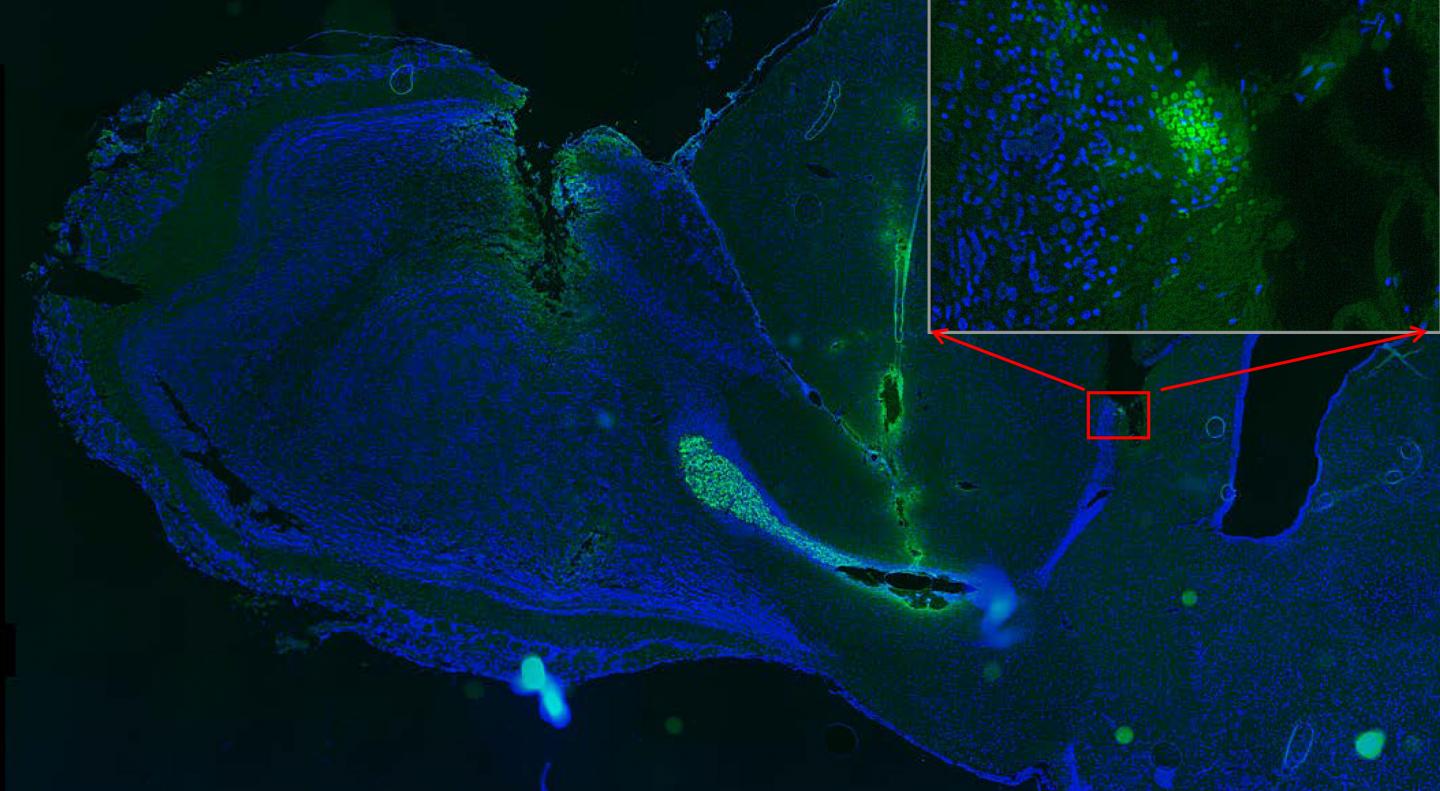
IMAGE

Credit: Junfeng Feng

Electric fields can be used to guide neural stem cells transplanted into the brain towards a specific location. The research, published July 11 in the journal Stem Cell Reports, opens possibilities for effectively guiding stem cells to repair brain damage.

Professor Min Zhao at the University of California, Davis School of Medicine's Institute for Regenerative Cures studies how electric fields can guide wound healing. Damaged tissues generate weak electric fields, and Zhao's research has shown how these electric fields can attract cells into wounds to heal them.

"One unmet need in regenerative medicine is how to effectively and safely mobilize and guide stem cells to migrate to lesion sites for repair," Zhao said. "Inefficient migration of those cells to lesions is a significant roadblock to developing effective clinical applications."

Dr. Junfeng Feng, a neurosurgeon at Ren Ji Hospital, Shanghai Jiao Tong University and Shanghai Institute of Head Trauma, visited Zhao's lab to study how electric fields might guide stem cells implanted in the brain.

Natural neural stem cells — cells that can develop into other brain tissues — are found deep in the brain, in the subventricular zone and hippocampus. To repair damage to the outer layers of the brain (the cortex), they have to migrate some distance, especially in the large human brain. Transplanted stem cells might also have to migrate some way to find an area of damage.

Stem Cells Move "Upstream"

Feng and Zhao developed a model of stem cell transplants in rats. They placed human neural stem cells in the rostral migration stream – a pathway in the rat brain that carries cells towards the olfactory bulb, which governs the animal's sense of smell. Cells move along this pathway partly carried by the flow of cerebrospinal fluid and partly guided by chemical signals.

By applying an electric field within the rat's brain, they found that they could get the transplanted stem cells to swim "upstream" against the fluid flow and natural cues and head for other locations within the brain.

The transplanted stem cells were still in their new locations weeks or months after treatment.

"Electrical mobilization and guidance of stem cells in the brain therefore provides a potential approach to facilitate stem cell therapies for brain diseases, stroke and injuries," Zhao said.

###

Additional authors on the paper are: at UC Davis, Lei Zhang, Jing Liu, Bruce Lyeth and Jan Nolta; Ji-Yao Jiang, Ren Ji Hospital, Shanghai Jiao Tong University and Shanghai Institute of Head Trauma; and Michael Russell, Aaken Laboratories, Davis. The work was supported by the California Institute for Regenerative Medicine with additional support from NIH, NSF and Research to Prevent Blindness, Inc.

Media Contact

Andy Fell
[email protected]
530-752-4533
@ucdavisnews

http://www.ucdavis.edu

Original Source

https://www.ucdavis.edu/news/neural-stem-cells-steered-electric-fields-rat-brain http://dx.doi.org/10.1016/j.stemcr.2017.05.035

Share12Tweet8Share2ShareShareShare2

Related Posts

Early Delivery Improves Outcomes for Mothers and Babies in Hypertensive Pregnancies — Biology

Early Delivery Improves Outcomes for Mothers and Babies in Hypertensive Pregnancies

May 21, 2026
How Atlantic Herring Rewired Their Reproductive Strategy to Thrive in Changing Oceans — Biology

How Atlantic Herring Rewired Their Reproductive Strategy to Thrive in Changing Oceans

May 20, 2026

Study Finds Young Fraser River Chinook Salmon Swimming in Chemical Mixture

May 20, 2026

Thousands of UK Beekeepers Contribute Honey to Advance Environmental Science

May 20, 2026
Please login to join discussion

POPULAR NEWS

  • blank

    New Study Reveals Plants Can Detect the Sound of Rain

    733 shares
    Share 292 Tweet 183
  • ESMO 2025: mRNA COVID Vaccines Enhance Efficacy of Cancer Immunotherapy

    304 shares
    Share 122 Tweet 76
  • Research Indicates Potential Connection Between Prenatal Medication Exposure and Elevated Autism Risk

    846 shares
    Share 338 Tweet 212
  • Breastmilk Balances E. coli and Beneficial Bacteria in Infant Gut Microbiomes

    58 shares
    Share 23 Tweet 15

About

We bring you the latest biotechnology news from best research centers and universities around the world. Check our website.

Follow us

Recent News

Innovative Reusable Brick Walls Revolutionize Construction Industry

Nonlinear Atomic Tunneling Enhanced by Bright Squeezed Vacuum

Label-Free Super-Resolution Imaging of Live Cells

Subscribe to Blog via Email

Enter your email address to subscribe to this blog and receive notifications of new posts by email.

Join 82 other subscribers
  • Contact Us

Bioengineer.org © Copyright 2023 All Rights Reserved.

Welcome Back!

Login to your account below

Forgotten Password?

Retrieve your password

Please enter your username or email address to reset your password.

Log In
No Result
View All Result
  • Homepages
    • Home Page 1
    • Home Page 2
  • News
  • National
  • Business
  • Health
  • Lifestyle
  • Science

Bioengineer.org © Copyright 2023 All Rights Reserved.
