• HOME
  • NEWS
  • EXPLORE
    • CAREER
      • Companies
      • Jobs
    • EVENTS
    • iGEM
      • News
      • Team
    • PHOTOS
    • VIDEO
    • WIKI
  • BLOG
  • COMMUNITY
    • FACEBOOK
    • INSTAGRAM
    • TWITTER
Wednesday, October 7, 2026
BIOENGINEER.ORG
No Result
View All Result
  • Login
  • HOME
  • NEWS
  • EXPLORE
    • CAREER
      • Companies
      • Jobs
        • Lecturer
        • PhD Studentship
        • Postdoc
        • Research Assistant
    • EVENTS
    • iGEM
      • News
      • Team
    • PHOTOS
    • VIDEO
    • WIKI
  • BLOG
  • COMMUNITY
    • FACEBOOK
    • INSTAGRAM
    • TWITTER
  • HOME
  • NEWS
  • EXPLORE
    • CAREER
      • Companies
      • Jobs
        • Lecturer
        • PhD Studentship
        • Postdoc
        • Research Assistant
    • EVENTS
    • iGEM
      • News
      • Team
    • PHOTOS
    • VIDEO
    • WIKI
  • BLOG
  • COMMUNITY
    • FACEBOOK
    • INSTAGRAM
    • TWITTER
No Result
View All Result
Bioengineer.org
No Result
View All Result
Home Headlines

Neural signature for fibromyalgia may aid diagnosis, treatment

Bioengineer.org by Bioengineer.org
January 21, 2018
in Headlines, Health, Science News
Reading Time: 2 mins read
0
Share on FacebookShare on TwitterShare on LinkedinShare on RedditShare on Telegram
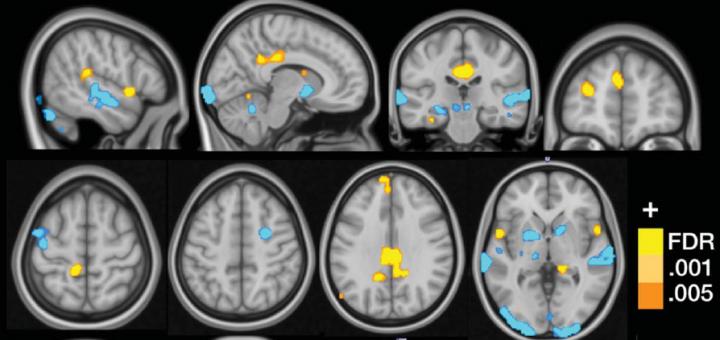
IMAGE

Credit: Image: Cognitive and Affective Control Laboratory / University of Colorado Boulder.

University of Colorado Boulder researchers have discovered a brain signature that identifies fibromyalgia sufferers with 93 percent accuracy, a potential breakthrough for future clinical diagnosis and treatment of the highly prevalent condition.

Fibromyalgia is commonly defined as chronic widespread musculoskeletal pain accompanied by symptoms such as fatigue, anxiety and mood disorders. The Centers for Disease Control and Prevention (CDC) estimates that fibromyalgia affects more than five million adults annually in the U.S., with significantly higher occurrence rates in women than in men.

Historically, fibromyalgia has been difficult to diagnose and treat due to a lack of a well-categorized tissue pathology and symptoms that overlap with other common chronic illnesses.

CU Boulder researchers used functional MRI scans (fMRI) to study brain activity in a group of 37 fibromyalgia patients and 35 control patients as they were exposed to a variety of non-painful visual, auditory and tactile cues as well as painful pressure.

The multisensory testing allowed the researchers to identify a series of three sub-markers, or neurological patterns, that correlated with the hypersensitivity to pain that characterizes fibromyalgia.

"The novelty of this study is that it provides potential neuroimaging-based tools that can be used with new patients to inform about the degree of certain neural pathology underlying their pain symptoms," said Marina López-Solà, a post-doctoral researcher in CU Boulder's Cognitive and Affective Control Laboratory and lead author of the new study. "The set of tools may be helpful to identify patient subtypes, which may be important for adjusting treatment selection on an individualized basis."

The findings were recently published in the journal PAIN, published by the International Association for the Study of Pain.

"Though many pain specialists have established clinical procedures for diagnosing fibromyalgia, the clinical label does not explain what is happening neurologically and it does not reflect the full individuality of patients' suffering," said Tor Wager, director of the Cognitive and Affective Control Laboratory. "The potential for brain measures like the ones we developed here is that they can tell us something about the particular brain abnormalities that drive an individual's suffering. That can help us both recognize fibromyalgia for what it is – a disorder of the central nervous system – and treat it more effectively."

If replicated and expanded upon in future studies, the results could eventually provide a neurological road map to brain activity that would inform diagnosis and therapeutic interventions for fibromyalgia.

"This is a helpful first step that builds off of other important previous work and is a natural step in the evolution of our understanding of fibromyalgia as a brain disorder" said López-Solà.

###

Media Contact

Marina López-Solà
[email protected]
303-817-2410
@cubouldernews

http://www.colorado.edu/news

Share12Tweet8Share2ShareShareShare2

Related Posts

Short-Course Antiviral Therapy Cures Acute Hepatitis C, But Eight Weeks May Be the Floor

Short-Course Antiviral Therapy Cures Acute Hepatitis C, But Eight Weeks May Be the Floor

October 7, 2026
Hidden Bacterial Partners Shape How Edible Mushroom Mycelia Grow and Function

Hidden Bacterial Partners Shape How Edible Mushroom Mycelia Grow and Function

October 7, 2026

Piranha Pineal Glands Reveal How Ancient Genome Duplication Diversified Fish Light Sensors

October 7, 2026

Hempcrete Gets a Strength Boost: Sulphate Additive Makes Carbon-Negative Building Material Tougher

October 7, 2026
Please login to join discussion

POPULAR NEWS

  • Alloys That Shrink Their Own Grains: New PIX Mechanism Refines Metals With Heat Alone

    Alloys That Shrink Their Own Grains: New PIX Mechanism Refines Metals With Heat Alone

    29 shares
    Share 12 Tweet 7
  • Endurance Exercise Reshapes the Liver in Males and Females Through Distinct Molecular Routes

    29 shares
    Share 12 Tweet 7
  • Single Transcription Factor PU.1 Rapidly Converts Fibroblasts into Macrophage-Lineage Cells

    29 shares
    Share 12 Tweet 7
  • New Scale Measures How Ready Nurse Educators Really Are for the AI Era

    29 shares
    Share 12 Tweet 7

About

We bring you the latest biotechnology news from best research centers and universities around the world. Check our website.

Follow us

Recent News

Alloys That Shrink Their Own Grains: New PIX Mechanism Refines Metals With Heat Alone

Endurance Exercise Reshapes the Liver in Males and Females Through Distinct Molecular Routes

Single Transcription Factor PU.1 Rapidly Converts Fibroblasts into Macrophage-Lineage Cells

Subscribe to Blog via Email

Success! An email was just sent to confirm your subscription. Please find the email now and click 'Confirm' to start subscribing.

Join 85 other subscribers
  • Contact Us

Bioengineer.org © Copyright 2023 All Rights Reserved.

Welcome Back!

Login to your account below

Forgotten Password?

Retrieve your password

Please enter your username or email address to reset your password.

Log In
No Result
View All Result
  • Homepages
    • Home Page 1
    • Home Page 2
  • News
  • National
  • Business
  • Health
  • Lifestyle
  • Science

Bioengineer.org © Copyright 2023 All Rights Reserved.