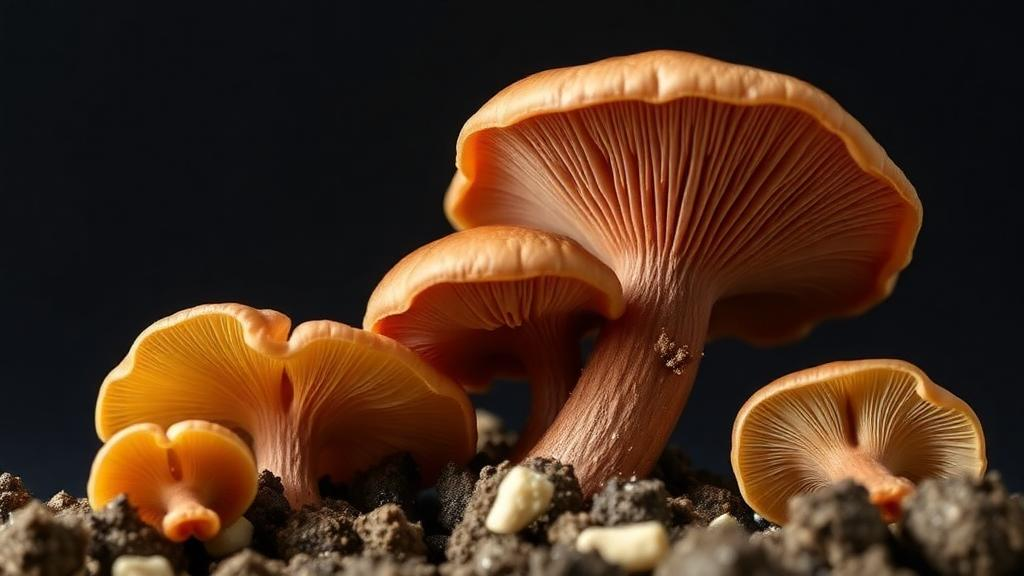
Beneath every cultivated mushroom lies a hidden world that scientists are only beginning to map. The visible fruiting bodies that end up in kitchens represent just one phase of a fungus’s life; for most of that life, the organism exists as a sprawling network of microscopic threads called mycelia. A new study published in the journal Microbial Ecology has now revealed that these mycelial networks are not living alone. They carry with them diverse communities of symbiotic bacteria, and the precise makeup of these bacterial entourages differs from strain to strain in ways that appear to track with how fast the fungus grows, what nutrients its tissues contain, and which oxidative enzymes it secretes into its surroundings.
The research, led by Mengzhe Gao, Shuting Zhou, and Yanfei Xu of Fujian Agriculture and Forestry University in China, with Shujing Sun as corresponding author, examined eight edible mushroom strains representing six species. The team set out to answer a deceptively simple question: do different strains of cultivated edible mushrooms host distinct bacterial communities on their mycelia, and if so, do those differences matter for fungal physiology? The answer, on both counts, appears to be yes, though with important nuances about what is conserved and what varies.
To characterize the bacterial passengers, the researchers used 16S rRNA gene amplicon sequencing, a standard molecular survey method that reads a marker gene present in all bacteria to identify which taxa are present and in what relative abundances. The results showed a striking pattern of conservation at the level of diversity. When the team calculated Shannon and Simpson indices, two widely used measures of alpha diversity that capture both the richness of species and the evenness of their distribution, they found no significant differences among the eight strains. In other words, every strain’s mycelium carried a bacterial community of roughly comparable internal diversity.
But diversity metrics tell only part of the story. When the researchers turned to principal component analysis, an ordination technique that visualizes the overall similarity of community compositions, they observed partial separation among the bacterial communities associated with different strains. A formal statistical test, PERMANOVA, confirmed that the differences in overall community structure were significant, with strain identity explaining a substantial fraction of the variation: the analysis returned an R-squared value of 0.422 with a p-value of 0.001. That means nearly half of the measurable variation in bacterial community structure could be attributed to which mushroom strain the bacteria were living with, a remarkably strong effect in microbial ecology studies.
Across all eight strains, four bacterial phyla dominated the mycelial symbiotic bacterial communities, or MSBCs as the authors call them: Firmicutes, Proteobacteria, Actinobacteria, and Bacteroidetes. These are major and familiar lineages in many microbial habitats, but their consistent dominance across unrelated mushroom species suggests a core set of bacterial partners that reliably associates with edible mushroom mycelia. Within that conserved backbone, however, the finer structure told a more individualized story. Several prevalent genera, including Tepidimicrobium, Acinetobacter, Enterobacter, Lactobacillus, and Sphingomonas, showed distinct abundance distributions from strain to strain, and a technique called LEfSe, which stands for linear discriminant analysis effect size, identified specific bacterial taxa that served as discriminative markers for particular strains.
One of the most conceptually interesting findings emerged when the researchers compared strains within the same species. Closely related strains of Flammulina filiformis, the enoki mushroom widely cultivated in East Asia, and Hypsizygus marmoreus, the brown beech mushroom, maintained similar alpha diversity in their bacterial communities, yet the compositions of those communities were clearly differentiated. This dissociation between diversity and composition echoes patterns seen in host-associated microbiomes across biology: two hosts can carry bacterial communities of equal richness while hosting substantially different players. It suggests that even at the level of strains within a single species, the fungus exerts some influence over which bacteria persist in its immediate vicinity.
The study did not stop at describing the communities. The researchers also measured a suite of mycelial physiological traits, including mycelial growth, nutrient composition, and the activities of extracellular oxidative enzymes, which fungi deploy to break down complex organic matter in their substrate. Using redundancy analysis, a multivariate method that relates community composition directly to measured environmental or physiological variables, along with Spearman correlation analysis, the team found significant associations between specific bacterial taxa and these mycelial traits. While correlation does not establish causation, the pattern raises the possibility that the bacteria are not merely hitchhikers but functional participants in the fungal life cycle, potentially influencing or responding to growth dynamics, nutritional status, and enzymatic output.
Why would bacteria and mushroom mycelia form such intimate associations? The broader literature on fungus-bacterium interactions offers several plausible mechanisms that this study’s correlations are consistent with. Bacteria living on fungal hyphae can gain access to exuded carbon compounds and protected microhabitats, while the fungus may benefit from bacterial contributions to nutrient mobilization, vitamin supply, or defense against competitors and pathogens. Oxidative enzyme activity is a particularly intriguing link, because lignocellulose degradation, the process by which many cultivated mushrooms extract nutrition from woody or agricultural substrates, depends on extracellular enzymes that bacteria can complement, inhibit, or modulate. The strain-specific patterns observed here hint that these functional relationships may be finely tuned rather than generic.
The practical implications for the mushroom industry could be considerable. Edible fungi are a major global food sector, and cultivation depends on reliable colonization of substrate by mycelia, consistent growth rates, and predictable fruiting. If the bacterial communities carried by mycelia influence growth speed, nutrient content, or enzyme activity, then managing those communities, whether through strain selection, substrate treatment, or deliberate inoculation with beneficial bacteria, could become a new lever for improving yields and quality. The finding that closely related strains of the same species carry differentiated bacterial communities also suggests that breeding programs might inadvertently select for altered microbiomes, a factor that has rarely been considered in mushroom genetics.
There are, of course, limits to what this study can establish. With eight strains across six species, the sample size is modest, and the associations reported are correlational; the authors themselves frame the links as potential rather than proven. Future work will need to test causality directly, for example by culturing specific bacterial isolates with mushroom mycelia under controlled conditions, or by manipulating communities and observing the consequences for growth and enzyme output. Metagenomic and transcriptomic approaches could also reveal what the bacteria are actually doing on the hyphae, moving beyond taxonomic identity to functional activity. Nevertheless, the study provides a clear and quantitative foundation: mycelial symbiotic bacterial communities in cultivated edible mushrooms combine conserved dominant lineages with strain-dependent variation, and that variation is statistically entangled with the physiological traits that growers care about most.
The work also adds edible mushrooms to the growing list of macroscopic organisms whose biology cannot be fully understood without their microbiomes. From plant roots to animal guts to fungal hyphae, the recurring lesson of modern microbial ecology is that hosts and their bacterial associates form integrated systems. For mushrooms, an organism whose industrial value rests entirely on the performance of its mycelium, recognizing the bacterial dimension of that performance may reshape how researchers and growers think about everything from spawn production to substrate formulation. As sequencing costs fall and cultivation experiments become more sophisticated, the invisible partners threading alongside mushroom mycelia are likely to move from the margins of fungal science to its center, and this study offers an early, careful map of the terrain they occupy.
Subject of Research: Symbiotic bacterial communities associated with the mycelia of cultivated edible mushroom strains and their relationship to mycelial physiological traits
Article Title: Mycelial Symbiotic Bacterial Communities and Their Associations with Mycelial Traits in Cultivated Edible Mushrooms
Article References: Gao, M., Zhou, S., Xu, Y., Wang, L., Xing, S., Chen, L., & Sun, S. (2026). Mycelial Symbiotic Bacterial Communities and Their Associations with Mycelial Traits in Cultivated Edible Mushrooms. Microbial Ecology. https://doi.org/10.1007/s00248-026-02903-2
Image Credits: AI Generated
DOI: 10.1007/s00248-026-02903-2
Keywords: edible mushrooms, mycelium, symbiotic bacteria, microbiome, 16S rRNA sequencing, Firmicutes, Proteobacteria, Flammulina filiformis, Hypsizygus marmoreus, oxidative enzymes, fungal ecology, microbial ecology
News Source: Morgan Morrow. (October 7, 2026). Hidden Bacterial Partners Shape How Edible Mushroom Mycelia Grow and Function. Scienmag.