• HOME
  • NEWS
  • EXPLORE
    • CAREER
      • Companies
      • Jobs
    • EVENTS
    • iGEM
      • News
      • Team
    • PHOTOS
    • VIDEO
    • WIKI
  • BLOG
  • COMMUNITY
    • FACEBOOK
    • INSTAGRAM
    • TWITTER
Monday, November 16, 2026
BIOENGINEER.ORG
No Result
View All Result
  • Login
  • HOME
  • NEWS
  • EXPLORE
    • CAREER
      • Companies
      • Jobs
        • Lecturer
        • PhD Studentship
        • Postdoc
        • Research Assistant
    • EVENTS
    • iGEM
      • News
      • Team
    • PHOTOS
    • VIDEO
    • WIKI
  • BLOG
  • COMMUNITY
    • FACEBOOK
    • INSTAGRAM
    • TWITTER
No Result
View All Result
Bioengineer.org
No Result
View All Result
Home NEWS Science News Technology

Neural Network Tool Classifies Concrete Surface Damage With 83.33 Percent Accuracy

by
November 16, 2026
in Technology
Reading Time: 2 mins read
0
Neural Network Tool Classifies Concrete Surface Damage With 83.33 Percent Accuracy

Neural Network Tool Classifies Concrete Surface Damage With 83.33 Percent Accuracy

Share on FacebookShare on TwitterShare on LinkedinShare on RedditShare on Telegram

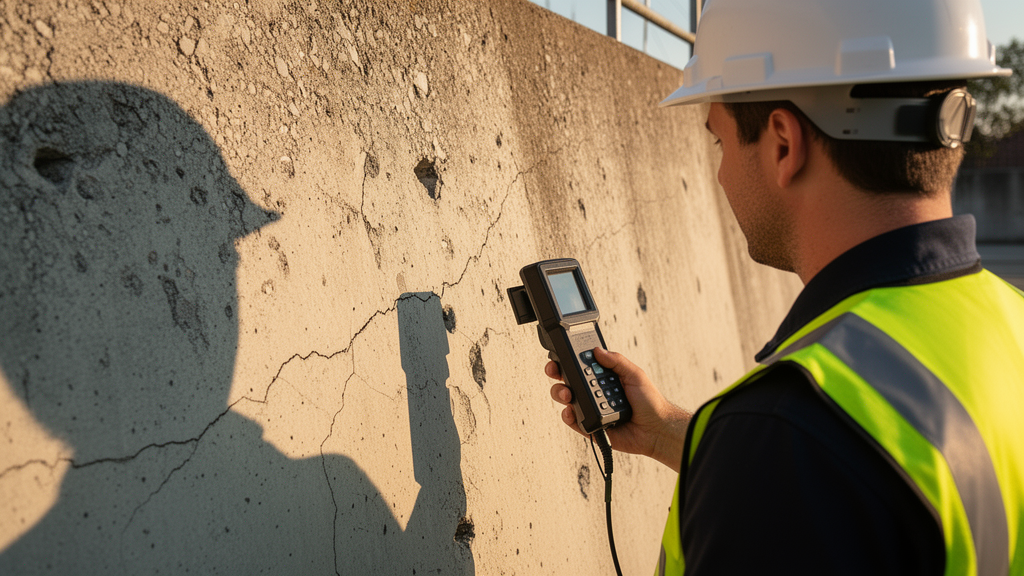
An automated classification and evaluation tool utilizing a convolutional neural network has achieved an overall classification accuracy of 83.33 percent when classifying damage in reinforced concrete structures. Developed to assess surface deterioration from field-acquired color images, the system incorporates an intuitive graphical user interface and operates at an average processing speed of 10.83 frames per second during evaluation.

Aged reinforced concrete structures exhibit various surface deterioration phenomena, such as delamination, leak, and rebar exposure. Conventional visual inspection practices used to monitor these conditions can often be unreliable because of human subjectivity and a persistent shortage of specialized personnel available to conduct detailed physical evaluations.

To address the limitations of manual visual inspection, researchers developed a graphical user interface tool powered by a convolutional neural network and verified its performance with field-acquired images. The workflow prepares input data by normalizing color images of 256 pixels each in width and height, followed by the application of data augmentation techniques prior to feature extraction.

During the feature extraction stage, deep visual characteristics are extracted from the normalized images through three convolutional layers and two pooling layers. Following this feature extraction process, the network classifies the structural damage into three distinct target types: delamination, leak, and rebar exposure. This final classification is carried out using a fully connected layer coupled with a softmax output layer.

The model was trained using the AdamW optimization algorithm, which minimizes a categorical cross-entropy loss function. To enhance generalizability and prevent unnecessary training, the researchers implemented an early stopping rule that automatically halted the training process if the validation loss failed to improve for 20 consecutive epochs.

The complete software application was implemented using Python libraries, specifically TensorFlow, Keras, and Tkinter. The authors designed the software with an intuitive graphical user interface that allows non-experts to carry out damage evaluations and conduct model retraining with a single-button operation.

In K-fold cross-validation using a total of 392 real-world images, the convolutional neural network obtained an average validation accuracy of 82.91 percent, with the best-performing model reaching a validation accuracy of 91.03 percent. In a subsequent evaluation on an independent test set of 60 images not used during training, the system achieved an overall classification accuracy of 83.33 percent, operating at an average processing speed of 10.83 frames per second.

Subject of Research: Automated classification of concrete structural damage using convolutional neural networks

Article Title: Image-Based Techniques for Classifying Damage in Concrete Structures

Article References: Heo, J., Hwang, J.-H., Cho, H.-C., & Ju, H. (2025). Image-Based Techniques for Classifying Damage in Concrete Structures. Architectural Research, 27(4), 157–165. https://doi.org/10.5659/AIKAR.2025.27.4.157

Image Credits: AI Generated

DOI: 10.5659/AIKAR.2025.27.4.157

Keywords: reinforced concrete structures, convolutional neural network, structural damage classification, delamination, leak detection, rebar exposure, visual inspection, graphical user interface, AdamW optimization, categorical cross-entropy, TensorFlow, Keras, Tkinter, K-fold cross-validation, data augmentation, image normalization, early stopping, processing speed

News Source: Cassandra Pierce. (November 16, 2026). Neural Network Tool Classifies Concrete Surface Damage With 83.33 Percent Accuracy. Scienmag.


Tags: AdamW optimizationcategorical cross-entropyconvolutional neural networkdata augmentationdelaminationearly stoppinggraphical user interfaceimage normalizationk-fold cross-validationKerasleak detectionprocessing speedrebar exposurereinforced concrete structuresstructural damage classificationTensorFlowTkintervisual inspection
Share12Tweet7Share2ShareShareShare1

Related Posts

Review Evaluates Smart Hydrogels for Postoperative Osteosarcoma Recurrence and Regeneration

Review Evaluates Smart Hydrogels for Postoperative Osteosarcoma Recurrence and Regeneration

November 16, 2026
Smart Nanomaterials Expand Gene Editor Delivery Options Beyond Lipid Nanoparticles

Smart Nanomaterials Expand Gene Editor Delivery Options Beyond Lipid Nanoparticles

November 16, 2026

Database Analysis Finds Compressive Strength Poorly Predicts Nanomaterial Geopolymer Composite Stiffness

November 16, 2026

Magnetic Properties of Ferrihydrite Nanoparticles Influenced by Surface-Sorbed Copper

November 16, 2026

POPULAR NEWS

  • Review Assesses Biochar Membranes as Sustainable Candidates for Industrial Carbon Dioxide Capture

    Review Assesses Biochar Membranes as Sustainable Candidates for Industrial Carbon Dioxide Capture

    29 shares
    Share 12 Tweet 7
  • Stacking Machine Learning Model Detects Toddler Autism Signs With Ninety-Nine Percent Accuracy

    29 shares
    Share 12 Tweet 7
  • Engineered Statistical Features Drive Network Anomaly Detection Over Complex Deep Architectures

    29 shares
    Share 12 Tweet 7
  • Integrated Camera and Laser Mapping Enables Automated 3D Tunnel Defect Inspection

    29 shares
    Share 12 Tweet 7

About

We bring you the latest biotechnology news from best research centers and universities around the world. Check our website.

Follow us

Recent News

Custom Ionic Liquids on Carbon Quantum Dots Boost Protein Drug Recognition

RNA Virus Reverse Genetics Systems Advance Countermeasure Design Across Diverse Pathogens

Review Evaluates Smart Hydrogels for Postoperative Osteosarcoma Recurrence and Regeneration

Subscribe to Blog via Email

Enter your email address to subscribe to this blog and receive notifications of new posts by email.

Join 87 other subscribers
  • Contact Us

Bioengineer.org © Copyright 2023 All Rights Reserved.

Welcome Back!

Login to your account below

Forgotten Password?

Retrieve your password

Please enter your username or email address to reset your password.

Log In
No Result
View All Result
  • Homepages
    • Home Page 1
    • Home Page 2
  • News
  • National
  • Business
  • Health
  • Lifestyle
  • Science

Bioengineer.org © Copyright 2023 All Rights Reserved.