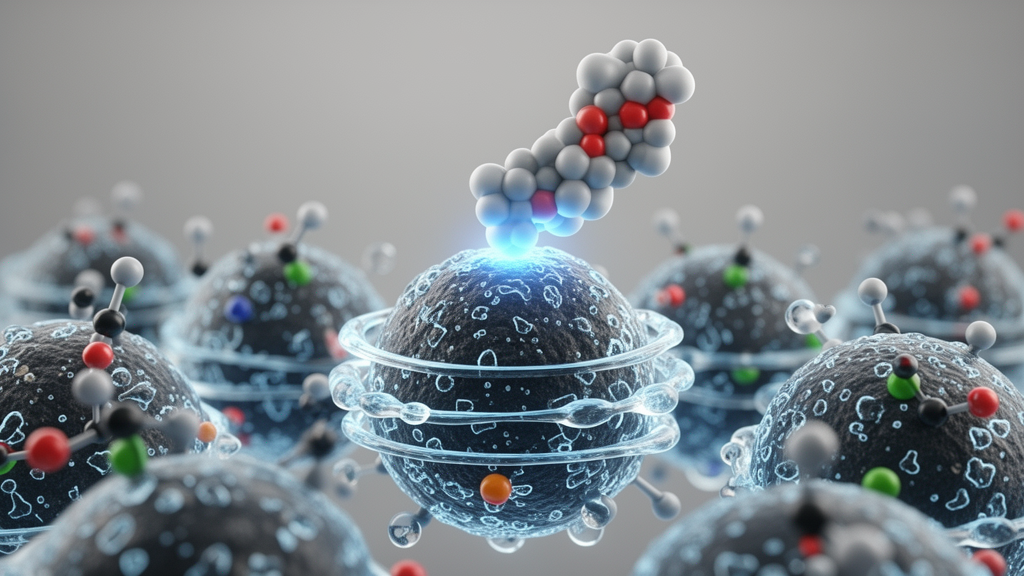
Biomedical researchers investigating protein–nanomaterial interfaces have established that tailoring the molecular architecture of surface-active ionic liquids immobilized on carbon quantum dots can significantly enhance drug recognition while safeguarding protein integrity. In a study published in Frontiers in Molecular Biosciences, investigators from North-Eastern Hill University and the Bhabha Atomic Research Centre demonstrated that decorating carbon quantum dots with specific amphiphilic ionic liquids systematically modulates the binding of the Alzheimer’s medication donepezil to hen egg white lysozyme. The experimental and computational investigation revealed that functionalizing carbon quantum dots with tetradecyl pyridinium bromide produced an approximate 4.7-fold increase in donepezil binding affinity relative to native lysozyme. Crucially, the researchers determined that the amplified drug recognition did not correlate with the direct binding affinity between the protein and the nanomaterial, demonstrating that the local structural and physicochemical organization of the hybrid nano–bio interface governs downstream molecular recognition rather than raw adsorption strength.
Protein interactions at engineered nano–bio interfaces represent a foundational mechanism for drug delivery platforms, biosensors, and biocatalytic devices, yet controlling protein conformation and function upon nanoparticle contact remains a significant physical challenge. Surface-active ionic liquids offer unique tunability through their cationic polar headgroups and hydrophobic tail architectures, providing chemical flexibility that conventional surfactants lack. The research team sought to clarify how systematically altering the cationic headgroup between imidazolium and pyridinium rings, as well as varying alkyl tail lengths between dodecyl and tetradecyl chains, influences protein stability and subsequent small-molecule recognition both in free solution and when assembled on ultrasmall carbon quantum dots.
To establish these interfacial relationships, the investigators compared four distinct surface-active ionic liquids whose synthesis was previously reported: dodecyl imidazolium bromide, tetradecyl imidazolium bromide, dodecyl pyridinium bromide, and tetradecyl pyridinium bromide. These amphiphiles were analyzed in their free state and after being immobilized on carbon quantum dots, with concentrations calculated assuming spherical nanoparticles with an average diameter of 8 nanometers and a graphite-like density of 2.26 grams per cubic centimeter. The team examined sequential molecular interactions by monitoring pristine lysozyme, lysozyme mixed with free ionic liquids, and lysozyme conjugated to pristine or functionalized carbon quantum dots.
The study employed an extensive analytical platform integrating steady-state UV–visible absorption and fluorescence spectroscopy, time-correlated single-photon counting, synchronous fluorescence, circular dichroism, Fourier transform infrared spectroscopy, small-angle neutron scattering, dynamic light scattering, and 100-nanosecond molecular dynamics simulations. Fluorescence spectra recorded at 298 Kelvin with excitation at 280 or 295 nanometers were corrected for sample absorbance and analyzed through Stern–Volmer quenching models, sphere-of-action equations, and Klotz binding isotherms to extract association constants and binding site densities. Förster resonance energy transfer calculations mapped donor–acceptor distances between lysozyme and quantum dots, while temperature-dependent titrations across 298 to 318 Kelvin yielded thermodynamic parameters including changes in standard Gibbs free energy, enthalpy, and entropy via Van ‘t Hoff analyses.
Initial measurements of lysozyme interacting with freely dispersed ionic liquids revealed that all four surfactants quenched the intrinsic tryptophan fluorescence of the protein primarily through a static, ground-state mechanism. Native lysozyme exhibited an amplitude-weighted average fluorescence lifetime of 1.54 nanoseconds, which remained relatively stable following surfactant addition, confirming the absence of dynamic collisional deactivation. Steady-state emission profiles diverged based on molecular architecture: the imidazolium variants and tetradecyl pyridinium bromide displayed initial fluorescence attenuation followed by partial recovery near their critical micelle concentrations, whereas dodecyl pyridinium bromide produced continuous quenching across the entire titration range. Dynamic light scattering demonstrated that lysozyme maintained its native hydrodynamic diameter of approximately 4 nanometers near the critical micelle concentrations, although supramolecular assemblies emerged above these concentrations without disrupting the underlying globular protein framework.
When lysozyme associated with carbon quantum dots, surface modification radically altered the binding landscape and energy transfer metrics. Free carbon quantum dots exhibited an apparent binding affinity of 4.10 times ten to the sixth per molar and a Stern–Volmer constant of 5.87 times ten to the sixth per molar at 298 Kelvin. Functionalization with tetradecyl imidazolium bromide elevated the apparent association constant to 26.79 times ten to the sixth per molar, establishing the overall affinity hierarchy of quantum dots functionalized with tetradecyl imidazolium surpassing dodecyl imidazolium, tetradecyl pyridinium, dodecyl pyridinium, and pristine quantum dots. Interestingly, Förster resonance energy transfer analysis revealed that the dodecyl imidazolium conjugate exhibited the highest energy transfer efficiency of 0.97 and the shortest donor–acceptor separation distance of 3.04 angstroms, whereas the tetradecyl imidazolium conjugate demonstrated an efficiency of 0.90 and a separation distance of 3.78 angstroms, indicating that physical proximity does not directly mirror thermodynamic binding affinity.
Evaluating secondary structure retention using circular dichroism and Fourier transform infrared spectroscopy confirmed that surface-active ionic liquids shielded lysozyme from nanoparticle-induced unfolding. Interaction with pristine carbon quantum dots severely compromised the protein, reducing its alpha-helical content from 43.0 percent in native lysozyme down to 28.3 percent by circular dichroism and 28.1 percent by infrared amide I deconvolution, accompanied by marked increases in beta-sheet and turn structures. Conversely, functionalization with ionic liquids largely prevented conformational breakdown. Conjugates bearing tetradecyl imidazolium and tetradecyl pyridinium headgroups retained 30.0 percent and 33.5 percent alpha-helicity by circular dichroism, while infrared measurements recorded 49.6 percent and 48.9 percent alpha-helical content, respectively. Small-angle neutron scattering profiles, fitted using a prolate ellipsoidal form factor with semi-major axes of 24.0 angstroms and screened Coulomb interparticle potentials, confirmed that the global morphology of the protein remained compact and preserved on the nanometer scale.
The critical finding of the study emerged when donepezil was introduced to the preformed lysozyme–nanoparticle conjugates. Native lysozyme bound donepezil with an apparent association constant of 2.55 times ten to the fourth per molar, which rose modestly to 3.27 times ten to the fourth per molar upon association with pristine carbon quantum dots. Surface functionalization with surface-active ionic liquids systematically amplified drug recognition: the conjugate bearing tetradecyl pyridinium bromide achieved an association constant of 12.06 times ten to the fourth per molar—representing a 4.7-fold increase over native lysozyme—followed by dodecyl pyridinium at 5.35, tetradecyl imidazolium at 5.28, and dodecyl imidazolium at 4.28 times ten to the fourth per molar. Fluorescence lifetime ratios remained close to unity across all systems, verifying that donepezil binding proceeded through spontaneous, ground-state static complexation with negative standard Gibbs free energy values spanning minus 24.61 to minus 29.29 kilojoules per mole at 298 Kelvin.
While carbon quantum dots modified with tetradecyl imidazolium displayed the strongest initial attraction to lysozyme, it was the tetradecyl pyridinium system that promoted the most potent drug binding. Circular dichroism analysis of the drug-loaded complexes explained this discrepancy: donepezil binding to pristine quantum dot conjugates triggered catastrophic secondary structural collapse, dropping alpha-helical content to 12.2 percent while beta-sheet content surged to 29.6 percent. In sharp contrast, the tetradecyl pyridinium conjugate retained 43.5 percent alpha-helical content after drug binding, closely matching native lysozyme at 41.7 percent. The tetradecyl imidazolium conjugate similarly preserved 42.1 percent alpha-helicity, demonstrating that robust preservation of the native protein scaffold, rather than tight adsorption to the underlying particle, dictates efficient ligand recognition.
Complementary 100-nanosecond atomistic molecular dynamics simulations conducted in explicit TIP3P water using the AMBER-IDNL force field provided structural explanations for these interfacial phenomena. Backbone root-mean-square deviations stabilized within 10 to 20 nanoseconds, while lysozyme radius of gyration values remained steady between 1.39 and 1.45 nanometers across all conjugate systems. Residue contact occupancy mapping revealed that dodecyl imidazolium interacted predominantly with residues Arg5, Phe34, Lys97, Arg114, Trp123, and Arg125, whereas tetradecyl imidazolium contacted an expanded network including Tyr53, Asp66, Ser81, Leu84, Thr118, Asp119, and Ala122. Dodecyl pyridinium targeted an entirely distinct surface patch comprising Trp62, Trp63, Arg73, Leu75, Pro79, Asp101, Gly102, Asn103, Asn106, Ala107, and Arg112. Secondary structure tracking via the Define Secondary Structure of Proteins algorithm confirmed that localized interfacial rearrangements occurred without triggering global protein denaturation.
The authors underscored that while these findings establish fundamental physicochemical rules for engineering protein–nanomaterial complexes, the results reflect controlled in vitro and in silico model systems using hen egg white lysozyme and donepezil. Nevertheless, the research demonstrates that rational tailoring of surface-active ionic liquid headgroups and hydrophobic chains provides an effective strategy for independently tuning protein stability and ligand affinity, offering precise design principles for next-generation nanotherapeutic delivery systems and functional biomaterials.
Subject of Research: Modulation of protein structure and donepezil recognition at ionic liquid-functionalized carbon quantum dot interfaces
Article Title: Molecular architecture of surface-active ionic liquids governs protein structural integrity and drug recognition at engineered carbon quantum dot nano–bio interfaces
Article References: Nonglamin, I., Kumar, S., & Mitra, S. (2026). Molecular architecture of surface-active ionic liquids governs protein structural integrity and drug recognition at engineered carbon quantum dot nano–bio interfaces. Frontiers in Molecular Biosciences, 13, Article 1971794. https://doi.org/10.3389/fmolb.2026.1971794
Image Credits: AI Generated
DOI: 10.3389/fmolb.2026.1971794
Keywords: carbon quantum dots, surface-active ionic liquids, lysozyme, donepezil, nano-bio interfaces, drug recognition, protein secondary structure, molecular dynamics, Molecular, architecture, surface-active, ionic
News Source: Katie Riggs. (November 16, 2026). Custom Ionic Liquids on Carbon Quantum Dots Boost Protein Drug Recognition. Scienmag.