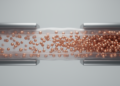
Researchers have combined a high-resolution numerical solver with an optimized artificial neural network to simulate one of the most intricate fluid-dynamics problems in modern thermal engineering: the flow of a Williamson–Casson hybrid nanofluid over an expanding curved surface. The study, which models a water-based suspension of alumina and copper nanoparticles, integrates magnetic dipole effects, second-order velocity slip, melting boundary conditions, non-Fourier heat transport and homogeneous–heterogeneous chemical reactions into a single computational framework. The work reports that switching from a single-nanoparticle fluid to the hybrid combination raises the skin friction coefficient by 19.05 percent and the local Nusselt number by 15.83 percent, while the neural surrogate achieves a coefficient of determination of 0.99997 with a mean absolute percentage error of just 0.11 percent.
The physical setting is deceptively simple. A flexible sheet is stretched along a circular arc, dragging the adjacent fluid with it and generating a boundary layer. Unlike flow over a flat plate, the curved geometry introduces centrifugal forces and an additional pressure gradient along the radius, which reshape velocity profiles, wall shear stress and heat transfer rates. Accurate modeling therefore requires curvilinear coordinates, with the radius of curvature as a governing parameter. This configuration matters industrially: polymer extrusion over curved rollers, thermal protection shields on curved aerospace hulls, continuous metallurgical casting on curved cooling tracks, and advanced electronics cooling all exploit or contend with exactly this physics.
The choice of rheology is central to the study. The Williamson–Casson model couples two distinct non-Newtonian behaviors. The Casson component imposes a yield stress, meaning the fluid behaves like an elastic solid until the applied shear exceeds an internal threshold, while the Williamson component captures shear-thinning, in which the fluid’s effective viscosity drops dramatically at high shear rates as its internal microstructure aligns with the flow. Adding alumina and copper nanoparticles to the base water further alters the macroscopic properties, increasing thermal conductivity and energy dissipation while also raising density and viscous resistance. According to the authors, this dual-regime balance acts as a flow-control mechanism that keeps the boundary layer attached to the curved geometry and prevents separation.
Magnetic effects enter through a small dipole placed a fixed distance below the stretching surface. The resulting non-uniform field exerts a Lorentz-type body force on the electrically conducting fluid, decelerating the primary velocity and thinning the momentum boundary layer. Because the magnetization of the fluid depends linearly on temperature through the Curie relation, the magnetic force is coupled to the thermal field, allowing engineers in principle to tune cooling rates by adjusting field strength and dipole distance. The simulations show that increasing the magnetic parameter compresses the streamlines against the curved wall, a signature of strong electromagnetic drag, while raising the ferrohydrodynamic interaction parameter slows the near-wall flow through increased internal viscous resistance.
Thermal transport is handled with the Cattaneo–Christov heat flux model, which corrects a fundamental shortcoming of Fourier’s law. Classical conduction assumes heat propagates instantaneously, a mathematical idealization at odds with relativity. The Cattaneo–Christov formulation introduces a thermal relaxation time, so heat travels as a wave with finite speed, producing a thermal lag that reduces the thickness of the thermal boundary layer. The model is directly relevant to laser-assisted manufacturing, cryogenic surgery, emergency coolant design around curved nuclear fuel rods, and thermal protection of re-entry vehicles, all situations where the speed of the thermal front determines whether a component or tissue survives.
At the wall, the classical no-slip condition is replaced by a second-order velocity slip, in which the fluid velocity at the surface deviates from the wall velocity in proportion to both the first and second derivatives of velocity. This correction matters in high-shear, micro-scale and non-Newtonian flows, where fluid molecules slip independently of the wall. The second-order term accounts for surface roughness and strong pressure gradients, avoiding the overestimated drag that first-order slip alone can produce. The boundary conditions also encode melting heat consumption at the surface and the concentration gradients of a binary chemical system in which reactant A converts to product B through coupled homogeneous and heterogeneous reaction steps.
Numerically, the team reduced the governing partial differential equations to a system of ordinary differential equations via similarity transformations and solved them with the parametric continuation method, chosen for its stability and ability to follow solution branches through turning points. A grid independence study tested meshes of 100 to 1600 nodes. At 100 nodes the maximum residual error was relatively high and the neural network’s error reached 1.85 percent, but at the optimal 400-node mesh the residual error fell to 4.85 × 10⁻⁸, the parameter sensitivity index dropped to zero, and the skin friction, Nusselt and Sherwood numbers plateaued with variations below 0.0001 percent on further refinement. Refining beyond 400 nodes consumed exponentially more computation, up to 4.12 seconds at 1600 nodes, without any gain in accuracy. Validation against previously published data showed maximum absolute deviations below 10⁻⁵.
The neural network component serves as a fast surrogate for the expensive boundary-value solver. A fully connected feed-forward architecture with twelve physical inputs, including the magnetic parameter, radiation parameter, Weissenberg number, curvature parameter and nanoparticle volume fractions, feeds ten hidden neurons and three outputs: the skin friction coefficient, Nusselt number and Sherwood number. Trained on solver-generated data split 70/15/15 into training, validation and testing sets, the Levenberg–Marquardt backpropagation network reached a best mean squared error of 1.4456 × 10⁻⁹ at epoch 134 in one case, with regression coefficients of 0.99978 for training, 0.99934 for validation and 0.99942 for testing. Error histograms clustered tightly around zero, and the absence of any upward drift in validation error indicated the network generalized without overfitting.
The parameter sweeps revealed consistent physical trends. Stronger magnetic fields and higher unsteadiness parameters decelerate the flow, while larger curvature parameters, equivalent to flatter geometries, relax centrifugal resistance and speed the fluid. Increasing the alumina volume fraction makes the denser mixture more sluggish. On the thermal side, radiation, viscous dissipation, thermophoresis and Brownian motion all thicken the thermal boundary layer and raise temperatures, whereas a negative heat source parameter acts as a sink and steepens cooling. Notably, raising the Eckert number from 0.0 to 0.6 reduced the Nusselt number by about 12.7 percent, because mechanical shear energy converted into internal heat erodes the temperature gradient that drives heat removal from the sheet.
Mass transfer followed its own logic. The hybrid nanofluid delivered a uniform 25.97 percent enhancement in the Sherwood number over the mono-nanofluid across all reactive states, attributed to modified species diffusivity and the disturbance created by the dual nanoparticle cloud. Increasing the Schmidt number from 1.0 to 2.2 boosted the local Sherwood flux by 59.54 percent, since lower molecular diffusivity compresses the concentration layer and steepens wall gradients. Conversely, raising the heterogeneous reaction rate constant reduced the Sherwood number by 19.39 percent, because faster surface reactions consume reactants at the interface and flatten the concentration gradient. The authors note that their framework is limited to steady, two-dimensional flow with constant species diffusivity, and they propose extending it to three-dimensional geometries with entropy generation analysis and physics-informed neural networks trained on experimental imaging data.
Subject of Research: Numerical simulation and neural network modeling of Williamson–Casson hybrid nanofluid flow over a curved stretching surface with magnetic, slip, melting and reaction effects
Article Title: AI-driven simulation and convergence analysis of non-Newtonian Williamson–Casson hybrid nanofluid with multi-slip and melting effects over an expanding curved surface
Article References: Hussain, S. M., Jubair, S., Ali, B., Ishaq, W., Flah, A., & Mohamed, M. (2026). AI-driven simulation and convergence analysis of non-Newtonian Williamson–Casson hybrid nanofluid with multi-slip and melting effects over an expanding curved surface. Results in Engineering, 32, Article 113690. https://doi.org/10.1016/j.rineng.2026.113690
Image Credits: AI Generated
DOI: 10.1016/j.rineng.2026.113690
Keywords: hybrid nanofluid, Williamson-Casson model, curved stretching sheet, magnetohydrodynamics, Cattaneo-Christov heat flux, velocity slip, melting boundary, artificial neural network, skin friction, Nusselt number, homogeneous-heterogeneous reactions, grid independence
News Source: Cassandra Pierce. (October 25, 2026). Neural Network Decodes Heat and Flow of Hybrid Nanofluid Over Curved Stretching Surfaces. Scienmag.