• HOME
  • NEWS
  • EXPLORE
    • CAREER
      • Companies
      • Jobs
    • EVENTS
    • iGEM
      • News
      • Team
    • PHOTOS
    • VIDEO
    • WIKI
  • BLOG
  • COMMUNITY
    • FACEBOOK
    • INSTAGRAM
    • TWITTER
Sunday, October 25, 2026
BIOENGINEER.ORG
No Result
View All Result
  • Login
  • HOME
  • NEWS
  • EXPLORE
    • CAREER
      • Companies
      • Jobs
        • Lecturer
        • PhD Studentship
        • Postdoc
        • Research Assistant
    • EVENTS
    • iGEM
      • News
      • Team
    • PHOTOS
    • VIDEO
    • WIKI
  • BLOG
  • COMMUNITY
    • FACEBOOK
    • INSTAGRAM
    • TWITTER
No Result
View All Result
Bioengineer.org
No Result
View All Result
Home NEWS Science News Technology

Copper nanoparticles improve three-state polymer memory performance

by
October 25, 2026
in Technology
Reading Time: 2 mins read
0
Copper nanoparticles improve three-state polymer memory performance

Copper nanoparticles improve three-state polymer memory performance

Share on FacebookShare on TwitterShare on LinkedinShare on RedditShare on Telegram

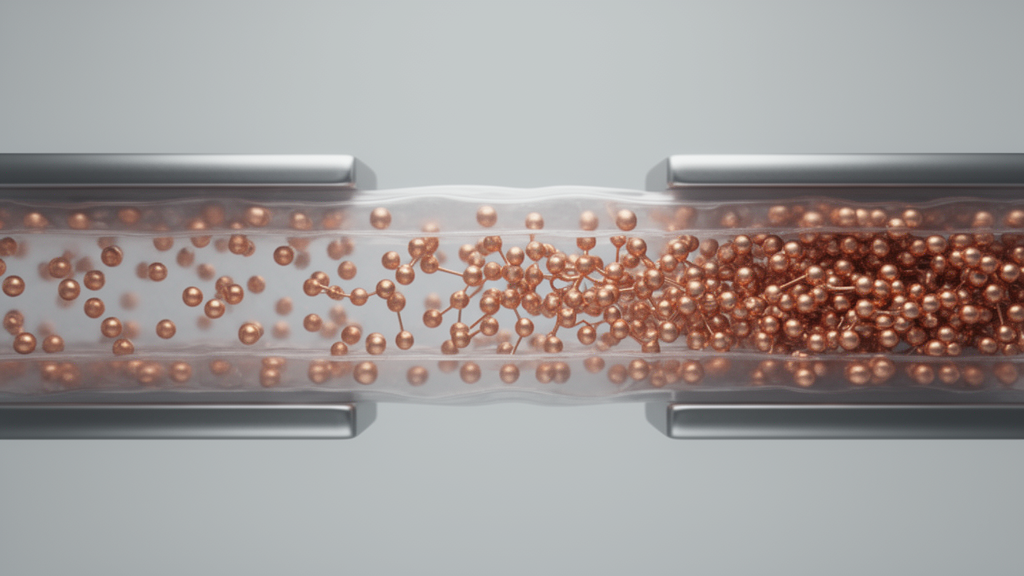
Adding copper nanoparticles to a purpose-designed carbazole copolymer produced a laboratory resistive random-access memory device with improved voltage and current characteristics, according to a study in the Journal of Materials Science. The composite device supported flash-type ternary memory behavior, meaning that it operated among three distinct resistance states rather than the two states used in binary storage. The authors identify this multilevel operation as a way to increase storage density compared with binary memory.

The underlying material, PCz–BB, is a donor–acceptor copolymer containing two different electron-withdrawing receptor groups. The researchers synthesized this polymer and incorporated copper nanoparticles to create PCz–BB:Cu nanocomposite films for memory devices. Compared with the unmodified polymer device, the composite had a smaller interval between its two threshold voltages: the reported values changed from −1.05/−1.95 V to −0.45/−0.90 V. In other words, the separation between the two switching thresholds decreased while both listed threshold values moved closer to zero.

The composite also increased the contrast among the device’s three current levels. The reported ON2/ON1/OFF current ratio rose from 1905:15:1 for the polymer memory device to 8950:50:1 for the copper-containing nanocomposite. Its three resistive states remained stable for more than three hours and 10^4 cycles. These findings describe the performance of the tested laboratory devices; the supplied abstract does not specify the number of devices examined, the measurement conditions or the results of testing beyond the reported duration and cycle count.

The authors explain the resistive switching using two concepts: charge trapping and conducting-filament theory. The study abstract presents these as the framework for the observed behavior but does not provide separate experimental measurements that distinguish the contribution of each mechanism. It also does not establish how copper nanoparticles individually affect charge trapping or filament formation. The work therefore demonstrates a measured improvement in selected ternary-memory characteristics for PCz–BB:Cu films and contributes to the design of materials intended to support higher-density electronic storage, rather than establishing performance under conditions outside those reported in the study.

Subject of Research: Copper-nanoparticle carbazole copolymer films for ternary resistive random-access memory

Article Title: Carbazole copolymer: Cu nanocomposite films for ternary resistive random access memory

Article References: Zhang, W., Dou, F., Wang, S., & Wang, C. (2026). Carbazole copolymer: Cu nanocomposite films for ternary resistive random access memory. Journal of Materials Science, 61(40), 30890-30903. https://doi.org/10.1007/s10853-026-12173-5

Image Credits: AI Generated

DOI: 10.1007/s10853-026-12173-5

Keywords: ternary memory, resistive random-access memory, carbazole copolymer, copper nanoparticles, nanocomposite films, charge trapping, conducting filaments, electronic storage, Carbazole, copolymer, nanocomposite, films

News Source: Neil Sanderson. (October 25, 2026). Copper nanoparticles improve three-state polymer memory performance. Scienmag.

Tags: Carbazolecarbazole copolymercharge trappingconducting filamentscopolymercopper nanoparticleselectronic storagefilmsnanocompositenanocomposite filmsresistive random-access memoryternary memory
Share12Tweet7Share2ShareShareShare1

Related Posts

Wearable system detects and transmits scents over distance

Wearable system detects and transmits scents over distance

October 25, 2026
Magnesium Source Choice Governs Durability of Enzyme-Solidified Mine Tailings

Magnesium Source Choice Governs Durability of Enzyme-Solidified Mine Tailings

October 25, 2026

Lab study finds mixed-acid corrosion varies by metal and organic acid

October 25, 2026

Cold-sprayed graphene sensor detects pulse in one-person test

October 25, 2026

POPULAR NEWS

  • Single-hospital ICU study links catheter infections to 65.1% mortality

    Single-hospital ICU study links catheter infections to 65.1% mortality

    29 shares
    Share 12 Tweet 7
  • Copper nanoparticles improve three-state polymer memory performance

    29 shares
    Share 12 Tweet 7
  • Wearable system detects and transmits scents over distance

    29 shares
    Share 12 Tweet 7
  • Research report: MicroRNA profiling of filtering and non-filtering regions of human trabecular meshwork: changes with ageing and in glaucoma

    29 shares
    Share 12 Tweet 7

About

We bring you the latest biotechnology news from best research centers and universities around the world. Check our website.

Follow us

Recent News

Single-hospital ICU study links catheter infections to 65.1% mortality

Copper nanoparticles improve three-state polymer memory performance

Wearable system detects and transmits scents over distance

Subscribe to Blog via Email

Enter your email address to subscribe to this blog and receive notifications of new posts by email.

Join 85 other subscribers
  • Contact Us

Bioengineer.org © Copyright 2023 All Rights Reserved.

Welcome Back!

Login to your account below

Forgotten Password?

Retrieve your password

Please enter your username or email address to reset your password.

Log In
No Result
View All Result
  • Homepages
    • Home Page 1
    • Home Page 2
  • News
  • National
  • Business
  • Health
  • Lifestyle
  • Science

Bioengineer.org © Copyright 2023 All Rights Reserved.