• HOME
  • NEWS
  • EXPLORE
    • CAREER
      • Companies
      • Jobs
    • EVENTS
    • iGEM
      • News
      • Team
    • PHOTOS
    • VIDEO
    • WIKI
  • BLOG
  • COMMUNITY
    • FACEBOOK
    • INSTAGRAM
    • TWITTER
Tuesday, July 7, 2026
BIOENGINEER.ORG
No Result
View All Result
  • Login
  • HOME
  • NEWS
  • EXPLORE
    • CAREER
      • Companies
      • Jobs
        • Lecturer
        • PhD Studentship
        • Postdoc
        • Research Assistant
    • EVENTS
    • iGEM
      • News
      • Team
    • PHOTOS
    • VIDEO
    • WIKI
  • BLOG
  • COMMUNITY
    • FACEBOOK
    • INSTAGRAM
    • TWITTER
  • HOME
  • NEWS
  • EXPLORE
    • CAREER
      • Companies
      • Jobs
        • Lecturer
        • PhD Studentship
        • Postdoc
        • Research Assistant
    • EVENTS
    • iGEM
      • News
      • Team
    • PHOTOS
    • VIDEO
    • WIKI
  • BLOG
  • COMMUNITY
    • FACEBOOK
    • INSTAGRAM
    • TWITTER
No Result
View All Result
Bioengineer.org
No Result
View All Result
Home NEWS Science News Biology

Neural engineer Qi Wang recognized with NSF CAREER Award

Bioengineer by Bioengineer
March 8, 2019
in Biology
Reading Time: 2 mins read
0
IMAGE
Share on FacebookShare on TwitterShare on LinkedinShare on RedditShare on Telegram

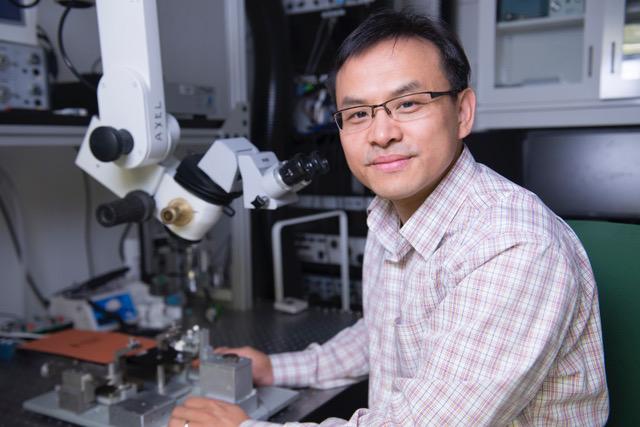
He is working to develop new technologies for restoring and enhancing sensory functions and cognition through brain-machine interfaces
IMAGE

Credit: Jane Nisselson/Columbia Engineering

New York, NY–March 05, 2019–Qi Wang, assistant professor of biomedical engineering at Columbia Engineering, has won a CAREER award from the National Science Foundation, one of the highest honors given to young faculty. The five-year $500,000 grant will support his project, “Enhancing perception and cognition while minimizing side effects through closed-loop peripheral neural stimulation.”

Wang studies how sensory information is processed in the brain to form perception and inform an optimal decision, and how this process is modulated by behavioral states, such as attention and arousal. An expert in deciphering the neural codes that underlie our perception and cognition, he is working to develop new technologies for restoring and enhancing sensory functions and cognition through brain-machine interfaces (BMI).

“Perception, cognition, and behavioral performance depend heavily on arousal level,” he explains. “My NSF project is built upon a novel idea: using peripheral neural stimulation to control arousal level to achieve optimal behavioral performance with minimal side effects. I believe this is the first use of an engineering framework to guide the design and validation of optimal, closed-loop neural stimulation for enhancing behavior.”

Wang’s research has long been focused on the locus coeruleus (LC), which plays a pivotal role in modulating brain functions through its regulation of arousal levels. The LC is the primary source of norepinephrine (NE) and scientists think that decreases in NE levels in the brain when the LC is damaged may underlie many neuropsychiatric disorders and neurodegenerative diseases, including Alzheimer’s, ADHD, schizophrenia, autism, and depression. But because the LC is so small and located so deeply within the brainstem, it has been a major challenge to access it safely and to manipulate its activity.

In an ideal world, neural stimulation technology would effectively elicit intended activity in targeted structures while minimizing effects on non-targeted structures. Many previous simulation and experimental results, including Wang’s, have demonstrated that neural responses are sensitive to certain parameters of the stimulus, but finding the optimal stimulus has been very difficult due to the high dimensionality of neural stimulation parameter space.

For his NSF project, Wang proposes to use a safe alternative–vagus nerve stimulation (VNS)–to control LC activity without directly interfacing with the LC.

“There has been a clear lack of an engineering framework to guide the design of VNS stimuli to selectively drive targeted neural structures and to validate this technology in a real-world setting,” he observes. “An ideal neural stimulation technology should allow the system to effectively elicit intended activity in targeted structures while minimizing effects on non-targeted structures.”

With expertise in neuroscience, electrophysiology, control engineering, and behavioral paradigms–and now with the NSF CAREER award–Wang is positioned to create a hybrid computational-experimental framework that specifically focuses on using VNS to enhance behavioral performance with minimal side effects and to enhance human perception, cognition, and behavioral performance using neural stimulation.

###

Media Contact
Holly Evarts
[email protected]

Original Source

https://engineering.columbia.edu/news/qi-wang-nsf

Tags: Biomedical/Environmental/Chemical EngineeringBiotechnologyMedicine/HealthneurobiologyTechnology/Engineering/Computer Science
Share12Tweet8Share2ShareShareShare2

Related Posts

Here are a few rewritten headlines for a science magazine post, each with a slightly different tone: Intriguing & poetic: How do organs sculpt themselves? Sea stars hold the secret Direct & research-focused: Sea stars reveal the hidden rules of organ formation Metaphorical & inviting: Tiny architects beneath the waves: What sea stars teach us about building organs Short & punchy: Star-shaped clues to how our organs take shape Question-led: Could a sea star show us how organs form? Elegant & feature-style: The body’s blueprint, glimpsed in a sea star’s arm

July 6, 2026
Bacteria evolve faster with unconventional gene copies — Biology

Bacteria evolve faster with unconventional gene copies

July 6, 2026

Neighbours rewire soil feedback via root microbiome shifts

July 6, 2026

Evolution-Inspired Biosensors Revolutionize Lipid Tracking in Real Time

July 2, 2026
Please login to join discussion

POPULAR NEWS

  • Detection of EDCs in Breast Milk and Infant Urine Up to Six Months Highlights Early Exposure Risks

    77 shares
    Share 31 Tweet 19
  • New Drug Candidate Developed at McMaster Shows Potential for Treating Brain Cancer

    58 shares
    Share 23 Tweet 15
  • Saying Goodbye to PGY-6: Pediatric Fellowship Realities

    103 shares
    Share 41 Tweet 26
  • KTU Researchers Explore Ultrasound’s Role in Enhancing Blood Flow Beyond Diagnostics

    53 shares
    Share 21 Tweet 13

About

We bring you the latest biotechnology news from best research centers and universities around the world. Check our website.

Follow us

Recent News

Flame retardant BDE-209 targets molecularly linked to ulcerative colitis

Ultra-high frequency particle impacts mimic rockbursts to shatter hard rock

Kidney transplant outcomes in older adults studied by German researchers

Subscribe to Blog via Email

Enter your email address to subscribe to this blog and receive notifications of new posts by email.

Join 83 other subscribers
  • Contact Us

Bioengineer.org © Copyright 2023 All Rights Reserved.

Welcome Back!

Login to your account below

Forgotten Password?

Retrieve your password

Please enter your username or email address to reset your password.

Log In
No Result
View All Result
  • Homepages
    • Home Page 1
    • Home Page 2
  • News
  • National
  • Business
  • Health
  • Lifestyle
  • Science

Bioengineer.org © Copyright 2023 All Rights Reserved.