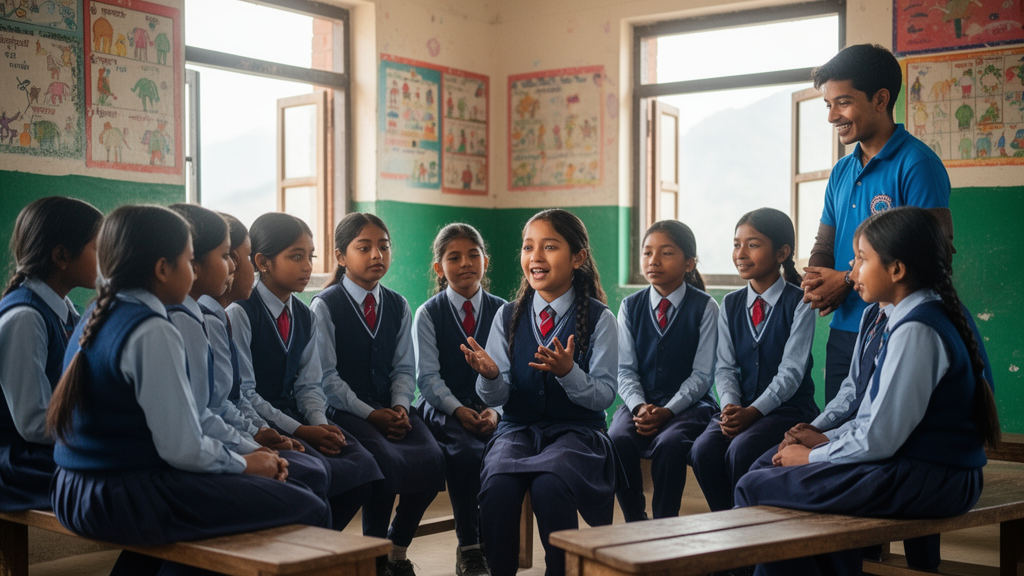
Adolescents in Nepal who took part in a school-based preventive mental health programme described the experience in predominantly positive terms, reporting perceived improvements in emotional regulation, relationships, financial behaviour, discipline and future orientation, according to a nested qualitative study published in Child and Adolescent Psychiatry and Mental Health. The study explored how adolescents, caregivers and head teachers experienced three modalities of the intervention: a self-regulation component, an economic component, and a combined arm delivering both, all delivered within a pilot prevention programme.
The research was nested within a pilot cluster-randomized controlled trial. Between September and October 2024, researchers conducted post-intervention semi-structured interviews with 18 adolescents, 18 caregivers and 3 head teachers across 6 participating intervention schools. Participants were purposively sampled to capture a range of engagement levels across the intervention arms. Interviews covered experiences of the programme, perceived benefits and challenges, and observations of change. Audio-recorded interviews were transcribed verbatim and analyzed using framework analysis, which combined deductive and inductive coding, and perspectives across the three participant groups were compared to support triangulation.
The analysis generated six overarching themes covering adolescents’ perceived changes, motivations for participation, acceptability, challenges, and the observations of caregivers and head teachers. Adolescents in the self-regulation arm described learning breathing and stress-management strategies that they perceived as helping them regulate emotions and communicate. Those in the economic arm described developing financial skills, including saving, tracking expenses and distinguishing needs from wants. Participants in the combined arm described experiences spanning both the emotional and financial domains.
Several features of the programme’s delivery stood out as important for engagement and acceptability. Adolescents pointed to facilitator support, peer interaction and interactive activities as elements that shaped their participation. Caregivers and head teachers, for their part, described perceived changes in adolescents’ communication, sense of responsibility and engagement at home and at school, adding an adult perspective that the researchers used to cross-check the adolescents’ own accounts.
The experience was not uniformly easy. Adolescents reported challenges related to academic pressures, competing responsibilities and the difficulty of sustaining newly learned practices after the sessions ended. These accounts of friction sat alongside the predominantly positive overall impressions, and the authors suggest that such obstacles are relevant to anyone planning similar programmes in school settings.
The study’s conclusions are deliberately cautious. The authors write that adolescents and adults described the interventions as acceptable and perceived them as supporting emotional, behavioral and practical skills, but they emphasize that these findings reflect perceptions gathered shortly after the intervention ended and do not establish sustained behavioral change or intervention effectiveness. In other words, the study documents how participants experienced and evaluated the programme, not whether it produced lasting clinical benefits.
Even so, the findings carry practical weight for a field in which evidence from low- and middle-income countries remains limited, as the authors note in their background. Adolescence is a critical period for mental health, with poverty and adversity increasing vulnerability to depression and anxiety, and understanding how young people themselves experience preventive interventions — including their perceived benefits, challenges and the factors influencing engagement — is central to designing programmes that adolescents will actually attend and complete.
Based on their results, the researchers suggest that supportive facilitation, peer and family engagement, and attention to school and social contexts may be important considerations when implementing and adapting school-based preventive interventions for adolescents. The study was conducted by a team including Rakesh Singh, Parinati Khanal, Mark J. D. Jordans and Crick Lund, among others, and is published as open access. Because the work is a qualitative study nested in a pilot trial with a small purposive sample from six schools, its findings are intended to illuminate participant experience and inform future implementation rather than to measure outcomes across populations.
Subject of Research: Adolescents' experiences of a school-based preventive mental health intervention in Nepal
Article Title: Adolescents’ experiences of participating in a school-based preventive mental health intervention in Nepal: a nested qualitative study
Article References: Singh, R., Khanal, P., Basnet, Y., Khadka, P., Luitel, N., Garman, E., Avendano, M., Evans-Lacko, S., Dedios Sanguineti, M. C., Jordans, M. J. D., & Lund, C. (2026). Adolescents’ experiences of participating in a school-based preventive mental health intervention in Nepal: a nested qualitative study. Child and Adolescent Psychiatry and Mental Health. https://doi.org/10.1186/s13034-026-01193-3
Image Credits: AI Generated
DOI: 10.1186/s13034-026-01193-3
Keywords: adolescent mental health, Nepal, school-based intervention, qualitative study, prevention, self-regulation, economic intervention, LMICs, caregivers, acceptability, Adolescents, experiences
News Source: Glenn Wilkins. (October 28, 2026). Nepalese adolescents describe how a school-based preventive mental health programme felt from the inside. Scienmag.