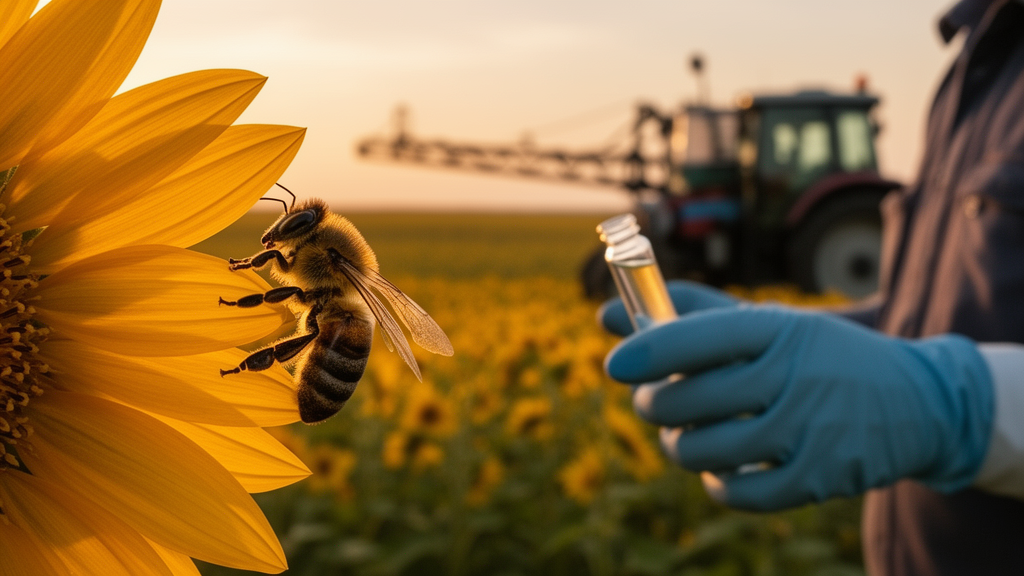
Neonicotinoid insecticides, the systemic compounds that bind to insect nicotinic acetylcholine receptors and account for roughly a quarter of the global insecticide market, face mounting ecological and regulatory pressure, according to a comprehensive review published in Applied Biological Chemistry. The review compiles global monitoring data, ecotoxicological endpoints and regulatory trends into an integrated assessment of a chemical class whose dominance is visibly eroding even as its residues persist in soils and waterways worldwide.
The market story is one of dramatic restructuring. In the 1990s, organophosphates held about 43 percent of the global insecticide market, pyrethroids 18 percent and carbamates 16 percent, while neonicotinoids represented a mere 1.8 percent. Driven by systemic properties and high efficacy at low application rates, neonicotinoids climbed past 10 percent of the market by 2008 and eventually reached roughly 25 to 28 percent. Yet between 2008 and 2024 their global share fell substantially, from 23.7 percent to 10.0 percent, while a category of newer chemistries expanded from 10.8 percent to 47.3 percent. Within the subclass, nitroguanidine compounds such as imidacloprid, thiamethoxam and clothianidin commanded about 86 percent of the neonicotinoid market, propelled by activity in Asia and the Americas.
Regional patterns diverge sharply. Latin America, Asia and North America together account for nearly 75 percent of global neonicotinoid use, whereas Europe holds a smaller share under stricter environmental rules. In South Korea, the sub-market transformed between 2008 and 2023: dinotefuran and acetamiprid surged to 44.4 percent and 24.6 percent respectively, while imidacloprid, clothianidin and thiamethoxam declined markedly, a shift the authors attribute to resistance management strategies and pollinator protection priorities.
The compounds’ agricultural efficiency conceals an environmental inefficiency. Less than 10 percent of the applied active ingredient is absorbed by crops; the majority disperses into soil and water. Structurally, neonicotinoids share an aromatic heterocyclic core linked to an electron-withdrawing group, and they divide into nitro-substituted, nitroguanidine and cyanoamidine classes. Nitroguanidine compounds show greater receptor binding affinity and stronger insecticidal activity, but that potency carries a cost: higher acute toxicity toward non-target arthropods, including honeybees, and, for imidacloprid and clothianidin, high structural stability and slow degradation that prolongs persistence in soil.
Human health evidence, drawn mainly from animal studies, is compound-specific. Established reference values vary widely: nitenpyram has a relatively high no observed adverse effect level of 53.7 milligrams per kilogram of body weight per day, whereas thiacloprid’s is far lower at 1.2, and imidacloprid’s chronic rat studies yielded 5.7. Imidacloprid has been reported to induce reproductive toxicity, hepatotoxicity and neurotoxicity in experimental animals, with ovarian damage and hormonal imbalance in female rats at 20 milligrams per kilogram per day, effects on sperm parameters and testosterone in males at 0.5 to 8, and hepatic changes at 20 to 45. Genotoxic effects, including micronucleus formation and chromosomal aberrations, appeared in vivo at doses of 40 to 300 milligrams per kilogram, though in vitro results were inconsistent. The review concludes that while neonicotinoids are less acutely toxic to mammals than to insects, accumulating evidence suggests effects on the nervous, reproductive, hepatic, immune and renal systems.
Aquatic ecosystems emerge as a particular concern. Acute exposure above 1 microgram per liter can be lethal to many aquatic species, but the review emphasizes that chronic low-level exposure in the nanogram-per-liter range is of greater concern because of irreversible neuronal damage. Daphnia magna shows low acute sensitivity to imidacloprid, with a 48-hour EC50 of 194 milligrams per liter under illuminated conditions, yet toxicokinetic-toxicodynamic modeling suggests recovery takes about 45 days after repeated exposure, meaning acute endpoints alone understate persistent harm. Aquatic insects are notably the most sensitive group, while algae and aquatic plants tolerate far higher concentrations. Metabolites compound the problem: dinotefuran breaks down into urea and guanidium derivatives equally toxic to earthworms, and thiamethoxam is rapidly converted to clothianidin, enhancing neurotoxic and reproductive effects.
For bees, the evidence is stark. Once considered relatively safe for pollinators, neonicotinoids at environmentally relevant sublethal concentrations disrupt foraging, navigation, olfactory learning, memory and colony behavior. Imidacloprid and thiamethoxam impair learning performance and homing ability in honeybees, and some studies report nicotine-like responses causing bees to preferentially return to contaminated food sources. Acute oral toxicity data show clothianidin and thiamethoxam as the most potent, with LD50 values of 2.844 to 21.80 and 4.679 to 29.90 nanograms per honeybee respectively, compared with 7,070 for acetamiprid and 14,600 for thiacloprid. Residues of clothianidin and thiamethoxam in pollen and nectar reduce colony growth and reproductive success in bumblebees, and imidacloprid suppresses immune responses in honeybees.
Regulators have responded. In May 2018 the European Union banned all outdoor uses of imidacloprid, clothianidin and thiamethoxam, following a 2013 moratorium on bee-attractive crops; France extended restrictions to acetamiprid and clothianidin; Canada’s Pest Management Regulatory Agency plans to phase out outdoor uses of thiamethoxam and clothianidin over aquatic invertebrate concerns; and US states including Maryland and Connecticut restrict residential uses. Risk assessment frameworks are also evolving: the European Food Safety Authority’s revised 2023 bee guidance and Korea’s 2025 update both expanded from acute adult honeybee toxicity to include chronic and larval toxicity, residue-based exposure assessments and colony-level studies.
Monitoring confirms the residues that motivated these actions. Korean nationwide surface and groundwater surveys found thiamethoxam at a maximum of 2.485 micrograms per liter in surface water and dinotefuran at 0.584 in groundwater, while global monitoring reported imidacloprid and thiamethoxam reaching up to 320 and 225 micrograms per liter. Hazard quotients compiled across heterogeneous studies place imidacloprid highest for aquatic risk in surface water at 15.9, while in soil thiacloprid and clothianidin show quotients of 90.8 and 33.2. The authors caution these screening values, derived from differing exposure metrics and endpoints, should be read as relative comparisons rather than directly equivalent risk estimates.
The review also flags synergistic toxicity as an emerging hazard: azole fungicides inhibit cytochrome P450 detoxification, and mixtures with neonicotinoids or pyrethroids increase honeybee toxicity, with combined clothianidin-fungicide exposure reducing colony activity and an acetamiprid-difenoconazole mixture reducing foraging. Proposed alternatives carry their own risks, as sulfoxaflor has shown sublethal pollinator effects including impaired homing and developmental abnormalities. The authors call for monitoring of environmental media, mixture toxicity assessment, metabolite inclusion in residue definitions, and behavioral endpoints such as navigation and colony maintenance in future risk evaluation, aiming to secure food production while safeguarding human and ecosystem health.
Subject of Research: Ecological toxicity, environmental residues and regulation of neonicotinoid insecticides
Article Title: Status and perspective of neonicotinoid insecticides from ecological toxicity and residue
Article References: Kim, K.-M., Ullah, W., Lee, H.-S., & Kim, J.-H. (2026). Status and perspective of neonicotinoid insecticides from ecological toxicity and residue. Applied Biological Chemistry, 69(1), Article 67. https://doi.org/10.1186/s13765-026-01128-8
Image Credits: AI Generated
DOI: 10.1186/s13765-026-01128-8
Keywords: neonicotinoids, imidacloprid, thiamethoxam, clothianidin, pollinators, honeybees, aquatic invertebrates, pesticide residues, ecological risk, regulation, EU ban, synergistic toxicity
News Source: Drew Townsend. (October 29, 2026). Neonicotinoid Insecticides Under Fire: Ecological Toxicity, Residues and a Shrinking Market. Scienmag.