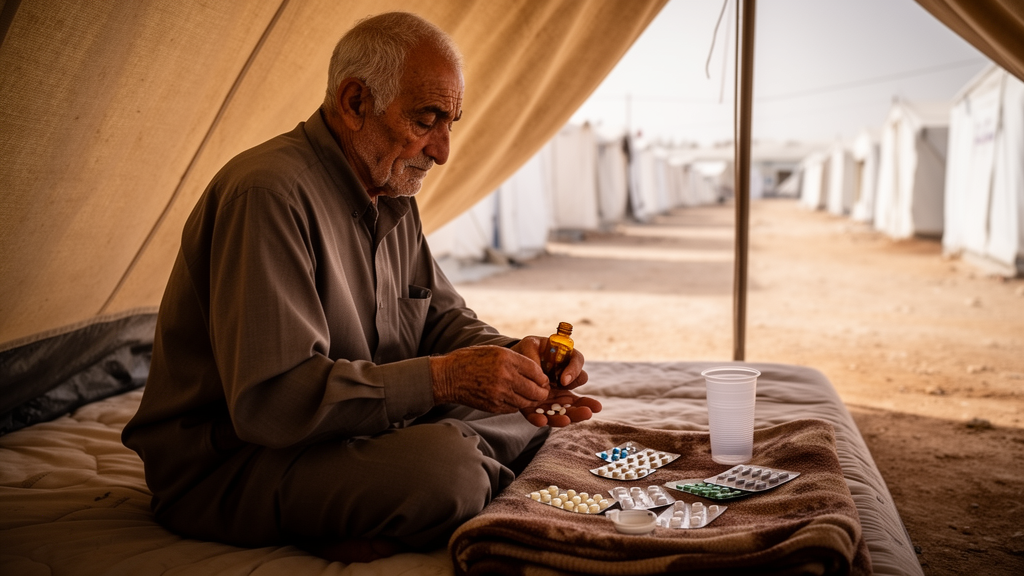
Nearly every internally displaced person with type 2 diabetes surveyed in camps in Al-Dana subdistrict, Northwest Syria, was found to be nonadherent to their diabetes medications, according to a cross-sectional study published in Globalization and Health. The researchers reported that 99.1% of participants demonstrated some degree of nonadherence, with a mean Adherence to Refills and Medications Scale (ARMS) score of 21.10 ± 5.59.
The study was conducted between January and March 2025 among adults with type 2 diabetes mellitus attending two health centers serving internally displaced person camps in the region. Data were collected using a structured questionnaire covering sociodemographic characteristics, clinical history, health care access, health literacy, and medication adherence.
To identify the factors associated with suboptimal adherence, the researchers used descriptive statistics and stepwise logistic regression modeling, reporting adjusted odds ratios (AOR) with 95% confidence intervals. This approach allowed them to estimate the strength of each factor’s association with adherence while accounting for the other variables in the model.
Two factors were associated with higher adherence. Attending the Albarakeh health center was strongly associated with better adherence (AOR = 37.68; 95% CI: 13.02–132.67), and receiving encouragement through regular physician visits and access to health information was also associated with higher adherence (AOR = 4.732; 95% CI: 2.022–12.40).
Several factors were linked to lower adherence. Female sex was associated with reduced adherence (AOR = 0.332; 95% CI: 0.149–0.713), as was skipping medication because of long distances to health facilities (AOR = 0.309; 95% CI: 0.089–0.993) and discontinuing medication due to side effects (AOR = 0.280; 95% CI: 0.098–0.728). These findings point to a combination of structural, geographic, and behavioral influences on whether displaced patients take their diabetes medications as prescribed.
The authors concluded that adherence to type 2 diabetes medications among internally displaced persons in Northwest Syria is critically low and that adherence is determined primarily by structural factors, whereas patients’ demographic characteristics play a significantly smaller role in medication adherence in the cohorts in the region studied.
The context matters for interpreting these results. As the study’s background notes, chronic disease management is challenging in conflict settings, with fragmented health care systems and unstable access to health care. In Northwest Syria, millions of internally displaced persons live in camps where insecurity, geographic barriers, and disrupted health care services complicate the management of noncommunicable diseases such as type 2 diabetes mellitus.
Because the study is cross-sectional, it captures associations at a single point in time and cannot establish causal relationships between the identified factors and adherence behavior. The findings are also specific to adults with type 2 diabetes attending two health centers serving IDP camps in Al-Dana subdistrict, so they may not generalize to other populations or settings in Syria or elsewhere.
Nevertheless, the near-universal nonadherence observed in this cohort underscores how fragile medication continuity can be for people managing chronic disease amid displacement. The identification of modifiable factors, such as regular physician visits, access to health information, and the burden of long distances to health facilities, offers a starting point for understanding where structural interventions might be directed in this setting.
Subject of Research: Medication adherence among internally displaced persons with type 2 diabetes in camps in Northwest Syria
Article Title: Factors associated with suboptimal adherence to type 2 diabetes medications among internally displaced persons in camps in Al-Dana subdistrict, Northwest Syria: a cross-sectional study
Article References: Allama, L., Saeed, S. N., Alhaffar, M. B. A., Alaeddin, A., Alkarat, A. A., Czifra, Á., & Sándor, J. (2026). Factors associated with suboptimal adherence to type 2 diabetes medications among internally displaced persons in camps in Al-Dana subdistrict, Northwest Syria: a cross-sectional study. Globalization and Health. https://doi.org/10.1186/s12992-026-01242-8
Image Credits: AI Generated
DOI: 10.1186/s12992-026-01242-8
Keywords: type 2 diabetes, medication adherence, internally displaced persons, Northwest Syria, cross-sectional study, ARMS scale, health care access, conflict settings, noncommunicable diseases, logistic regression, Factors, associated
News Source: Courtney Benton. (October 29, 2026). Nearly all displaced Syrians with type 2 diabetes in Northwest Syria camps show suboptimal medication adherence. Scienmag.