• HOME
  • NEWS
  • EXPLORE
    • CAREER
      • Companies
      • Jobs
    • EVENTS
    • iGEM
      • News
      • Team
    • PHOTOS
    • VIDEO
    • WIKI
  • BLOG
  • COMMUNITY
    • FACEBOOK
    • INSTAGRAM
    • TWITTER
Friday, July 3, 2026
BIOENGINEER.ORG
No Result
View All Result
  • Login
  • HOME
  • NEWS
  • EXPLORE
    • CAREER
      • Companies
      • Jobs
        • Lecturer
        • PhD Studentship
        • Postdoc
        • Research Assistant
    • EVENTS
    • iGEM
      • News
      • Team
    • PHOTOS
    • VIDEO
    • WIKI
  • BLOG
  • COMMUNITY
    • FACEBOOK
    • INSTAGRAM
    • TWITTER
  • HOME
  • NEWS
  • EXPLORE
    • CAREER
      • Companies
      • Jobs
        • Lecturer
        • PhD Studentship
        • Postdoc
        • Research Assistant
    • EVENTS
    • iGEM
      • News
      • Team
    • PHOTOS
    • VIDEO
    • WIKI
  • BLOG
  • COMMUNITY
    • FACEBOOK
    • INSTAGRAM
    • TWITTER
No Result
View All Result
Bioengineer.org
No Result
View All Result
Home NEWS Science News Chemistry

Neandertal genes in the petri dish

Bioengineer by Bioengineer
June 18, 2020
in Chemistry
Reading Time: 2 mins read
0
IMAGE
Share on FacebookShare on TwitterShare on LinkedinShare on RedditShare on Telegram

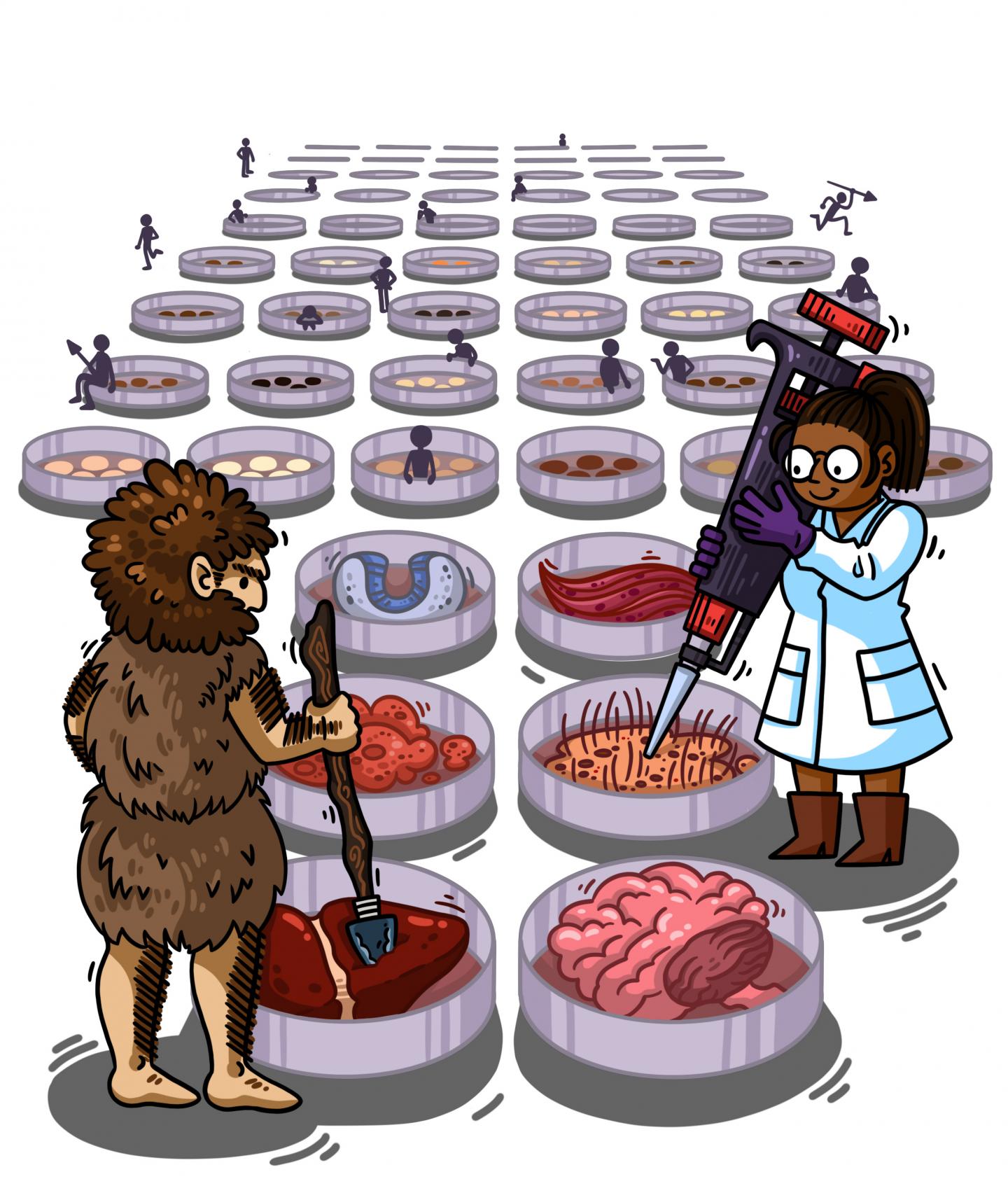
Researchers are studying the Neandertal DNA found in modern humans using stem cells and organoids
IMAGE

Credit: Petra Korlevi

“Using iPSC lines to study the functions of archaic human DNA is an untapped but very interesting approach,” says senior author J. Gray Camp of the Max Planck Institute for Evolutionary Anthropology in Leipzig, Germany, and the University of Basel in Switzerland. “No one has ever been able to look at the role Neandertal DNA plays during development.”

Studies have found that about two percent of the genomes of modern humans from outside Africa are composed of Neandertal DNA. This archaic DNA is a result of mating between the two groups tens of thousands of years ago.

In the new study, the team used resources from the Human Induced Pluripotent Stem Cells Initiative (HipSci), an international consortium that provides data and cell lines for research. Nearly all of the data and cell lines in HipSci are from people of UK and Northern European descent. The researchers analyzed this cell line resource for its Neandertal DNA content and annotated functional Neandertal variants for each of the cell lines.

“Some Neandertal alleles have relatively high frequency in this population,” Camp explains. “Because of that, this iPSC resource contains certain genes that are homozygous for Neandertal alleles, including genes associated with skin and hair color that are highly prevalent in Europeans.”

Camp’s team used four cell lines to generate brain organoids and generated single-cell RNA sequencing data to analyze their cell composition. They showed that this transcriptomic data could be used to track Neandertal-derived RNA across developmental processes. “This is a proof-of-principal study showing that you can use these resources to study the activity of Neandertal DNA in a developmental process,” Camp says. “The real challenge will be scaling up the number of lines in one experiment, but this is already starting to be possible.”

Camp notes that this research could be expanded to study other ancient human populations, including Denisovans, which have genes that are present primarily in Oceanian populations. His team also plans to continue studying Neandertal alleles using HipSci and other resources. “Organoids can be used to study a number of different developmental processes and phenotypes controlled by Neandertal DNA, including the intestinal tract and digestion, cognition and neural function, and the immune response to pathogens,” he concludes.

The researchers have generated a web browser with this information to make the data easily accessible for future research.

###

Media Contact
Dr. J. Gray Camp
[email protected]

Related Journal Article

http://dx.doi.org/10.1016/j.stemcr.2020.05.018

Tags: BiochemistryBiologyCell BiologyDevelopmental/Reproductive BiologyGeneticsMedicine/Health
Share12Tweet8Share2ShareShareShare2

Related Posts

Graz University of Technology Deciphers the Structural Secrets of MOF Thin Films — Chemistry

Graz University of Technology Deciphers the Structural Secrets of MOF Thin Films

July 2, 2026
Breaking Thermodynamic Limits: Wavelength-Driven Catalysis Advances Ammonia Synthesis — Chemistry

Breaking Thermodynamic Limits: Wavelength-Driven Catalysis Advances Ammonia Synthesis

July 2, 2026

From Quantum Mechanics to AI-Powered Materials Discovery: MARVEL Marks 12 Years of Transforming Computational Science

July 2, 2026

Djire Recognized with National Award for Outstanding Contributions in Research and Teaching

July 2, 2026
Please login to join discussion

POPULAR NEWS

  • Detection of EDCs in Breast Milk and Infant Urine Up to Six Months Highlights Early Exposure Risks

    77 shares
    Share 31 Tweet 19
  • Saying Goodbye to PGY-6: Pediatric Fellowship Realities

    103 shares
    Share 41 Tweet 26
  • New Drug Candidate Developed at McMaster Shows Potential for Treating Brain Cancer

    58 shares
    Share 23 Tweet 15
  • KTU Researchers Explore Ultrasound’s Role in Enhancing Blood Flow Beyond Diagnostics

    53 shares
    Share 21 Tweet 13

About

BIOENGINEER.ORG

We bring you the latest biotechnology news from best research centers and universities around the world. Check our website.

Follow us

Recent News

Steatosis Drives Liver Metastasis Diversity in CRC

Unlocking the Mysteries of Alzheimer’s Disease

Pensoft Introduces New Peer-Reviewed Journal of Regeneration to Advance Restorative Biology Across Species

Subscribe to Blog via Email

Enter your email address to subscribe to this blog and receive notifications of new posts by email.

Join 83 other subscribers
  • Contact Us

Bioengineer.org © Copyright 2023 All Rights Reserved.

Welcome Back!

Login to your account below

Forgotten Password?

Retrieve your password

Please enter your username or email address to reset your password.

Log In
No Result
View All Result
  • Homepages
    • Home Page 1
    • Home Page 2
  • News
  • National
  • Business
  • Health
  • Lifestyle
  • Science

Bioengineer.org © Copyright 2023 All Rights Reserved.