Two native strains of the soil bacterium Bacillus subtilis, isolated from Iranian farmland, suppressed major potato fungal pathogens in laboratory assays and improved tuber yield under real field conditions, according to a study published on 16 July 2026 in the Egyptian Journal of Biological Pest Control. The work, led by Mohsen Mobini-Dehkordi with Mohammad Kazem Momeni and Sadegh Farhadian, set out to test whether bacteria already adapted to local Iranian soils could serve as homegrown alternatives to synthetic fungicides in one of the country’s most important staple crops.
The researchers began by collecting subsurface soil samples from nine regions across Iran, including Ardabil, Zanjan, Asalem, Urmia, Tonekabon, Tehran, Shahrekord, Isfahan and Shiraz. Using dilution plating, heat shock treatment at 80 degrees Celsius to enrich for spore-forming bacteria, and a battery of biochemical tests covering amylase and gelatinase activity, hydrogen sulfide production, nitrate reduction, citrate utilization and thermotolerance, they recovered 45 bacterial isolates. In parallel, they sampled diseased potato tubers and leaves from Nafch, Shahrekord and Fereydan and cultured four fungal genera from symptomatic tissue: Fusarium, Alternaria, Phytophthora and Sclerotinia, the causal agents of Fusarium wilt, early blight, late blight and white mold respectively.
Each of the 45 bacterial isolates was then challenged against the fungal pathogens in dual-culture plate assays, in which a mycelial plug of the pathogen grows toward a spot of bacteria and the reduction in fungal colony radius on the bacterial side measures antagonism. Thirty-one isolates showed significant antagonistic activity, with mean inhibition values ranging from 0.0 percent to 33.5 plus or minus 6.2 percent. Three isolates stood out: B27 at 32.5 percent, BS1 at 33.5 percent and BS2 at 25.5 percent, while the reference strain B. subtilis PTCC 1720 reached 24.3 percent, validating the assay. The abstract reports that BS1 suppressed Fusarium oxysporum growth by 48 percent in vitro.
To confirm the identity of the best performers, the team amplified and sequenced the full-length 16S rRNA gene, roughly 1500 base pairs, using universal bacterial primers, and compared the sequences against GenBank reference databases. Both top isolates matched reference B. subtilis strains and were deposited in NCBI GenBank under accession numbers OQ343721 and OQ343719. The two strains were designated BS1-Kaolin and BS2-Maharloo, with BS2 showing maximal inhibition of Alternaria species and BS1 the strongest suppression of Fusarium species in the preliminary screening.
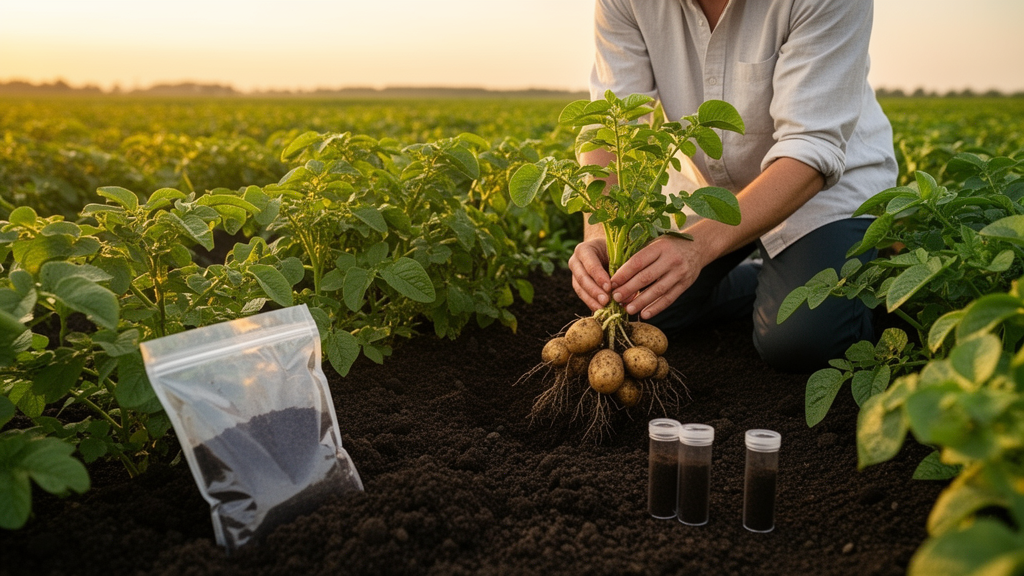
The decisive test took place in an experimental field in Chaharmahal and Bakhtiari Province, where 100 surface-sterilized tubers of the commercial potato cultivar Agria were planted in ten rows in mid-June under typical regional summer conditions with moderate temperatures and low rainfall. Twenty-five days after emergence, the researchers applied bacterial or fungal spore suspensions, each 500 microliters of a 10 to the ninth CFU per milliliter preparation, to wounds made at the plant stems, followed by foliar spray. A randomized complete block design split the experiment into two cohorts, one targeting Alternaria and one targeting Fusarium, each with five treatments: an uninoculated control, a pathogen-only control, the bacterium alone, pathogen plus bacterium, and the chemical fungicide kresoxim-methyl as the standard.
The field results revealed a clear hierarchy. Inoculation with either pathogen cut tuber weight by 40 to 55 percent relative to uninoculated controls, confirming strong disease pressure: in the Alternaria group, the pathogen-only treatment yielded 760.8 plus or minus 34.7 grams of tubers against 939.1 plus or minus 39.6 grams in the untreated control, while in the Fusarium group the pathogen drove yield down to 364.3 plus or minus 16.9 grams from 639.8 plus or minus 38.3 grams. The bacterial treatments, by contrast, increased total tuber weight by 30 to 45 percent compared with controls and raised tuber proliferation by 18 to 27 percent, with the best case reaching a 75.6 percent recovery of pathogen-induced yield loss in the Fusarium group.
Notably, the chemical fungicide still produced the highest absolute tuber weight gains of 55 to 60 percent, and in the Alternaria group it reached 1209.8 plus or minus 50.9 grams of total tubers, the highest of any treatment, with correspondingly large shoot biomass. Yet the bacterial treatments outperformed the fungicide on tuber numbers, increasing them by 15 to 20 percent compared with the chemical treatment. In the Fusarium group, BS1 alone yielded 640.1 plus or minus 29.2 grams of tubers, the highest among the biological treatments and comparable to the uninoculated control, while BS2 alone produced 528.8 plus or minus 31.4 grams alongside the highest tuber-to-plant ratio of 8.8 and balanced aerial biomass. Analysis of variance with Fisher’s least significant difference comparisons confirmed that treatment effects on tuber yield parameters were significant at the 5 percent level.
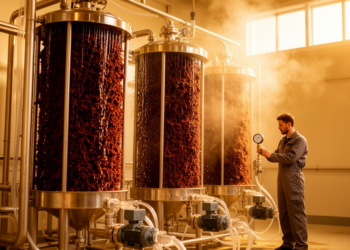
Beyond disease suppression, the strains showed traits favorable for industrial production. In tryptic soy broth at 30 degrees Celsius with shaking at 120 rpm, BS1’s wet biomass climbed from 2.8 grams per liter on day one to 27.5 grams per liter by day three, stabilizing near 25 grams per liter, while endospore formation began on day four at 8 percent and rose steadily to 95 percent by day ten. After 72 hours, BS1 reached 43.1 grams per liter wet biomass and 16.02 milligrams per milliliter dry weight in TSB, roughly double the yield in nutrient broth, and in an industrial fermentation medium it produced 38.1 grams per liter wet weight, a 3.2 percent edge over BS2. Spore quantification relied on heat treatment at 80 degrees Celsius to kill vegetative cells before plating for heat-resistant colony counts.
The authors attribute the dual biocontrol and growth-promoting effects to mechanisms documented for B. subtilis, including antifungal lipopeptides such as bacillomycin, fengycin and surfactin that disrupt fungal membranes and inhibit spore germination, alongside phytohormone production and nutrient mobilization. They caution that efficacy is strain-dependent and that the field experiment was conducted at a single site with two blocks per treatment, so broader validation across locations and seasons remains necessary. The fungal pathogens were also identified only to the genus level by morphology and pathogenicity testing. Even so, the combination of native adaptation, measurable field yield protection, higher tuber numbers than a commercial fungicide and scalable fermentation performance positions these two Iranian isolates as credible candidates for integrated disease management in sustainable and organic potato production systems.
Subject of Research: Native Bacillus subtilis strains from Iranian soils as biocontrol and growth-promoting agents against potato fungal pathogens
Article Title: Antifungal capacity and field validation of native Bacillus subtilis strains for sustainable potato disease control
Article References: Mobini-Dehkordi, M., Kazem Momeni, M., & Farhadian, S. (2026). Antifungal capacity and field validation of native Bacillus subtilis strains for sustainable potato disease control. Egyptian Journal of Biological Pest Control, 36(1), Article 25. https://doi.org/10.1186/s41938-026-00903-5
Image Credits: AI Generated
DOI: 10.1186/s41938-026-00903-5
Keywords: Bacillus subtilis, biocontrol, potato, fungal pathogens, Fusarium, Alternaria, field trial, Iran, sustainable agriculture, plant growth promotion, 16S rRNA, sporulation
News Source: Alan Morgan. (October 29, 2026). Native soil bacteria from Iran boost potato yields and fight fungal disease in field trials. Scienmag.