Despite expert recommendations to talk about good and bad touch during preschool years, just 3 in 5 parents agree that this is the right age to start
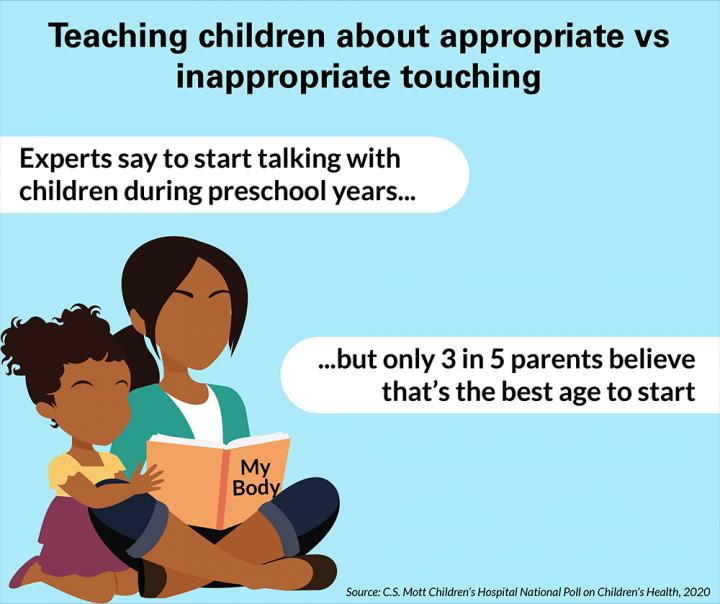
Credit: C.S. Mott Children’s Hospital National Poll on Children’s Health at the University of Michigan.
ANN ARBOR, Mich. — Experts recommend starting conversations about inappropriate touching during the preschool years, but less than half of parents of preschoolers in a national poll say they’ve begun that discussion.
Meanwhile, one in four parents of elementary school-age children say they have not yet begun talking about inappropriate touching, according to the C.S. Mott Children’s Hospital National Poll on Children’s Health at the University of Michigan.
The report is based on responses from 1,106 parents who had at least one child age 2-9 years.
“This is a conversation parents should be having multiple times in age-appropriate ways,” says Mott Poll co-director Sarah Clark.
Three in five parents agree that the preschool years is the right time to talk about inappropriate touching. But among parents of preschoolers who have not talked about it, 71% believe their child is too young.
Many parents also say they want more help navigating the conversation – but two in five say they haven’t received any information on how to talk with their child about inappropriate touching. Just a quarter of parents have received such information from a health care provider.
“Many parents have not gotten any information about how to talk with children about inappropriate touching. Without practical tips or suggestions, parents may be at a loss for how to begin.”
Clark notes that parents may start this process during the preschool years by teaching the anatomically correct names for body parts and explaining what parts are private.
Among parents of elementary school-age children who have not talked about inappropriate touching, the most common reason was just not getting around to it (39%). Another 18% said that discussions are unnecessary because inappropriate touching of children rarely happens.
“Parents shouldn’t disregard the reality of child sexual abuse,” Clark says. “Statistics show that up to 1 in 4 girls and 1 in 6 boys will be sexually abused before the age of 18.”
Other common reasons for not talking about inappropriate touching with school-age children include feeling the child is still too young (36%), not wanting to scare the child (21%), and not knowing how to bring it up (18%).
“It’s clear that this is a challenging area for many parents. However, it’s essential to help children understand the difference between appropriate and inappropriate touching, and that they should tell mom or dad if any inappropriate touching occurs. Failure to do so leaves children unequipped to deal with one of the gravest dangers of childhood.”
In addition to discussions, Clark says parents should think about family rules that can reinforce the concept of personal boundaries. For example, parents shouldn’t force children to accept hugs, kisses or other physical contact from anybody, including family members and friends.
Sixty percent of parents said they’d like their child’s school to teach students about the topic, and 76% want the school to provide information for parents.
“In the past, talking about appropriate vs inappropriate touching was probably something that parents would want to keep in the family,” says Clark. “However, it’s clear that parents want information and resources on how best to approach this sensitive topic. Schools and child health providers have a substantial role in helping families recognize and confront child sexual abuse.”
###
Media Contact
Beata Mostafavi
[email protected]
734-764-2220