• HOME
  • NEWS
  • EXPLORE
    • CAREER
      • Companies
      • Jobs
    • EVENTS
    • iGEM
      • News
      • Team
    • PHOTOS
    • VIDEO
    • WIKI
  • BLOG
  • COMMUNITY
    • FACEBOOK
    • INSTAGRAM
    • TWITTER
Saturday, May 16, 2026
BIOENGINEER.ORG
No Result
View All Result
  • Login
  • HOME
  • NEWS
  • EXPLORE
    • CAREER
      • Companies
      • Jobs
        • Lecturer
        • PhD Studentship
        • Postdoc
        • Research Assistant
    • EVENTS
    • iGEM
      • News
      • Team
    • PHOTOS
    • VIDEO
    • WIKI
  • BLOG
  • COMMUNITY
    • FACEBOOK
    • INSTAGRAM
    • TWITTER
  • HOME
  • NEWS
  • EXPLORE
    • CAREER
      • Companies
      • Jobs
        • Lecturer
        • PhD Studentship
        • Postdoc
        • Research Assistant
    • EVENTS
    • iGEM
      • News
      • Team
    • PHOTOS
    • VIDEO
    • WIKI
  • BLOG
  • COMMUNITY
    • FACEBOOK
    • INSTAGRAM
    • TWITTER
No Result
View All Result
Bioengineer.org
No Result
View All Result
Home NEWS Science News

NASA’s Aqua satellite reveals Tropical Cyclone Esami’s dissipation

Bioengineer by Bioengineer
January 27, 2020
in Science News
Reading Time: 2 mins read
0
IMAGE
Share on FacebookShare on TwitterShare on LinkedinShare on RedditShare on Telegram

IMAGE

Credit: Credit: NASA/NRL


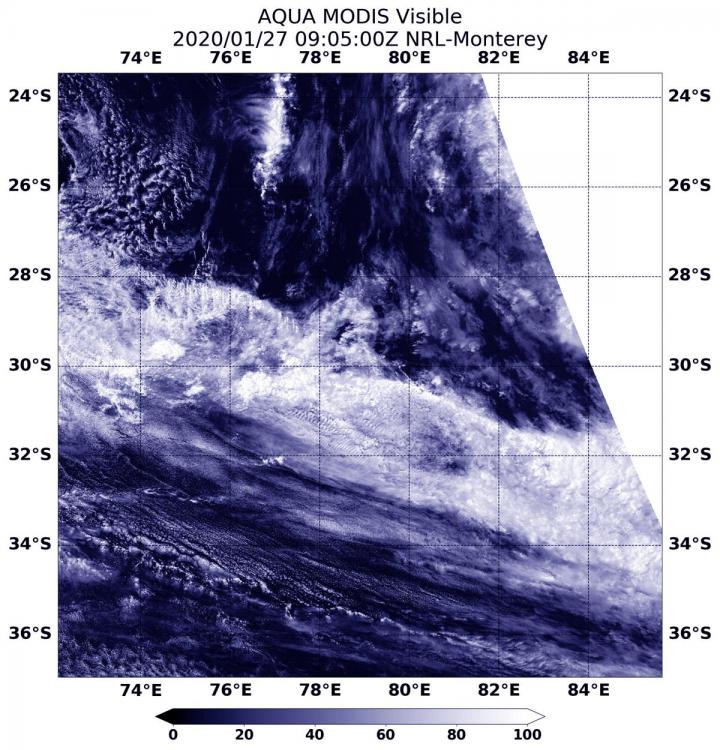
Tropical Cyclone Esami formed in the Southern Indian Ocean and just three days later, visible imagery from NASA’s Aqua satellite confirmed the storm had dissipated.

Tropical Cyclone Esami formed on January 24 at 4 p.m. EST (2100 UTC) about 764 miles east-southeast of Port Louis, Mauritius. Esami’s maximum sustained winds peaked the next day on Jan. 25 at 45 knots (52 mph/83 kph).

On January 26 at 4 p.m. EST (2100 UTC), the Joint Typhoon Warning Center issued their final warning on Tropical Cyclone Esami. At that time, Esami had weakened to a depression with maximum sustained winds near 30 knots (34.5 mph/55.5 kph). It was located near latitude 29.8 degrees south and longitude 77.9 degrees west, about 1,260 miles east-southeast of Port Louis, Mauritius. The depression was moving to the south-southeast and was dissipating.

When NASA’s Aqua satellite passed over the Southern Indian Ocean on Jan. 27 at 4:05 a.m. EST (0905 UTC), the Moderate Resolution Imaging Spectroradiometer or MODIS instrument provided a visible image that revealed the remnants of Esami were dissipating.

Typhoons and hurricanes are the most powerful weather events on Earth. NASA’s expertise in space and scientific exploration contributes to essential services provided to the American people by other federal agencies, such as hurricane weather forecasting.

###

Media Contact
Rob Gutro
[email protected]

Original Source

https://blogs.nasa.gov/hurricanes/2020/01/27/esami-southern-indian-ocean/

Tags: Atmospheric ChemistryAtmospheric ScienceClimate ChangeClimate ScienceEarth ScienceMeteorologyTechnology/Engineering/Computer ScienceTemperature-Dependent PhenomenaWeather/Storms
Share12Tweet8Share2ShareShareShare2

Related Posts

Perinatal and Early Childhood Factors in PFAPA Persistence — Technology and Engineering

Perinatal and Early Childhood Factors in PFAPA Persistence

May 16, 2026

New Actinomycin Derivatives Target Malaria More Selectively

May 16, 2026

Mobile App Enhances Exercise for Older Adults’ Cognition

May 16, 2026

Botulinum Toxin Reduces Urinary Retention Post-Hemorrhoidopexy

May 16, 2026
Please login to join discussion

POPULAR NEWS

  • Research Indicates Potential Connection Between Prenatal Medication Exposure and Elevated Autism Risk

    843 shares
    Share 337 Tweet 211
  • New Study Reveals Plants Can Detect the Sound of Rain

    730 shares
    Share 291 Tweet 182
  • Salmonella Haem Blocks Macrophages, Boosts Infection

    62 shares
    Share 25 Tweet 16
  • Breastmilk Balances E. coli and Beneficial Bacteria in Infant Gut Microbiomes

    58 shares
    Share 23 Tweet 15

About

We bring you the latest biotechnology news from best research centers and universities around the world. Check our website.

Follow us

Recent News

Perinatal and Early Childhood Factors in PFAPA Persistence

New Actinomycin Derivatives Target Malaria More Selectively

Mobile App Enhances Exercise for Older Adults’ Cognition

Subscribe to Blog via Email

Enter your email address to subscribe to this blog and receive notifications of new posts by email.

Join 82 other subscribers
  • Contact Us

Bioengineer.org © Copyright 2023 All Rights Reserved.

Welcome Back!

Login to your account below

Forgotten Password?

Retrieve your password

Please enter your username or email address to reset your password.

Log In
No Result
View All Result
  • Homepages
    • Home Page 1
    • Home Page 2
  • News
  • National
  • Business
  • Health
  • Lifestyle
  • Science

Bioengineer.org © Copyright 2023 All Rights Reserved.