• HOME
  • NEWS
  • EXPLORE
    • CAREER
      • Companies
      • Jobs
    • EVENTS
    • iGEM
      • News
      • Team
    • PHOTOS
    • VIDEO
    • WIKI
  • BLOG
  • COMMUNITY
    • FACEBOOK
    • INSTAGRAM
    • TWITTER
Monday, October 5, 2026
BIOENGINEER.ORG
No Result
View All Result
  • Login
  • HOME
  • NEWS
  • EXPLORE
    • CAREER
      • Companies
      • Jobs
        • Lecturer
        • PhD Studentship
        • Postdoc
        • Research Assistant
    • EVENTS
    • iGEM
      • News
      • Team
    • PHOTOS
    • VIDEO
    • WIKI
  • BLOG
  • COMMUNITY
    • FACEBOOK
    • INSTAGRAM
    • TWITTER
  • HOME
  • NEWS
  • EXPLORE
    • CAREER
      • Companies
      • Jobs
        • Lecturer
        • PhD Studentship
        • Postdoc
        • Research Assistant
    • EVENTS
    • iGEM
      • News
      • Team
    • PHOTOS
    • VIDEO
    • WIKI
  • BLOG
  • COMMUNITY
    • FACEBOOK
    • INSTAGRAM
    • TWITTER
No Result
View All Result
Bioengineer.org
No Result
View All Result
Home NEWS Science News

NASA sees Tropical Cyclone Olga merge with a cold front

Bioengineer by Bioengineer
October 28, 2019
in Science News
Reading Time: 2 mins read
0
IMAGE
Share on FacebookShare on TwitterShare on LinkedinShare on RedditShare on Telegram

IMAGE

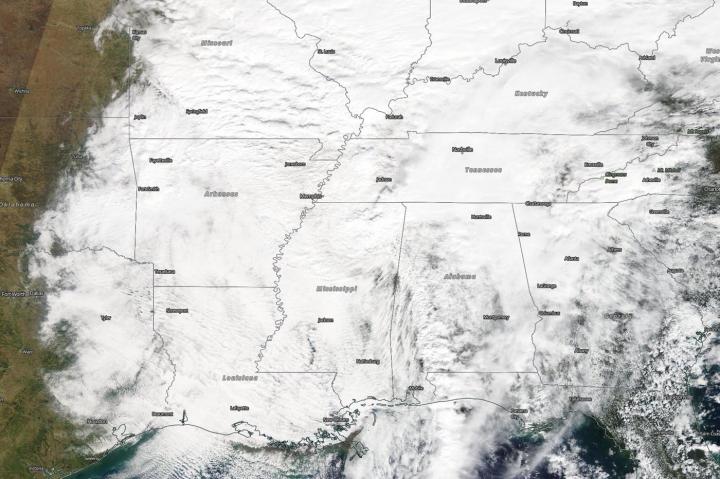
Credit: NASA Worldview


Tropical Depression 17 strengthened briefly into a tropical storm on the same day it formed, Oct. 25. NASA’s Terra satellite captured a look at the clouds associated with its remnants merging with a cold front over the southern U.S.

Tropical Depression 17 formed early on Friday, Oct. 25 and by 5 p.m. EDT it had strengthened and organized into a tropical storm and was renamed Olga. However, by 11 p.m. EDT, Olga transitioned again into a post-tropical storm.

The last advisory on Tropical Storm Olga was issued at 11 p.m. EDT on Oct. 25 by the National Hurricane Center or NHC. At that time, the center of Post-Tropical Cyclone Olga was located near latitude 27.8 degrees north and longitude 92.2 degrees west. The post-tropical cyclone was moving toward the northeast near 17 mph (28 kph) and maximum sustained winds were near 50 mph (85 kph) and weakening.

At that time, the NHC discussion said, “Earlier this evening, the last 2 passes through Olga made by an Air Force Reserve Hurricane Hunter aircraft showed that the cyclone had become embedded within a cold front. Strong northwesterly flow was observed within 10 nautical miles northwest of Olga’s center and a sharp temperature and dew point gradient was measured across the cyclone. It does not appear that Olga has separated from the front in any significant way since the plane left. In fact, recent surface observations suggest that either the front passes through the center of the cyclone or its circulation has become poorly defined. Based on all these data, Olga is now classified as post-tropical and this is the last NHC advisory.”

Since Olga became entangled with the front, the winds and seas associated the front were then considered to be representative of the overall system.

Olga’s remnants moved through the Mississippi Valley today and toward the Great Lakes on Sunday, Oct. 27.

###

Media Contact
Rob Gutro
[email protected]

Original Source

https://blogs.nasa.gov/hurricanes/2019/10/28/olga-atlantic-ocean/

Tags: Atmospheric ChemistryAtmospheric ScienceClimate ChangeClimate ScienceEarth ScienceMeteorologyTechnology/Engineering/Computer ScienceTemperature-Dependent PhenomenaWeather/Storms
Share13Tweet8Share2ShareShareShare2

Related Posts

Rare SARS-CoV-2 Deletion in nsp3 Emerges From Routine Genomic Surveillance

Rare SARS-CoV-2 Deletion in nsp3 Emerges From Routine Genomic Surveillance

October 5, 2026
Political Divide Shapes How Americans Judge Vaccine Safety and Effectiveness, National Survey Finds

Political Divide Shapes How Americans Judge Vaccine Safety and Effectiveness, National Survey Finds

October 5, 2026

Rare ERBB2 Variants Expand the Genetic Picture of a Multisystem Congenital Disorder

October 5, 2026

Electric Vehicle Fires, Wildfire Smoke and 3D Printing Take Center Stage as Exposure Scientists Gather in Vancouver

October 5, 2026
Please login to join discussion

POPULAR NEWS

  • Alloys That Shrink Their Own Grains: New PIX Mechanism Refines Metals With Heat Alone

    Alloys That Shrink Their Own Grains: New PIX Mechanism Refines Metals With Heat Alone

    29 shares
    Share 12 Tweet 7
  • Endurance Exercise Reshapes the Liver in Males and Females Through Distinct Molecular Routes

    29 shares
    Share 12 Tweet 7
  • Single Transcription Factor PU.1 Rapidly Converts Fibroblasts into Macrophage-Lineage Cells

    29 shares
    Share 12 Tweet 7
  • New Scale Measures How Ready Nurse Educators Really Are for the AI Era

    29 shares
    Share 12 Tweet 7

About

We bring you the latest biotechnology news from best research centers and universities around the world. Check our website.

Follow us

Recent News

Alloys That Shrink Their Own Grains: New PIX Mechanism Refines Metals With Heat Alone

Endurance Exercise Reshapes the Liver in Males and Females Through Distinct Molecular Routes

Single Transcription Factor PU.1 Rapidly Converts Fibroblasts into Macrophage-Lineage Cells

Subscribe to Blog via Email

Success! An email was just sent to confirm your subscription. Please find the email now and click 'Confirm' to start subscribing.

Join 85 other subscribers
  • Contact Us

Bioengineer.org © Copyright 2023 All Rights Reserved.

Welcome Back!

Login to your account below

Forgotten Password?

Retrieve your password

Please enter your username or email address to reset your password.

Log In
No Result
View All Result
  • Homepages
    • Home Page 1
    • Home Page 2
  • News
  • National
  • Business
  • Health
  • Lifestyle
  • Science

Bioengineer.org © Copyright 2023 All Rights Reserved.