• HOME
  • NEWS
  • EXPLORE
    • CAREER
      • Companies
      • Jobs
    • EVENTS
    • iGEM
      • News
      • Team
    • PHOTOS
    • VIDEO
    • WIKI
  • BLOG
  • COMMUNITY
    • FACEBOOK
    • INSTAGRAM
    • TWITTER
Wednesday, June 24, 2026
BIOENGINEER.ORG
No Result
View All Result
  • Login
  • HOME
  • NEWS
  • EXPLORE
    • CAREER
      • Companies
      • Jobs
        • Lecturer
        • PhD Studentship
        • Postdoc
        • Research Assistant
    • EVENTS
    • iGEM
      • News
      • Team
    • PHOTOS
    • VIDEO
    • WIKI
  • BLOG
  • COMMUNITY
    • FACEBOOK
    • INSTAGRAM
    • TWITTER
  • HOME
  • NEWS
  • EXPLORE
    • CAREER
      • Companies
      • Jobs
        • Lecturer
        • PhD Studentship
        • Postdoc
        • Research Assistant
    • EVENTS
    • iGEM
      • News
      • Team
    • PHOTOS
    • VIDEO
    • WIKI
  • BLOG
  • COMMUNITY
    • FACEBOOK
    • INSTAGRAM
    • TWITTER
No Result
View All Result
Bioengineer.org
No Result
View All Result
Home NEWS Science News

NASA sees Tropical Cyclone Dineo at Mozambique coast

Bioengineer by Bioengineer
February 15, 2017
in Science News
Reading Time: 2 mins read
0
Share on FacebookShare on TwitterShare on LinkedinShare on RedditShare on Telegram
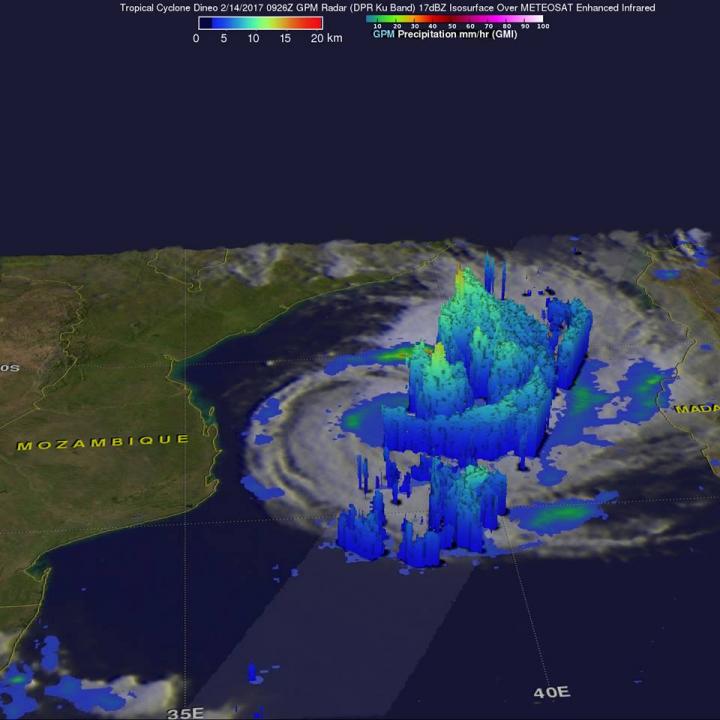
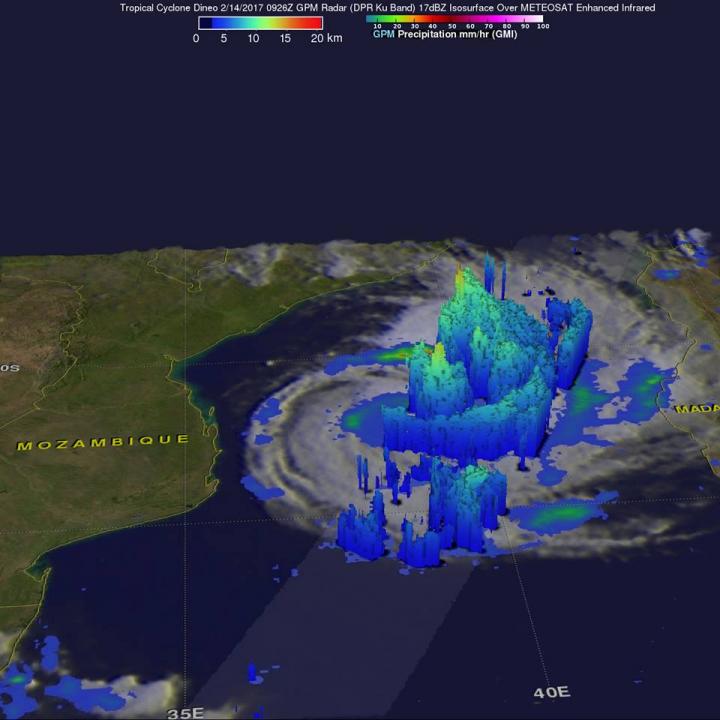
IMAGE

Credit: Credits: NASA/JAXA, Hal Pierce

When NASA's Aqua satellite passed over Tropical Cyclone Dineo in the Mozambique Channel on Feb. 15, the storm was centered just off the coast of Mozambique and moving toward landfall.

At 6:15 a.m. EST (1115 UTC) on Feb. 15, the Moderate Resolution Imaging Spectroradiometer or MODIS instrument aboard NASA's Aqua satellite showed the center of Tropical Cyclone Dineo just off the coast of Mozambique. Visible light satellite imagery showed a well-defined storm with thick bands of thunderstorms wrapping around the low-level center. The MODIS image also showed a cloud-filled eye.

On Feb. 14, when the Global Precipitation Measurement mission or GPM core observatory satellite flew over Dineo at 0926 UTC (4:26 a.m. EST) and found very heavy precipitation in bands of thunderstorms on Dineo's northeastern side. The most intense rainfall was measured by GPM's Dual-Frequency Precipitation Radar (DPR) falling at a rate of over 132 mm (5.2 inches) per hour in the intense storms in the northeastern quadrant of the tropical cyclone.

On Feb. 15 at 1500 UTC (10 a.m. EST) Tropical Cyclone Dineo's maximum sustained winds were near 80.5 mph (70 knots/129.6 kph). Dineo appears to have reached its peak strength, according to the Joint Typhoon Warning Center. Dineo was located near 23.5 degrees south latitude and 35.8 degrees east longitude, about 235 nautical miles west-southwest of Europa Island, and just off the coast of Mozambique.

Dineo was moving to the west-southwest and the eye is expected to make landfall by 2100 UTC (4 p.m. EST).

After making landfall in southern Mozambique Dineo is forecast to move west and weaken quickly.

###

Media Contact

Rob Gutro
[email protected]
@NASAGoddard

http://www.nasa.gov/goddard

############

Story Source: Materials provided by Scienmag

Share12Tweet8Share2ShareShareShare2

Related Posts

PINK1 Loss Impairs Dopamine Neuron Mitochondria via p38

June 24, 2026
Researchers Showcase Large-Scale Solar-Powered Plastic Recycling in Real-World Application — Technology and Engineering

Researchers Showcase Large-Scale Solar-Powered Plastic Recycling in Real-World Application

June 24, 2026

Newly Identified Protein Associated with Increased Risk of Severe COVID-19 and Lung Disease

June 24, 2026

Power Grid Constraints Hinder Emission Reduction Benefits of Electric Vehicles

June 24, 2026
Please login to join discussion

POPULAR NEWS

  • Saying Goodbye to PGY-6: Pediatric Fellowship Realities

    103 shares
    Share 41 Tweet 26
  • Multi-Hospital Study Reveals Long Covid Burden Is Twice as High as Current Estimates

    92 shares
    Share 36 Tweet 23
  • Detection of EDCs in Breast Milk and Infant Urine Up to Six Months Highlights Early Exposure Risks

    77 shares
    Share 31 Tweet 19
  • New Drug Candidate Developed at McMaster Shows Potential for Treating Brain Cancer

    58 shares
    Share 23 Tweet 15

About

We bring you the latest biotechnology news from best research centers and universities around the world. Check our website.

Follow us

Recent News

PINK1 Loss Impairs Dopamine Neuron Mitochondria via p38

Researchers Showcase Large-Scale Solar-Powered Plastic Recycling in Real-World Application

Newly Identified Protein Associated with Increased Risk of Severe COVID-19 and Lung Disease

Subscribe to Blog via Email

Enter your email address to subscribe to this blog and receive notifications of new posts by email.

Join 82 other subscribers
  • Contact Us

Bioengineer.org © Copyright 2023 All Rights Reserved.

Welcome Back!

Login to your account below

Forgotten Password?

Retrieve your password

Please enter your username or email address to reset your password.

Log In
No Result
View All Result
  • Homepages
    • Home Page 1
    • Home Page 2
  • News
  • National
  • Business
  • Health
  • Lifestyle
  • Science

Bioengineer.org © Copyright 2023 All Rights Reserved.