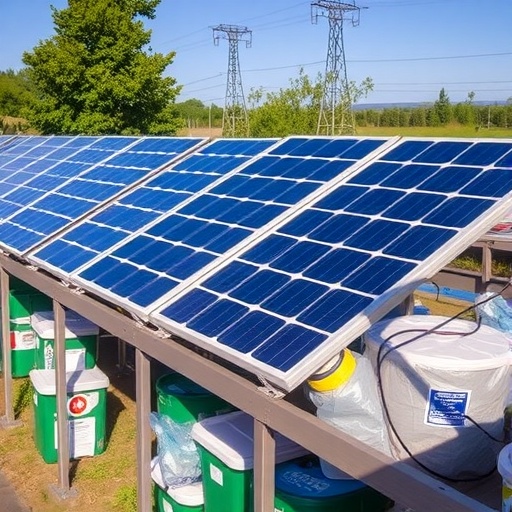
In a groundbreaking advancement that merges environmental sustainability with clean energy innovation, researchers at the University of Cambridge have unveiled a solar-powered reactor capable of transforming plastic waste directly into clean hydrogen fuel. This development moves beyond previous laboratory-scale experiments, establishing a scalable technology that operates effectively under real-world outdoor conditions. Their pioneering approach not only addresses the escalating global crisis of plastic pollution but also provides a novel pathway for generating renewable energy via hydrogen production, potentially revolutionizing both industries.
The team’s earlier research demonstrated that a compact solar reactor could convert plastic polymers into hydrogen and valuable chemicals at a laboratory scale, using photocatalytic materials. However, the critical challenge was scaling this technology up to sizes and conditions relevant for industrial use. The newly developed device, approximately one square meter in size—vastly larger than prior 25-centimeter reactors—was tested outdoors at Cambridge University’s Chemistry Department, successfully harnessing natural sunlight to drive the chemical transformations. This real-world demonstration represents a major milestone in translating bench-top science into practical applications.
Unlike conventional photovoltaic solar panels that generate electricity, this solar-driven reactor conducts a specialized chemical process in which sunlight initiates the splitting of water molecules and simultaneously reforms solid plastic waste into clean hydrogen fuel and useful industrial chemicals. The core of the technology revolves around a light-absorbing photocatalyst—designed to operate efficiently under ambient outdoor conditions—to facilitate this complex photochemical transformation with high selectivity and energy efficiency.
A significant hurdle in scaling the technology involved the manufacturing of effective photocatalyst panels. Earlier versions required high-temperature synthesis, harsh chemical treatments, and complex procedures involving nanoscale particles in liquid suspensions. These methods, while suitable for small-scale experiments, proved impractical for producing large-area reactors due to cost and complexity. The team tackled these issues by developing a spray-coating technique that applies a single-source precursor-derived co-catalyst film directly onto glass substrates at room temperature. This low-cost, straightforward process uses cobalt and zirconium-based molecular precursors, enabling mass production of catalyst panels without the need for specialized industrial equipment.
Ariffin Bin Mohamad Annuar, co-first author of the study, emphasized the unexpected simplicity of the system despite its sophisticated functionality. By using a household paint sprayer to deposit the catalyst layers onto one-square-meter glass panels, the researchers created scalable solar reactors easily deployable in the field. The reactors operate submerged in aqueous solutions in open environments, converting various types of solid waste—including cellulose and polyethylene terephthalate (PET) commonly found in beverage bottles—into hydrogen alongside multi-functional chemicals. This synergy between waste valorization and renewable hydrogen generation exemplifies a circular economy approach with vast ecological and economic potential.
The chemistry underpinning this innovation focuses on photoreforming, a process where semiconductor materials absorb sunlight to generate energetic charge carriers that drive the chemical breakdown of plastics and water molecules. The catalyst films’ molecular design incorporates cobalt as an active co-catalyst, enhancing the efficiency of hole scavenging and hydrogen evolution reactions, while the zirconium ligands stabilize the surface structure and facilitate charge transfer. This meticulous molecular engineering ensures durability and sustained reactivity under continuously fluctuating sunlight intensity and outdoor environmental stresses, critical factors for long-term commercial viability.
Testing under natural sunlight revealed that the large-scale reactors deliver consistent hydrogen yields, confirming that technical challenges related to scaling—such as light penetration, mass transport, and catalyst adhesion—have been effectively addressed. The research team also conducted a comprehensive techno-economic analysis, quantifying the costs associated with catalyst fabrication, system deployment, and operation. Their findings suggest that commercialization is plausible, provided further enhancements in catalyst longevity and conversion efficiencies are achieved, placing this technology within reach of energy and waste management industries.
Beyond technical details, the environmental implications of this solar-powered photoreforming are profound. Current global plastic waste accumulates at an alarming rate, with limited recycling infrastructure and low material recovery from landfills and oceans. Turning plastic refuse into hydrogen not only reduces pollution but also offers a clean fuel alternative for sectors struggling to decarbonize, such as transportation and chemical manufacturing. The clean hydrogen produced can feed fuel cell vehicles, power grids, or serve as feedstock for green chemical synthesis, thereby integrating waste management with renewable energy systems.
The collaborative nature of the project is highlighted through contributions from multiple teams within Cambridge’s Department of Chemistry. Professor Dominic Wright’s group synthesized the cobalt and zirconium molecular precursors critical for catalyst performance, while the Reisner lab optimized the reactor design and outdoor testing protocols. This interdisciplinary synergy demonstrates how fundamental chemistry and engineering coalesce to solve pressing global problems. The research received support from notable institutions, including the UK Department of Science, Innovation and Technology, the Royal Academy of Engineering, and industry partner Petronas, underscoring the importance of public-private partnerships in sustainable innovation.
Despite its promise, the researchers acknowledge ongoing challenges. The catalyst’s durability must improve to withstand prolonged operational cycles without degradation, and conversion yields require optimization to enhance economic competitiveness. Additionally, integrating these solar reactors into existing waste processing and energy infrastructure will demand thoughtful system engineering and policy support. Nevertheless, the filed patent and positive commercial outlook pave the way for rapid development, and further pilot projects are anticipated to validate scalability in diverse geographical and climatic contexts.
Published in the prestigious journal Nature Chemical Engineering, the study titled “Photoreforming of solid waste on 1 m² scale under real-world conditions using single-source precursor-derived co-catalyst films” represents a seminal contribution to renewable energy and environmental chemistry. By pioneering a simple, scalable, and effective method to harness solar energy for turning plastic pollution into high-value fuels and chemicals, the University of Cambridge team charts a promising roadmap for sustainable technological solutions capable of addressing some of the most urgent challenges facing humanity today.
Subject of Research: Solar-powered photoreforming technology to convert plastic waste into clean hydrogen fuel at a scalable, outdoor-operational level.
Article Title: ‘Photoreforming of solid waste on 1 m² scale using single-source precursor-derived co-catalyst films’
News Publication Date: 24-Jun-2026
Web References: https://doi.org/10.1038/s44286-026-00406-y
References:
Ariffin Bin Mohamad Annuar, Yongpeng Liu et al. ‘Photoreforming of solid waste on 1 m² scale under real-world conditions using single-source precursor-derived co-catalyst films.’ Nature Chemical Engineering (2026). DOI: 10.1038/s44286-026-00406-y.
Image Credits: University of Cambridge
Keywords
Plastic waste recycling, hydrogen fuel, solar photoreforming, photocatalyst films, scalable clean energy, cobalt-zirconium co-catalysts, environmental sustainability, renewable hydrogen production, plastic pollution solution, outdoor solar reactors, spray-coating fabrication, circular economy.
Tags: Cambridge University solar researchClean energy innovationindustrial-scale solar recyclinglarge-scale solar reactorphotocatalytic plastic conversionplastic waste to hydrogen fuelreal-world solar reactor applicationrenewable hydrogen productionsolar hydrogen fuel generationsolar-driven chemical reactorsolar-powered plastic recyclingsustainable plastic waste management