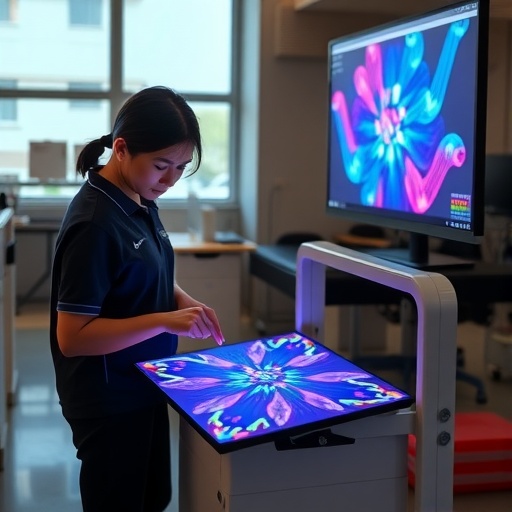
A new generation of flexible displays could soon make electronic light as soft, thin and adaptable as the surfaces they cover. Researchers at the National University of Singapore’s College of Design and Engineering, working with scientists from the Agency for Science, Technology and Research’s Institute of Materials Research and Engineering and Institute of High Performance Computing, have developed electrochemiluminescent devices that reach a brightness of 1,552 candelas per square metre. That is roughly three to four times brighter than a typical smartphone screen used indoors and 3.2 times brighter than the strongest conventional electrochemiluminescent devices reported previously.
The advance addresses a problem that has held back flexible displays for years. Organic light-emitting diodes can produce vivid images, but they require complex stacks of thin functional layers that are difficult to bend repeatedly without damage. Light-emitting capacitors have a simpler structure, yet often need hundreds or thousands of volts, making them impractical for wearable electronics. Electrochemiluminescent, or ECL, devices appear to offer a more natural alternative: they are thin, flexible and potentially energy efficient. Their weakness has been their low brightness and poor operating lifetime, which made them more suitable for laboratory demonstrations than real-world displays.
ECL devices produce light through electrochemical reactions in a liquid layer placed between two electrodes. When an alternating electrical voltage is applied, a light-emitting molecule in the electrolyte repeatedly gains and loses electrons. These oxidation and reduction reactions create excited molecular states, and when the molecules return to their lower-energy state, they release photons. The process resembles bioluminescence in principle, although electricity rather than a biological reaction drives the emission. In earlier devices, however, slow ion movement, inefficient charge transfer and chemical degradation at the electrode interface consumed much of the available energy before it could become visible light.
The Singapore-led team, headed by Assistant Professor Tan Yu Jun of NUS’s Department of Mechanical Engineering, focused first on the liquid electrolyte. Conventional ECL systems commonly use an ionic liquid, a salt that remains liquid at room temperature. Although ionic liquids are attractive because they do not evaporate easily and can support electrochemical reactions, their relatively large ions can move sluggishly through the device. The researchers replaced the conventional electrolyte with one containing a smaller, more mobile negative ion. This change accelerated interfacial electron exchange and reduced chemical instability near the electrode, allowing the light-producing reactions to proceed more efficiently.
The researchers also found that the two ions in the liquid play different roles in determining performance. The smaller negative ion helps charges move rapidly and suppresses unwanted chemical reactions, while the positive ion improves the solubility of the light-emitting dye. A higher concentration of dissolved emitter gives the device more molecular material with which to generate photons. Together, these effects increase both the speed of the electrochemical reactions and the amount of light-emitting “fuel” available inside the liquid layer. The result is not simply a brighter flash, but a more productive and stable reaction cycle.
Device architecture provided a second major improvement. Instead of placing two identical transparent electrodes on opposite sides of the active layer, the team paired electrodes with different functions. One electrode was textured to increase the effective area and promote electrochemical reactions, while the other was kept smooth to preserve optical transparency. A thin silver mirror behind the rear electrode redirected light that would otherwise escape backward, sending more of the generated emission toward the viewer. This asymmetric arrangement allowed the researchers to combine efficient charge transfer with improved light extraction without adding the elaborate multilayer structure associated with many conventional displays.
The redesigned devices also showed a substantial improvement in durability. During repeated on-and-off cycling, the new ECL system retained brightness up to 82 times higher than the conventional design after 10 cycles. Under continuous operation, it emitted light for two hours, compared with approximately 29 minutes for the older device. The researchers say the system can produce a steady glow rather than the brief flicker seen in earlier ECL experiments and can operate using a small battery. That combination of continuous emission, low operating power and mechanical flexibility is particularly important for displays intended to sit on skin, clothing, packaging or soft machines.
To demonstrate possible applications, the team built several working prototypes. One was a flexible skin patch that used red and blue light to indicate different readings from a sweat-glucose sensor. Such a system could eventually provide an immediate visual warning when a measured physiological signal moves outside a desired range, without requiring a separate phone or rigid screen. The prototype does not itself replace a medical diagnostic system, but it illustrates how sensing and visual feedback could be integrated into a single lightweight platform that conforms to the body.
The researchers also created a seven-segment display capable of showing the numbers one through nine and changing them rapidly over repeated cycles. This type of simple numerical interface could be useful in smart packaging, environmental sensors, machine surfaces and soft robots, where conventional rigid electronics may be difficult to integrate. A third prototype continued glowing while fully submerged in water, demonstrating a level of water resistance that could support underwater signalling and monitoring. Because ECL layers can be made thin, soft and transparent, future versions could become visual skins that communicate touch, movement or damage across the bodies of flexible machines.
The work, published in Science Advances on 20 May 2026, marks a significant step toward turning ECL from a chemically interesting light-emitting phenomenon into a practical display technology. The researchers acknowledge that colour performance remains uneven: red emission is currently the strongest, while blue and green light require further improvement in brightness and stability. Their next goals include developing new light-emitting molecules and electrolytes, refining electrode structures, and creating stretchable and self-healing devices that can continue functioning after deformation or minor damage. If those challenges are solved, flexible ECL displays could provide low-power visual communication directly on skin, wearable devices, underwater equipment and soft robotic surfaces.
Subject of Research: Electrochemiluminescent displays and flexible light-emitting devices
Article Title: Ionic liquid–regulated interfacial charge transport and asymmetric device architecture for high-performance electrochemiluminescence
News Publication Date: 20 May 2026
Web References: NUS College of Design and Engineering; Science Advances article
References: DOI: 10.1126/sciadv.aed9796
Image Credits: College of Design and Engineering, NUS
Keywords
Electrochemiluminescence, flexible displays, wearable electronics, ionic liquids, light-emitting devices, soft robotics, underwater displays, glucose sensing, electrochemistry, NUS CDE
Tags: advances in organic light-emitting diodesbreakthrough in brightness for bendable displaysdevelopment of lightweight wearable display technologyenergy-efficient flexible display materialsflexible electronic displayshigh-brightness electrochemiluminescent devicesimprovements in lifetime and performance of flexible displaysinnovative electrochemical light emissionintegration of ECL technology in consumer electronicsmaterial engineering for flexible light-emitting devicesovercoming durability challenges in flexible screensresearch on thin and adaptable display surfaces