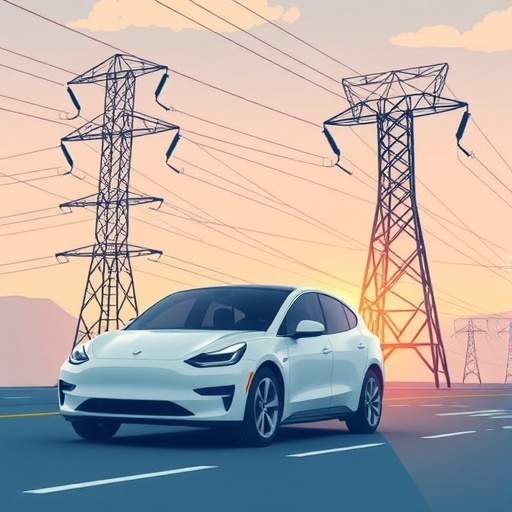
The carbon-reduction potential of electric vehicles (EVs) in China demonstrates significant disparities across urban centers, largely shaped by economic inequities and the shared nature of power grids. A cutting-edge study led by researchers at University College London (UCL) uncovers how wealthier Chinese cities, while spearheading EV adoption, inadvertently transfer much of their carbon emissions to less affluent neighboring cities through the interconnected electricity network. This dynamic dilutes the overall environmental benefits of vehicle electrification and imposes substantial pollution and economic burdens on underprivileged urban areas.
China’s rapid embrace of electric vehicles has been remarkable. In recent years, millions of EVs have flooded city streets, predominantly in wealthier regions boasting higher GDP per capita. These cities lead the charge in decarbonizing transport, shifting away from carbon-intensive petrol and diesel vehicles towards cleaner electric alternatives. Yet, electrification is only part of the equation. The electricity required to power these vehicles—increasing power demand dramatically—has profound implications for the broader energy infrastructure and its environmental footprint.
Electric vehicles rely on electricity generation that still predominantly depends on coal and other fossil fuels, especially in less developed cities. These economically disadvantaged areas often serve as power production hubs on the regional grids that supply electricity to wealthier cities. Consequently, while the urban centers with abundant EVs demonstrate reductions in tailpipe emissions, the environmental cost manifests elsewhere. Fossil-fuel-dependent cities face heightened pollution levels and economic stresses as they shoulder the responsibility for increased electricity production.
The UCL study meticulously analyzed 245 million vehicle registrations from 285 major Chinese cities in 2020, mapping the flow of electric vehicle energy consumption against power generation sources. The findings reveal a striking pattern: the richest cities meet nearly 42% of their EV electricity demand from less developed cities powered largely by coal or equivalent carbon-intensive fuel sources. This intercity energy flow effectively displaces carbon emissions from affluent to poorer cities, undermining the overall climate benefit of EV adoption.
Moreover, this transfer mechanism leads to a paradoxical rise in carbon emissions per electric vehicle within these economically disadvantaged “carbon importer” cities. Emission intensities per EV in these areas exceed those associated with petrol vehicles by a staggering 16.9% to 52%, reflecting the pollution burden imposed by producing electricity for others. These findings expose a spatial environmental injustice where citizens in less affluent cities endure disproportionate health and ecological damages due to others’ cleaner vehicle usage.
This carbon emissions displacement complicates national and international accounting frameworks. Apparent carbon reductions in wealthier cities mask the true environmental costs, as emissions are effectively outsourced rather than eliminated. The phenomenon challenges existing decarbonization policies by obscuring emission sources and sinks across spatial boundaries within power grids. Accurate, transparent emissions accounting must consider these intercity energy exchanges to develop equitable mitigation strategies.
Nearly half of the surveyed Chinese cities—136 out of 285—became net carbon importers in this setup, seeing their emissions increase due to EV-related power generation for external consumption. This demographic overlap links economic disadvantage to environmental burden, underscoring a systemic inequality in China’s green energy transition. The national government’s emissions reduction mandates thus place an undue fiscal and social cost on already struggling cities, exacerbating regional disparities.
Lead author Dr. Jianing Liu emphasizes the necessity of clean power generation complementing vehicle electrification. “Electric vehicles are invaluable for reducing tailpipe emissions,” Liu states, “but if the electric grid is fossil-fuel reliant, then carbon emissions are merely transferred to the power generation stage, defeating the purpose of decarbonization.” This highlights the critical need for simultaneous investments in renewable energy capacity alongside rapid EV deployment.
China’s electricity grid remains heavily dependent on coal, which accounts for a substantial share of nationwide power generation. While the government has set ambitious EV adoption targets and expanded charging infrastructure across cities, the incomplete decarbonization of electricity supply undermines these efforts. Clean energy integration is vital to ensuring that the benefits of electrified transport materialize in real carbon emission reductions, rather than just geographic emissions displacement.
The study’s insights extend beyond China, providing valuable lessons for global urban centers engaged in electrifying transportation amidst uneven economic development. Countries like the United States, India, and Brazil exhibit similar patterns where major electric power consumption occurs in affluent cities, but fossil-fuel-based electricity production is localized in poorer regions. Recognizing and addressing these disparities is essential for designing equitable national policies and international climate commitments.
Professor Zhifu Mi, senior author of the study, stresses the importance of integrated policy frameworks. “Decarbonizing the grid must move in tandem with promoting electric vehicles,” he explains. “Policies also need safeguards to prevent less developed cities from bearing disproportionate carbon and economic burdens.” Solutions may include compensatory mechanisms for “carbon importer” cities, incentivizing renewable power deployment in high-burden regions, and refining carbon accounting practices to capture intercity emissions flows accurately.
From an environmental justice perspective, this new research reveals how the seemingly green transition to EVs can mask deep-seated inequalities. Without coordinated grid decarbonization and fair policy interventions, the shift toward electric mobility risks reinforcing regional disparities in air quality, public health, and economic opportunity. China’s experience, illuminated by this comprehensive analysis, underscores the urgent need to marry clean vehicle technology with clean energy transformation in a socially equitable manner.
Overall, while electric vehicles represent a vital technology for reducing carbon emissions, their climate benefits depend critically on the cleanliness of the electric power that fuels them. In China and internationally, city-level disparities in electricity generation sources and socioeconomic status influence the net environmental gains from electrification. Understanding and overcoming these challenges through integrated energy, transportation, and social policy is paramount if electric vehicles are to fulfill their potential in the fight against climate change.
Subject of Research: Intercity disparities in carbon emission reductions associated with electric vehicle adoption and electricity generation in China
Article Title: Intercity inequality in carbon emission reductions from vehicle electrification in China
News Publication Date: 24 June 2026
Web References: DOI link
References: Jianing Liu, Longfei Zheng, Huibin Du, Zizheng Liu, Peng Zhang, Fenjie Long, Pengjun Zhao, Priti Parikh & Zhifu Mi (2026), Nature Cities
Keywords
Carbon emissions, Electric vehicles, Cities, Energy infrastructure, Transportation electrification, Environmental inequality, Power grid decarbonization, Environmental justice
Tags: decarbonizing transport in urban Chinaeconomic inequities in energy useelectric vehicle carbon reductionelectricity generation and fossil fuelsenvironmental burdens on underprivileged citiesenvironmental impact of electric vehiclesEV adoption in wealthy citiespollution transfer in power gridspower demand and energy infrastructurepower grid constraints in Chinaregional electricity networks Chinaurban disparities in EV benefits