• HOME
  • NEWS
  • EXPLORE
    • CAREER
      • Companies
      • Jobs
    • EVENTS
    • iGEM
      • News
      • Team
    • PHOTOS
    • VIDEO
    • WIKI
  • BLOG
  • COMMUNITY
    • FACEBOOK
    • INSTAGRAM
    • TWITTER
Thursday, June 25, 2026
BIOENGINEER.ORG
No Result
View All Result
  • Login
  • HOME
  • NEWS
  • EXPLORE
    • CAREER
      • Companies
      • Jobs
        • Lecturer
        • PhD Studentship
        • Postdoc
        • Research Assistant
    • EVENTS
    • iGEM
      • News
      • Team
    • PHOTOS
    • VIDEO
    • WIKI
  • BLOG
  • COMMUNITY
    • FACEBOOK
    • INSTAGRAM
    • TWITTER
  • HOME
  • NEWS
  • EXPLORE
    • CAREER
      • Companies
      • Jobs
        • Lecturer
        • PhD Studentship
        • Postdoc
        • Research Assistant
    • EVENTS
    • iGEM
      • News
      • Team
    • PHOTOS
    • VIDEO
    • WIKI
  • BLOG
  • COMMUNITY
    • FACEBOOK
    • INSTAGRAM
    • TWITTER
No Result
View All Result
Bioengineer.org
No Result
View All Result
Home NEWS Science News Chemistry

NASA satellite’s lone view of Betelgeuse reveals more strange behavior

Bioengineer by Bioengineer
August 13, 2020
in Chemistry
Reading Time: 2 mins read
0
IMAGE
Share on FacebookShare on TwitterShare on LinkedinShare on RedditShare on Telegram

IMAGE

Credit: NASA/STEREO/HI

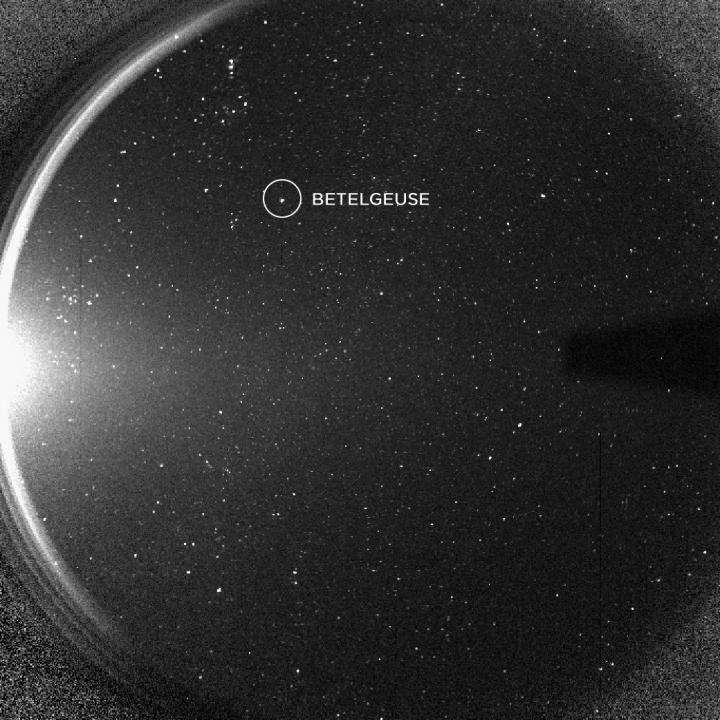
For several weeks in summer 2020, NASA’s Solar and Terrestrial Relations Observatory, or STEREO, had the solar system’s best view of the star Betelgeuse, whose extreme dimming over the past several months has intrigued scientists. STEREO’s measurements revealed more unexpected dimming by the star, further adding to the questions around Betelgeuse’s recent behavior.

Starting in late spring 2020, Betelgeuse has appeared close to the Sun in the sky because of Earth’s position in space. However, the STEREO spacecraft is currently about 70 degrees away from Earth — meaning that in late June, STEREO was in approximately the same position that Earth was in around mid-April, and could therefore see the stars that appeared in Earth’s night sky during April.

Scientists took advantage of this unique orbital position to keep tabs on Betelgeuse while the star was invisible to Earth-bound observatories. During this period between late June and early August, STEREO observed Betelgeuse on five separate days, rolling the spacecraft for about two hours each time to place Betelgeuse in the field of view of STEREO’s Heliospheric Imager, an instrument usually used to capture images of the Sun’s outflowing material, the solar wind, as it passes by the spacecraft and towards Earth. The team shortened the instrument’s exposure time to account for Betelgeuse’s relative brightness compared to the solar wind. The instrument’s wide field of view covers about 70 degrees of sky, which allowed scientists to calibrate their measurements using steady stars in the night sky across several weeks.

STEREO’s measurements revealed that Betelgeuse is dimming again — an unexpected development so soon after its last dim period. Betelgeuse typically goes through brightness cycles lasing about 420 days, with the previous minimum in February 2020, meaning this dimming is happening unexpectedly early. These observations were reported by the science team via The Astronomer’s Telegram on July 28, 2020. This is an intriguing phenomenon that scientists will study with additional Earth-orbiting and ground-based observatories when Betelgeuse returns to the night sky in late August.

###

Media Contact
Sarah Frazier
[email protected]

Original Source

https://www.nasa.gov/feature/goddard/2020/nasa-satellite-s-lone-view-of-betelgeuse-reveals-more-strange-behavior

Tags: AstronomyAstrophysicsSatellite Missions/ShuttlesSpace/Planetary ScienceStars/The Sun
Share12Tweet8Share2ShareShareShare2

Related Posts

AI and Physics Collaborate to Design Advanced Hydrogen Storage Materials

June 25, 2026

International Team Including Dresden Scientists Develops Novel Designer Proteins for Advanced Study of Living Tissue

June 25, 2026

New Study Uncovers Key Factors Driving Water Chemistry in Nanoscale Environments

June 25, 2026

Plasma Technology Extends Catalyst Lifespan in Hydrogen Production

June 24, 2026
Please login to join discussion

POPULAR NEWS

  • Saying Goodbye to PGY-6: Pediatric Fellowship Realities

    103 shares
    Share 41 Tweet 26
  • Multi-Hospital Study Reveals Long Covid Burden Is Twice as High as Current Estimates

    92 shares
    Share 36 Tweet 23
  • Detection of EDCs in Breast Milk and Infant Urine Up to Six Months Highlights Early Exposure Risks

    77 shares
    Share 31 Tweet 19
  • New Drug Candidate Developed at McMaster Shows Potential for Treating Brain Cancer

    58 shares
    Share 23 Tweet 15

About

We bring you the latest biotechnology news from best research centers and universities around the world. Check our website.

Follow us

Recent News

Tracking Lanthanide-Labeled Microplastics in Plants

POSTECH Researchers Slash Cost of Reconstituted Cell-Free Systems by 95%

AI and Physics Collaborate to Design Advanced Hydrogen Storage Materials

Subscribe to Blog via Email

Success! An email was just sent to confirm your subscription. Please find the email now and click 'Confirm' to start subscribing.

Join 82 other subscribers
  • Contact Us

Bioengineer.org © Copyright 2023 All Rights Reserved.

Welcome Back!

Login to your account below

Forgotten Password?

Retrieve your password

Please enter your username or email address to reset your password.

Log In
No Result
View All Result
  • Homepages
    • Home Page 1
    • Home Page 2
  • News
  • National
  • Business
  • Health
  • Lifestyle
  • Science

Bioengineer.org © Copyright 2023 All Rights Reserved.