• HOME
  • NEWS
  • EXPLORE
    • CAREER
      • Companies
      • Jobs
    • EVENTS
    • iGEM
      • News
      • Team
    • PHOTOS
    • VIDEO
    • WIKI
  • BLOG
  • COMMUNITY
    • FACEBOOK
    • INSTAGRAM
    • TWITTER
Monday, October 5, 2026
BIOENGINEER.ORG
No Result
View All Result
  • Login
  • HOME
  • NEWS
  • EXPLORE
    • CAREER
      • Companies
      • Jobs
        • Lecturer
        • PhD Studentship
        • Postdoc
        • Research Assistant
    • EVENTS
    • iGEM
      • News
      • Team
    • PHOTOS
    • VIDEO
    • WIKI
  • BLOG
  • COMMUNITY
    • FACEBOOK
    • INSTAGRAM
    • TWITTER
  • HOME
  • NEWS
  • EXPLORE
    • CAREER
      • Companies
      • Jobs
        • Lecturer
        • PhD Studentship
        • Postdoc
        • Research Assistant
    • EVENTS
    • iGEM
      • News
      • Team
    • PHOTOS
    • VIDEO
    • WIKI
  • BLOG
  • COMMUNITY
    • FACEBOOK
    • INSTAGRAM
    • TWITTER
No Result
View All Result
Bioengineer.org
No Result
View All Result
Home NEWS Science News

NASA observes Tropical Storm Kyarr form near southwest India coast

Bioengineer by Bioengineer
October 26, 2019
in Science News
Reading Time: 2 mins read
0
IMAGE
Share on FacebookShare on TwitterShare on LinkedinShare on RedditShare on Telegram

IMAGE

Credit: NASA/NRL


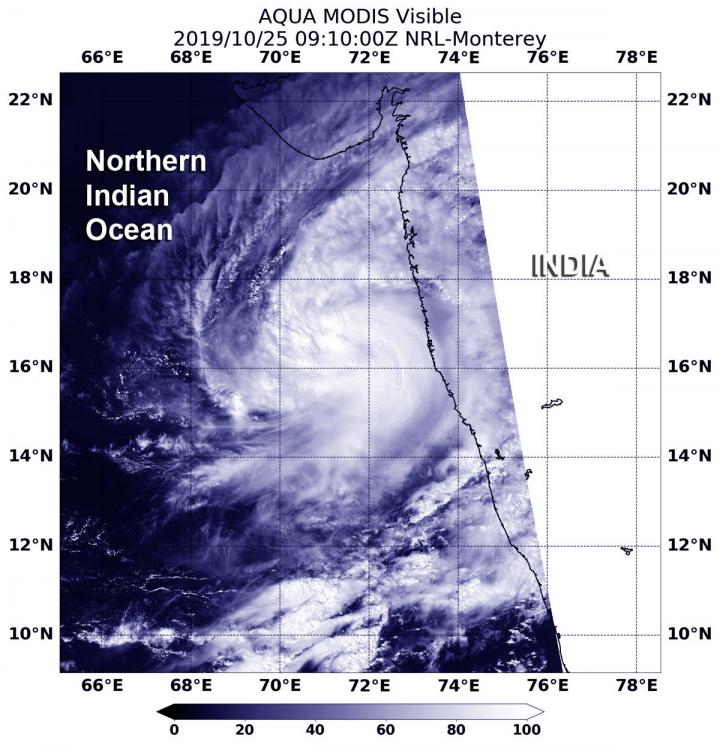
Tropical Storm Kyarr formed near the southwestern coast of India, and NASA’s Aqua satellite provided forecasters with a visible image of the storm that revealed it organized quickly.

Kyarr formed early on Oct. 25 from a low-pressure area designated as System 97A in the northern Indian Ocean. Once the storm consolidated, it intensified quickly and became a tropical storm just off the southwest India coast.

The India Meteorological Department issued some warnings on Kyarr on Oct. 25. There is a heavy rainfall warning in effect that calls for light to moderate rainfall in most places. Heavy to very heavy falls are predicted at isolated places very likely over coastal districts of Karnataka, Goa and south Konkan and isolated heavy rainfall over north Konkan during next 24 hours. There is also a wind warning in effect calling for gale-force winds with speeds reaching 70-80 kph (43 to 50 mph) gusting to 90 kph (56 mph), prevailing around the system center over east-central Arabian Sea. It is very likely to increase gradually becoming 90-100 kph (56 to 62 mph).

On Oct. 25 at 5:10 a.m. EDT (0910 UTC), the Moderate Imaging Spectroradiometer or MODIS instrument that flies aboard NASA’s Aqua satellite provided a visible image of Kyarr. The image showed that there is a large band of powerful thunderstorms circling Kyarr’s low-level center of circulation. In addition, infrared satellite imagery showed that Kyarr has a solid core of strong convection – that is, rising air which forms the thunderstorms that make up a tropical cyclone, wrap around the low-level circulation center. Microwave satellite imagery revealed the storm had developed an eye, a sign of strengthening.

The shape of the storm is a clue to forecasters that a storm is either strengthening or weakening. If a storm takes on a more rounded shape it is getting more organized and strengthening. Conversely, if it becomes less rounded or elongated, it is a sign the storm is weakening.

At 11 a.m. EDT (1500 UTC) on Oct. 25, the Joint Typhoon Warning Center or JTWC noted Tropical Cyclone Kyarr was located near latitude 16.3 degrees north and longitude 71.9 degrees east, about 579 nautical miles south-southeast of Karachi, Pakistan. Maximum sustained winds were 55 knots (63 mph/102 kph).

Kyarr is drifting generally northward while located between two subtropical ridges (elongated areas of high pressure) located to the northwest and northeast of the tropical storm. As those ridges strengthen and build, Kyarr is forecast to turn to the northwest and rapidly intensify.

The JTWC expects the storm will peak after three days, but will then start to weaken on approach to the Oman coastline.

###

Hurricanes are the most powerful weather event on Earth. NASA’s expertise in space and scientific exploration contributes to essential services provided to the American people by other federal agencies, such as hurricane weather forecasting.

By Rob Gutro

NASA’s Goddard Space Flight Center

Media Contact
Rob Gutro
[email protected]

Original Source

https://blogs.nasa.gov/hurricanes/2019/10/25/kyarr-northern-indian-ocean/

Tags: Atmospheric ChemistryAtmospheric ScienceClimate ChangeClimate ScienceEarth ScienceMeteorologyTechnology/Engineering/Computer ScienceTemperature-Dependent PhenomenaWeather/Storms
Share12Tweet8Share2ShareShareShare2

Related Posts

AI Reads Students' Faces to Measure Attention in Online Classes

AI Reads Students’ Faces to Measure Attention in Online Classes

October 5, 2026
Blood Clones That Masquerade as Cancer: New Framework Draws Hard Lines in Precision Oncology

Blood Clones That Masquerade as Cancer: New Framework Draws Hard Lines in Precision Oncology

October 5, 2026

A Hidden DNA Insertion Paints Quinoa Leaves in Red and Green

October 5, 2026

Biochar Research Booms as Scientists Map the Race to Rescue the World’s Dying Soils

October 5, 2026
Please login to join discussion

POPULAR NEWS

  • Alloys That Shrink Their Own Grains: New PIX Mechanism Refines Metals With Heat Alone

    Alloys That Shrink Their Own Grains: New PIX Mechanism Refines Metals With Heat Alone

    29 shares
    Share 12 Tweet 7
  • Endurance Exercise Reshapes the Liver in Males and Females Through Distinct Molecular Routes

    29 shares
    Share 12 Tweet 7
  • Single Transcription Factor PU.1 Rapidly Converts Fibroblasts into Macrophage-Lineage Cells

    29 shares
    Share 12 Tweet 7
  • New Scale Measures How Ready Nurse Educators Really Are for the AI Era

    29 shares
    Share 12 Tweet 7

About

We bring you the latest biotechnology news from best research centers and universities around the world. Check our website.

Follow us

Recent News

Alloys That Shrink Their Own Grains: New PIX Mechanism Refines Metals With Heat Alone

Endurance Exercise Reshapes the Liver in Males and Females Through Distinct Molecular Routes

Single Transcription Factor PU.1 Rapidly Converts Fibroblasts into Macrophage-Lineage Cells

Subscribe to Blog via Email

Success! An email was just sent to confirm your subscription. Please find the email now and click 'Confirm' to start subscribing.

Join 85 other subscribers
  • Contact Us

Bioengineer.org © Copyright 2023 All Rights Reserved.

Welcome Back!

Login to your account below

Forgotten Password?

Retrieve your password

Please enter your username or email address to reset your password.

Log In
No Result
View All Result
  • Homepages
    • Home Page 1
    • Home Page 2
  • News
  • National
  • Business
  • Health
  • Lifestyle
  • Science

Bioengineer.org © Copyright 2023 All Rights Reserved.