• HOME
  • NEWS
  • EXPLORE
    • CAREER
      • Companies
      • Jobs
    • EVENTS
    • iGEM
      • News
      • Team
    • PHOTOS
    • VIDEO
    • WIKI
  • BLOG
  • COMMUNITY
    • FACEBOOK
    • INSTAGRAM
    • TWITTER
Monday, September 28, 2026
BIOENGINEER.ORG
No Result
View All Result
  • Login
  • HOME
  • NEWS
  • EXPLORE
    • CAREER
      • Companies
      • Jobs
        • Lecturer
        • PhD Studentship
        • Postdoc
        • Research Assistant
    • EVENTS
    • iGEM
      • News
      • Team
    • PHOTOS
    • VIDEO
    • WIKI
  • BLOG
  • COMMUNITY
    • FACEBOOK
    • INSTAGRAM
    • TWITTER
  • HOME
  • NEWS
  • EXPLORE
    • CAREER
      • Companies
      • Jobs
        • Lecturer
        • PhD Studentship
        • Postdoc
        • Research Assistant
    • EVENTS
    • iGEM
      • News
      • Team
    • PHOTOS
    • VIDEO
    • WIKI
  • BLOG
  • COMMUNITY
    • FACEBOOK
    • INSTAGRAM
    • TWITTER
No Result
View All Result
Bioengineer.org
No Result
View All Result
Home NEWS Science News Biology

NASA-NOAA satellite’s night-time look at Tropical Storm Kiko

Bioengineer by Bioengineer
September 14, 2019
in Biology
Reading Time: 2 mins read
0
IMAGE
Share on FacebookShare on TwitterShare on LinkedinShare on RedditShare on Telegram

IMAGE

Credit: NASA/NOAA/NRL

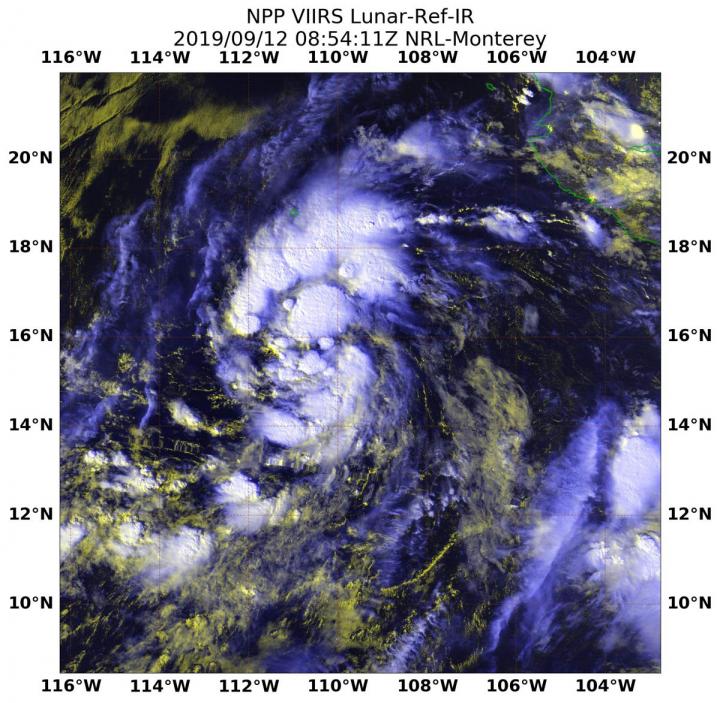
NASA-NOAA’s Suomi NPP satellite passed over the Eastern Pacific Ocean in the early hours of Sept. 12 and grabbed a nighttime look at Tropical Storm Kiko.

Kiko developed on Sept. 11 as Tropical Depression 13E and strengthened into a tropical storm by 5 p.m. EDT. Once it attained tropical storm status, it was named Kiko.

On Sept. 12 at 4:54 a.m. EDT (0854 UTC), the Visible Infrared Imaging Radiometer Suite (VIIRS) instrument aboard NASA-NOAA’s Suomi NPP provided an infrared image of the strengthening storm. At the time of the overpass the National Hurricane Center (NHC) noted, “There’s a small patch of convection (rising air that formed thunderstorms) near the estimated center, with another larger cluster much farther south. For the most part, however, the circulation consists of a broken low- and mid-level cloud deck with a few embedded showers.” The Suomi NPP image also showed a larger band of thunderstorms had developed north of center.

At 11 a.m. EDT (1500 UTC), the center of Tropical Storm Kiko was located near latitude 16.9 degrees north and longitude 114.4 degrees west. Kiko is far from land and about 505 miles (815 km) southwest of the southern tip of Baja California, Mexico. Kiko was moving toward the west-northwest near 10 mph (17 kph) and this motion is expected to continue through Monday. Maximum sustained winds are near 40 mph (65 km/h) with higher gusts. Estimated minimum central pressure is 1004 millibars.

Some strengthening is forecast during the next 48 hours, and Kiko is expected to approach hurricane strength later this weekend.

For updated forecasts, visit: http://www.nhc.noaa.gov

###

Media Contact
Rob Gutro
[email protected]

Original Source

https://blogs.nasa.gov/hurricanes/2019/09/13/kiko-eastern-pacific-ocean/

Tags: Atmospheric ChemistryAtmospheric ScienceClimate ChangeClimate ScienceEarth ScienceMeteorologyPollution/RemediationTechnology/Engineering/Computer ScienceTemperature-Dependent Phenomena
Share12Tweet8Share2ShareShareShare2

Related Posts

Engineered mini CRISPR enzyme gets a 60-fold power boost for gene editing

Engineered mini CRISPR enzyme gets a 60-fold power boost for gene editing

September 27, 2026
Vitamin D Receptor Gene Variants Tied to Diabetic Foot Ulcer Risk in Kerala Study

Vitamin D Receptor Gene Variants Tied to Diabetic Foot Ulcer Risk in Kerala Study

September 27, 2026

Approved Metabolism Drugs Rescue Disease Signs in SMA Mice

September 27, 2026

Infant Gut Microbes and Diet-Derived Metabolites Linked to Childhood Asthma Risk

September 27, 2026
Please login to join discussion

POPULAR NEWS

  • Trunk Control May Hold a Key to Balance and Fall Risk in Older Adults

    29 shares
    Share 12 Tweet 7
  • AI Tells Doctors When It Is Unsure About Cancer Treatment Success

    29 shares
    Share 12 Tweet 7
  • Engineered mini CRISPR enzyme gets a 60-fold power boost for gene editing

    29 shares
    Share 12 Tweet 7
  • When Autism Diagnoses Fade: Early Intervention and Milder Symptoms Mark Children Who Lose the Label

    29 shares
    Share 12 Tweet 7

About

We bring you the latest biotechnology news from best research centers and universities around the world. Check our website.

Follow us

Recent News

Trunk Control May Hold a Key to Balance and Fall Risk in Older Adults

AI Tells Doctors When It Is Unsure About Cancer Treatment Success

Engineered mini CRISPR enzyme gets a 60-fold power boost for gene editing

Subscribe to Blog via Email

Enter your email address to subscribe to this blog and receive notifications of new posts by email.

Join 85 other subscribers
  • Contact Us

Bioengineer.org © Copyright 2023 All Rights Reserved.

Welcome Back!

Login to your account below

Forgotten Password?

Retrieve your password

Please enter your username or email address to reset your password.

Log In
No Result
View All Result
  • Homepages
    • Home Page 1
    • Home Page 2
  • News
  • National
  • Business
  • Health
  • Lifestyle
  • Science

Bioengineer.org © Copyright 2023 All Rights Reserved.