• HOME
  • NEWS
  • EXPLORE
    • CAREER
      • Companies
      • Jobs
    • EVENTS
    • iGEM
      • News
      • Team
    • PHOTOS
    • VIDEO
    • WIKI
  • BLOG
  • COMMUNITY
    • FACEBOOK
    • INSTAGRAM
    • TWITTER
Wednesday, December 17, 2025
BIOENGINEER.ORG
No Result
View All Result
  • Login
  • HOME
  • NEWS
  • EXPLORE
    • CAREER
      • Companies
      • Jobs
        • Lecturer
        • PhD Studentship
        • Postdoc
        • Research Assistant
    • EVENTS
    • iGEM
      • News
      • Team
    • PHOTOS
    • VIDEO
    • WIKI
  • BLOG
  • COMMUNITY
    • FACEBOOK
    • INSTAGRAM
    • TWITTER
  • HOME
  • NEWS
  • EXPLORE
    • CAREER
      • Companies
      • Jobs
        • Lecturer
        • PhD Studentship
        • Postdoc
        • Research Assistant
    • EVENTS
    • iGEM
      • News
      • Team
    • PHOTOS
    • VIDEO
    • WIKI
  • BLOG
  • COMMUNITY
    • FACEBOOK
    • INSTAGRAM
    • TWITTER
No Result
View All Result
Bioengineer.org
No Result
View All Result
Home NEWS Science News Science

NASA-NOAA satellite tracking Barry through Louisiana, Arkansas

Bioengineer by Bioengineer
July 15, 2019
in Science
Reading Time: 2 mins read
0
IMAGE
Share on FacebookShare on TwitterShare on LinkedinShare on RedditShare on Telegram

IMAGE

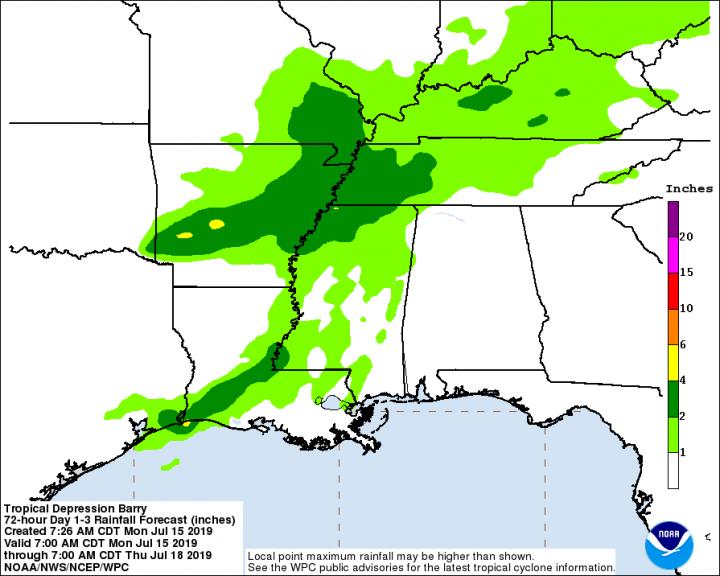
Credit: Credit: NWS/NOAA/NCEP/WPC

Barry, now a tropical depression, continues moving slowly north through Arkansas and rainfall and flooding remains a concern. NASA-NOAA’s Suomi NPP satellite passed over the south central United States yesterday, July 14 and captured a visible image of then Tropical Storm Barry.

Tropical Storm Barry tracked through northwestern Louisiana on July 14, and weakened to a tropical depression. On its track, Barry dropped up to 15 inches (38 cm) of rain in some isolated placed. Barry’s rainfall created flooding along the Mississippi River.

The Visible Infrared Imaging Radiometer Suite (VIIRS) instrument aboard Suomi NPP provided a visible image of the storm on July 14 after it moved inland over Louisiana. The VIIRS image showed an elongated storm over Louisiana stretching over the Mississippi River Valley and into Arkansas, Mississippi, western Alabama and southwestern Tennessee.

On July 15, NOAA’s National Weather Service Weather Prediction Center in College Park, Maryland said that local flash flooding remains a likely threat through the day. Flash Flood Watches and Warnings are in effect for portions of far southeast Texas through much of Louisiana, Mississippi and Arkansas, and including parts of the mid-Mississippi Valley. Barry is expected to produce additional rain accumulations of 2 to 4 inches with isolated maximum amounts of 8 inches across Arkansas, western Tennessee and Kentucky, southeast Missouri, and northwest Mississippi.

At 5 a.m. EDT (0900 UTC), the center of Tropical Depression Barry was located near latitude 34.4 degrees north and longitude 93.5 degrees west. That’s about 80 miles (125 km) west-southwest of Little Rock Arkansas. The depression is moving toward the north near 9 mph (15 kph) and this motion is expected to continue through today, before turning off to the northeast by Tuesday. Maximum sustained winds are near 25 mph (35 kph) with higher gusts. Little change in strength is forecast during the next 48 hours. The estimated minimum central pressure is 1008 millibars (29.77 inches).

In addition to the heavy rainfall, the National Weather Service noted, “A couple of tornadoes are possible today from the Mid-South toward the Lower Ohio Valley.”

For river flood forecasts, visit: https://water.weather.gov/ahps/

By Rob Gutro
NASA’s Goddard Space Flight Center

###

Media Contact
Rob Gutro
[email protected]

Original Source

https://blogs.nasa.gov/hurricanes/2019/07/15/barry-was-td2-atlantic-ocean-9/

Tags: Atmospheric ChemistryAtmospheric ScienceClimate ChangeClimate ScienceEarth ScienceMeteorologyTechnology/Engineering/Computer ScienceTemperature-Dependent PhenomenaWeather/Storms
Share12Tweet8Share2ShareShareShare2

Related Posts

Five or more hours of smartphone usage per day may increase obesity

July 25, 2019
IMAGE

NASA’s terra satellite finds tropical storm 07W’s strength on the side

July 25, 2019

NASA finds one burst of energy in weakening Depression Dalila

July 25, 2019

Researcher’s innovative flood mapping helps water and emergency management officials

July 25, 2019
Please login to join discussion

POPULAR NEWS

  • Nurses’ Views on Online Learning: Effects on Performance

    Nurses’ Views on Online Learning: Effects on Performance

    70 shares
    Share 28 Tweet 18
  • NSF funds machine-learning research at UNO and UNL to study energy requirements of walking in older adults

    70 shares
    Share 28 Tweet 18
  • MoCK2 Kinase Shapes Mitochondrial Dynamics in Rice Fungal Pathogen

    72 shares
    Share 29 Tweet 18
  • Unraveling Levofloxacin’s Impact on Brain Function

    52 shares
    Share 21 Tweet 13

About

We bring you the latest biotechnology news from best research centers and universities around the world. Check our website.

Follow us

Recent News

nSOFA Scores Forecast Extended Ventilation in Neonates

Unrecognized Lean MASLD in U.S. Adults Revealed

Muscle Metrics Link Malnutrition Risks in Older Patients

Subscribe to Blog via Email

Success! An email was just sent to confirm your subscription. Please find the email now and click 'Confirm' to start subscribing.

Join 70 other subscribers
  • Contact Us

Bioengineer.org © Copyright 2023 All Rights Reserved.

Welcome Back!

Login to your account below

Forgotten Password?

Retrieve your password

Please enter your username or email address to reset your password.

Log In
No Result
View All Result
  • Homepages
    • Home Page 1
    • Home Page 2
  • News
  • National
  • Business
  • Health
  • Lifestyle
  • Science

Bioengineer.org © Copyright 2023 All Rights Reserved.