• HOME
  • NEWS
  • EXPLORE
    • CAREER
      • Companies
      • Jobs
    • EVENTS
    • iGEM
      • News
      • Team
    • PHOTOS
    • VIDEO
    • WIKI
  • BLOG
  • COMMUNITY
    • FACEBOOK
    • INSTAGRAM
    • TWITTER
Thursday, June 18, 2026
BIOENGINEER.ORG
No Result
View All Result
  • Login
  • HOME
  • NEWS
  • EXPLORE
    • CAREER
      • Companies
      • Jobs
        • Lecturer
        • PhD Studentship
        • Postdoc
        • Research Assistant
    • EVENTS
    • iGEM
      • News
      • Team
    • PHOTOS
    • VIDEO
    • WIKI
  • BLOG
  • COMMUNITY
    • FACEBOOK
    • INSTAGRAM
    • TWITTER
  • HOME
  • NEWS
  • EXPLORE
    • CAREER
      • Companies
      • Jobs
        • Lecturer
        • PhD Studentship
        • Postdoc
        • Research Assistant
    • EVENTS
    • iGEM
      • News
      • Team
    • PHOTOS
    • VIDEO
    • WIKI
  • BLOG
  • COMMUNITY
    • FACEBOOK
    • INSTAGRAM
    • TWITTER
No Result
View All Result
Bioengineer.org
No Result
View All Result
Home NEWS Science News

NASA-NOAA satellite finds Jerry now a post-tropical storm

Bioengineer by Bioengineer
September 25, 2019
in Science News
Reading Time: 2 mins read
0
IMAGE
Share on FacebookShare on TwitterShare on LinkedinShare on RedditShare on Telegram

IMAGE

Credit: NASA/NOAA/NRL

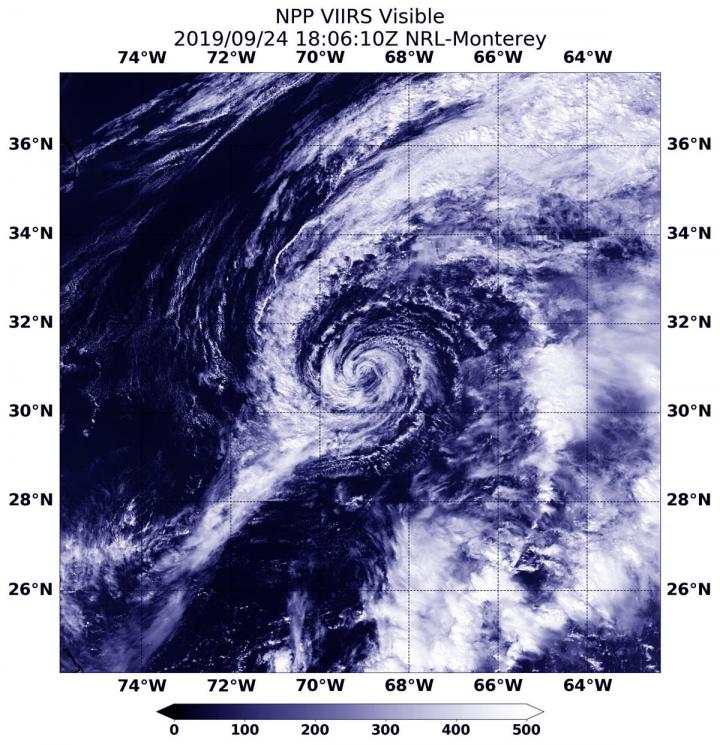
NASA-NOAA’s Suomi NPP satellite passed over Jerry and provided forecasters with a view of its structure that helped confirm it is now post-tropical.

On Sept. 25 at 12:48 p.m. EDT (1806 UTC), the Visible Infrared Imaging Radiometer Suite (VIIRS) instrument aboard Suomi NPP provided a visible image Jerry. The VIIRS image showed the storm as swirls of clouds with no organized deep convection/developing strong thunderstorms. NOAA’s National Hurricane Center or NHC said since around 11 a.m. EDT (1500 UTC) yesterday [Sept. 24], that lack of strong thunderstorms was seen in earlier satellite imagery, including from NASA’s Aqua and Terra satellites. As a result, Jerry was designated as a post-tropical cyclone.

A Post-Tropical Storm is a generic term for a former tropical cyclone that no longer possesses sufficient tropical characteristics to be considered a tropical cyclone. Former tropical cyclones that have become fully extratropical, subtropical, or remnant lows, are three classes of post-tropical cyclones. In any case, they no longer possesses sufficient tropical characteristics to be considered a tropical cyclone. However, post-tropical cyclones can continue carrying heavy rains and high winds.

A Tropical Storm Warning was in effect for Bermuda for Sept. 25. At 8 a.m. EDT (1200 UTC), the center of Post-Tropical Cyclone Jerry was located near latitude 32.0 degrees north and longitude 67.4 degrees west. The post-tropical cyclone is moving toward the northeast near 7 mph (11 kph). Maximum sustained winds are near 45 mph (75 km/h) with higher gusts.

On the forecast track, the center of Jerry is expected to pass near Bermuda later today. Jerry is expected to produce 1 inch or less of rainfall across Bermuda through tonight. Swells generated by Jerry will continue to affect Bermuda during the next few days. Gradual weakening is expected during the next few days.

###

Hurricanes are the most powerful weather event on Earth. NASA’s expertise in space and scientific exploration contributes to essential services provided to the American people by other federal agencies, such as hurricane weather forecasting.

For updated forecasts. visit: http://www.nhc.noaa.gov

Rob Gutro

NASA’s Goddard Space Flight Center, Greenbelt, Md.

Media Contact
Rob Gutro
[email protected]

Original Source

https://blogs.nasa.gov/hurricanes/2019/09/25/jerry-north-atlantic-ocean-6/

Tags: Atmospheric ChemistryAtmospheric ScienceClimate ChangeClimate ScienceEarth ScienceMeteorologyTechnology/Engineering/Computer ScienceTemperature-Dependent PhenomenaWeather/Storms
Share12Tweet8Share2ShareShareShare2

Related Posts

Confined Migration Causes DNA Damage in Neurons

June 18, 2026

Multimodal Multitask AI Transforms Lung Cancer Grading

June 18, 2026

New Study Seeks to Prolong Immune System Longevity

June 18, 2026

KAIST Creates Next-Generation Self-Powered Wearable Sensor withstanding 668% Stretch

June 18, 2026
Please login to join discussion

POPULAR NEWS

  • ESMO 2025: mRNA COVID Vaccines Enhance Efficacy of Cancer Immunotherapy

    326 shares
    Share 130 Tweet 82
  • Saying Goodbye to PGY-6: Pediatric Fellowship Realities

    102 shares
    Share 41 Tweet 26
  • Multi-Hospital Study Reveals Long Covid Burden Is Twice as High as Current Estimates

    92 shares
    Share 36 Tweet 23
  • Detection of EDCs in Breast Milk and Infant Urine Up to Six Months Highlights Early Exposure Risks

    76 shares
    Share 30 Tweet 19

About

We bring you the latest biotechnology news from best research centers and universities around the world. Check our website.

Follow us

Recent News

Confined Migration Causes DNA Damage in Neurons

Multimodal Multitask AI Transforms Lung Cancer Grading

New Study Seeks to Prolong Immune System Longevity

Subscribe to Blog via Email

Enter your email address to subscribe to this blog and receive notifications of new posts by email.

Join 82 other subscribers
  • Contact Us

Bioengineer.org © Copyright 2023 All Rights Reserved.

Welcome Back!

Login to your account below

Forgotten Password?

Retrieve your password

Please enter your username or email address to reset your password.

Log In
No Result
View All Result
  • Homepages
    • Home Page 1
    • Home Page 2
  • News
  • National
  • Business
  • Health
  • Lifestyle
  • Science

Bioengineer.org © Copyright 2023 All Rights Reserved.