Hurricane wind monitoring mission will continue through 2023
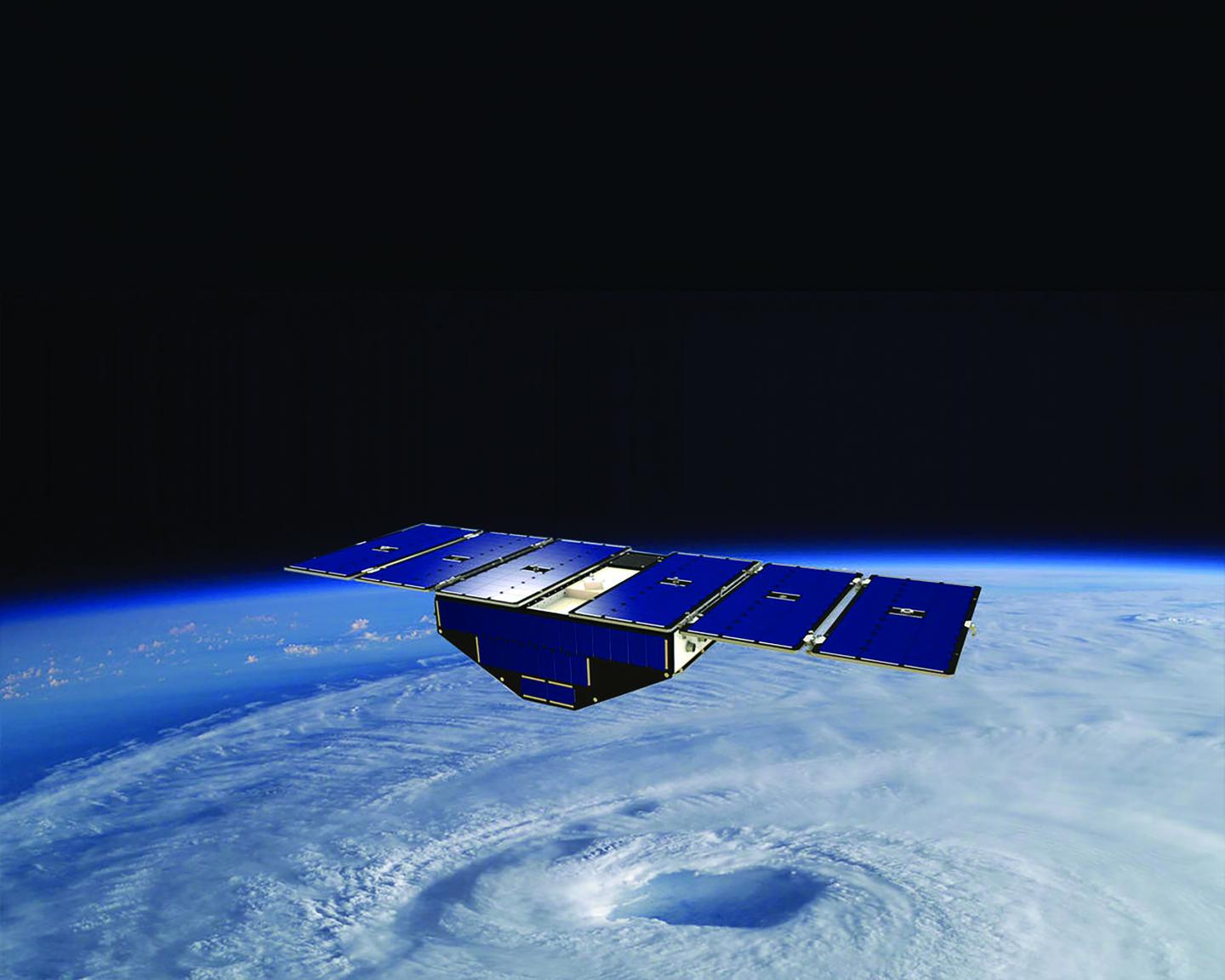
Credit: NASA
SAN ANTONIO — Nov. 9, 2020 — NASA has extended the Cyclone Global Navigation Satellite System (CYGNSS) mission through 2023 with plans to revisit extending the mission through 2026. The constellation of microsatellites designed, built and operated by Southwest Research Institute with the University of Michigan has made history over the last three-plus years, penetrating thick clouds and heavy rains to accurately assess wind speeds and better understand hurricane intensification.
The NASA senior review panel rated the mission extension proposal as excellent, based on the current health of the constellation of instruments, particularly considering the low-cost nature of the sensors. They also found that the operations team has been agile in dealing with unexpected GPS signal variability, using state-of-the-art engineering automation to handle instrument anomalies.
The microsatellites — each roughly the size of carry-on luggage — make frequent measurements of ocean surface winds to monitor the location, intensity, size and development of tropical cyclones. Flying in formation, the spacecraft cover an orbital swath that passes over most of the Earth’s hurricane-producing zone, up to 35 degrees north and south of the Equator.
“Launched in late 2016, the spacecraft have provided round-the-clock surface wind speed measurements to help improve intensity forecasting of tropical cyclones,” said SwRI’s William Wells, CYGNSS operations phase systems engineer. “We continue to develop new versions of algorithms that improve the data, in addition to exploring novel applications, such as soil moisture monitoring and ionospheric modeling.”
This science is critical because, over the last few decades, forecasters have improved hurricane path prediction significantly, but the ability to predict the intensity of storms has lagged. Collecting data during a storm is difficult and dangerous, but conventional space technology could not provide accurate measurements. GPS signals penetrate intense rainstorms, and the microsatellites use these signals, reflected off the ocean surface, to calculate wind speeds.
“Moving forward, we continue adapting the mission for new investigations related to tropical cyclones, oceanography and land science applications among many others,” said SwRI’s Jillian Redfern, CYGNSS project manager and mission operations manager. “For instance, CYGNSS has detected and mapped flood inundation under dense forest canopies and monitored flooding in and around Houston and Havana after landfalls by Hurricanes Maria and Irma, respectively.”
In addition, NASA recently selected SwRI to participate in a $6 billion indefinite delivery/indefinite quantity contract, listing an evolution of the CYGNSS platform in its Rapid Spacecraft Development Office (RSDO) IV catalog. Rapid IV contracts serve as a fast and flexible means for the government to acquire spacecraft and related components, equipment and services in support of NASA missions and other federal agencies. The spacecraft designs, related items and services may be tailored, as needed, to meet the unique needs of each mission.
“The CYGNSS project team is delighted to receive approval for a three-year mission extension and is very appreciative of NASA for its continuing support,” said Dr. Chris Ruf, the CYGNSS principal investigator from the University of Michigan. “The science investigations to date using ocean surface wind measurements to study tropical meteorology in general, and tropical cyclone processes and forecasting in particular, can continue to progress and improve our understanding of the physical processes involved and our ability to predict them. I’m sure I speak for all the members of the science and operations teams when I say we are very excited about what the next three years will bring.”
SwRI led the engineering development and manages the operation of the constellation. The University of Michigan Climate and Space Sciences and Engineering Department leads the science investigation, contributed to the engineering development, and manages science operations. The Earth Science Division of NASA’s Science Mission Directorate oversees the mission. SwRI’s office in Boulder, Colorado, hosts the mission operations center, which commands the spacecraft, collects the telemetry and transmits the data to the science operations center at the University of Michigan.
For more information, visit https:/
###
Media Contact
Maria Stothoff
[email protected]
Original Source
https:/