• HOME
  • NEWS
  • EXPLORE
    • CAREER
      • Companies
      • Jobs
    • EVENTS
    • iGEM
      • News
      • Team
    • PHOTOS
    • VIDEO
    • WIKI
  • BLOG
  • COMMUNITY
    • FACEBOOK
    • INSTAGRAM
    • TWITTER
Saturday, May 16, 2026
BIOENGINEER.ORG
No Result
View All Result
  • Login
  • HOME
  • NEWS
  • EXPLORE
    • CAREER
      • Companies
      • Jobs
        • Lecturer
        • PhD Studentship
        • Postdoc
        • Research Assistant
    • EVENTS
    • iGEM
      • News
      • Team
    • PHOTOS
    • VIDEO
    • WIKI
  • BLOG
  • COMMUNITY
    • FACEBOOK
    • INSTAGRAM
    • TWITTER
  • HOME
  • NEWS
  • EXPLORE
    • CAREER
      • Companies
      • Jobs
        • Lecturer
        • PhD Studentship
        • Postdoc
        • Research Assistant
    • EVENTS
    • iGEM
      • News
      • Team
    • PHOTOS
    • VIDEO
    • WIKI
  • BLOG
  • COMMUNITY
    • FACEBOOK
    • INSTAGRAM
    • TWITTER
No Result
View All Result
Bioengineer.org
No Result
View All Result
Home NEWS Science News

NASA analyzes ex-Tropical Cyclone Damien’s rainfall in Western Australia

Bioengineer by Bioengineer
February 10, 2020
in Science News
Reading Time: 2 mins read
0
IMAGE
Share on FacebookShare on TwitterShare on LinkedinShare on RedditShare on Telegram

IMAGE

Credit: Credit: NASA/JAXA/NRL


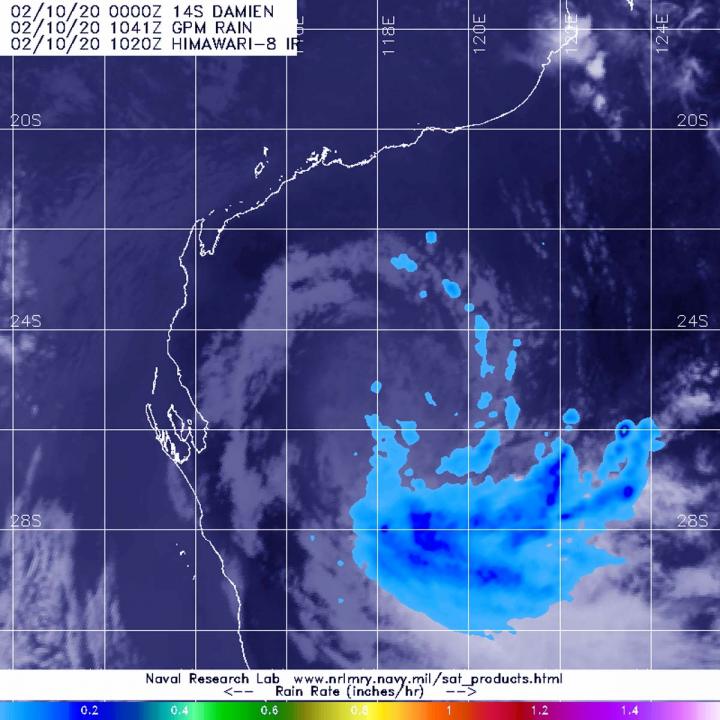
Tropical Cyclone Damien made landfall on Feb. 9 along the northern Pilbara coast of Western Australia. On Feb. 10, the GPM or Global Precipitation Measurement mission core satellite analyzed the rainfall generated by the remnants that triggered warnings.

As Damien was making landfall around 1:15 a.m. EST (0615 UTC) on Feb. 9, the MODIS instrument aboard NASA’s Aqua satellite captured a visible image of the storm. The MODIS image showed the recently developed eye on the coastline. By 11 a.m. EST, Damien’s center had moved inland into Western Australia. Tropical Cyclone Damien has weakened to a Category 2 system, according to the Australian Bureau of Meteorology (ABM).

On Feb. 10 at 5:41 a.m. EST (1041 UTC), GPM passed over Western Australia and measured the rate of rainfall from Damien’s remnants. GPM showed heaviest rainfall occurring south of the center and falling at a rate of at least 0.2 inches (5 mm) per hour.

The Australian Bureau of Meteorology posted an update at 3 a.m. EST (4 p.m. AWST), Feb. 10, and noted Ex-Tropical Cyclone Damien was located over the northeast Gascoyne, about 62 miles (100 kilometers) north northeast of Meekatharra, moving towards the south.

ABM said, “Ex-Tropical Cyclone Damien is expected to carry with it an area of heavy rainfall as it moves south southeast through the southeastern Gascoyne and the adjacent Goldfields.” That heavy rainfall that may lead to flash flooding.

ABM’s update noted, “Heavy rainfall is forecast over the southeastern Gascoyne and adjacent Goldfields, this area will gradually move south overnight Monday (Feb. 10). Strong and squally winds are also possible. Locations which may be affected include Mount Magnet, Cue, Leinster and Sandstone.”

Since 9 a.m. AWST Monday (8 p.m. EST on Sunday, Feb 9) the following rainfall amounts have been observed: Wiluna Airport 40 mm (1.57 inches) and at Meekatharra 29.8 (1.17 inches).

For updated warnings, visit: http://www.bom.gov.au/wa/warnings/

###

Media Contact
Rob Gutro
[email protected]

Original Source

https://blogs.nasa.gov/hurricanes/2020/02/10/damien-southern-indian-ocean-3/

Tags: Atmospheric ChemistryAtmospheric ScienceClimate ChangeClimate ScienceEarth ScienceMeteorologyTechnology/Engineering/Computer ScienceTemperature-Dependent PhenomenaWeather/Storms
Share12Tweet8Share2ShareShareShare2

Related Posts

Four New Hydroxyl Fatty Acids from Bacillus sp.

May 16, 2026

Validating B-IPQ Short Form for Older Colombians

May 16, 2026

Narrative Medicine Boosts Residency Training Outcomes

May 16, 2026

Perinatal and Early Childhood Factors in PFAPA Persistence

May 16, 2026
Please login to join discussion

POPULAR NEWS

  • Research Indicates Potential Connection Between Prenatal Medication Exposure and Elevated Autism Risk

    843 shares
    Share 337 Tweet 211
  • New Study Reveals Plants Can Detect the Sound of Rain

    730 shares
    Share 291 Tweet 182
  • Salmonella Haem Blocks Macrophages, Boosts Infection

    62 shares
    Share 25 Tweet 16
  • Breastmilk Balances E. coli and Beneficial Bacteria in Infant Gut Microbiomes

    58 shares
    Share 23 Tweet 15

About

BIOENGINEER.ORG

We bring you the latest biotechnology news from best research centers and universities around the world. Check our website.

Follow us

Recent News

Four New Hydroxyl Fatty Acids from Bacillus sp.

Validating B-IPQ Short Form for Older Colombians

Narrative Medicine Boosts Residency Training Outcomes

Subscribe to Blog via Email

Enter your email address to subscribe to this blog and receive notifications of new posts by email.

Join 82 other subscribers
  • Contact Us

Bioengineer.org © Copyright 2023 All Rights Reserved.

Welcome Back!

Login to your account below

Forgotten Password?

Retrieve your password

Please enter your username or email address to reset your password.

Log In
No Result
View All Result
  • Homepages
    • Home Page 1
    • Home Page 2
  • News
  • National
  • Business
  • Health
  • Lifestyle
  • Science

Bioengineer.org © Copyright 2023 All Rights Reserved.