A manganese-curcumin nanozyme coated with Prussian blue and embedded in a film-forming silk fibroin-polyvinyl butyral dressing reduced bacterial burden, inflammation and residual wound area in an infected diabetic wound model in mice. When the dressing was combined with 808-nanometre near-infrared irradiation, the mean relative wound area on day 14 was 8.90 ± 2.74%, compared with 38.60 ± 3.59% in untreated controls. The result comes from a preclinical study in 20 male Kunming mice, not from a clinical trial in people with diabetes, and its interpretation is limited by missing control groups and the ethanol content of the film-forming solution.
The investigators designed the material to address three features of chronic wounds: microbial infection, oxidative stress and prolonged inflammation. Their platform combines amorphous Mn²⁺-curcumin particles, which exhibit superoxide dismutase-like and catalase-like activity, with a Prussian blue coating that contributes photothermal conversion and changes the surface chemistry of the manganese centres. These nanocomposites, designated MC@PB-2, were suspended in a silk fibroin-polyvinyl butyral solution that forms a transparent film directly on a wound.
The resulting SPMP dressing was about 50 micrometres thick and could conform to irregular surfaces, while its water-vapour transmission rate remained close to 1.2 milligrams per square centimetre per hour over three days. Mn-Cur nanoparticles were assembled at room temperature through coordination between manganese acetate and curcumin in a dimethylformamide-ethanol mixture. Spherical particles measured 467.95 ± 68.89 nanometres after 12 hours of ageing.
Adding Prussian blue precursors produced a core-shell structure: at a precursor concentration of 1 millimolar, the composite particles reached 670.90 ± 135.72 nanometres and were covered by a dense crystalline shell. Elemental mapping and X-ray photoelectron spectroscopy indicated that manganese was not confined to the curcumin-rich core. Its surface proportion rose from 2.0% in Mn-Cur to 2.8% after coating, and a signal attributed to Mn(III) appeared near 643.0 electron volts, consistent with a surface environment that differed from that of the uncoordinated particles.
The study linked this change in manganese valence distribution to the altered catalytic behaviour of the coated nanozyme. The composites displayed a trade-off between antioxidant functions. MC@PB-2 had the strongest superoxide-scavenging activity, removing 82.62 ± 0.79% of superoxide at 50 micrograms per millilitre; uncoordinated Mn-Cur achieved 79.15 ± 1.22% only at 200 micrograms per millilitre.
All three materials decomposed hydrogen peroxide and produced oxygen, but their apparent catalase-like efficiency ranked Mn-Cur above MC@PB-1 and MC@PB-2. The Prussian blue coating also reduced direct hydroxyl-radical scavenging: at 200 micrograms per millilitre, the measured ratios were 43.81 ± 1.53% for Mn-Cur, 35.51 ± 1.46% for MC@PB-1 and 29.71 ± 1.65% for MC@PB-2. Conversely, the coating markedly improved the ability to quench the stable radicals ABTS and DPPH.
MC@PB-2 scavenged 42.77 ± 1.78% of ABTS and 72.23 ± 2.56% of DPPH at 200 micrograms per millilitre. The proposed antioxidant mechanism combined SOD-like dismutation of superoxide into hydrogen peroxide and oxygen with CAT-like decomposition of hydrogen peroxide, while accessible curcumin groups contributed to radical scavenging. Under 808-nanometre irradiation at 1.5 watts per square centimetre, a 100-microgram-per-millilitre dispersion of MC@PB-2 reached 50.2 °C in 10 minutes, compared with 40.6 °C for Mn-Cur and 41.8 °C for MC@PB-1.
Its photothermal conversion efficiency was 10.54%. Colony-counting experiments against Staphylococcus aureus and Escherichia coli showed that the shell weakened direct antibacterial activity without irradiation: at 200 micrograms per millilitre, survival was 80.49 ± 3.93% for S. aureus and 71.40 ± 2.31% for E. coli with MC@PB-2. Irradiation changed those values to 3.93 ± 1.35% and 0.08 ± 0.04%, respectively.
Live/dead staining showed more dead bacteria after irradiation, while scanning electron microscopy revealed depressed, wrinkled cell surfaces and increased absorbance at 260 nanometres in the supernatants. Together, these observations were consistent with photothermal disruption of bacterial membranes and leakage of intracellular contents. The coated nanozyme also showed reduced toxicity toward human umbilical vein endothelial cells.
Following 24 hours at 200 micrograms per millilitre, cell viability was 69.11 ± 1.73% for Mn-Cur, 86.69 ± 1.68% for MC@PB-1 and 99.14 ± 1.77% for MC@PB-2. No obvious haemolysis was detected at that concentration, and the nanozymes did not significantly affect cell proliferation over 72 hours below 50 micrograms per millilitre. In scratch assays, the migration ratio after 24 hours was 72.03 ± 0.49% in controls, 85.07 ± 2.54% after exposure to SP film extract and 86.46 ± 1.52% after SPMP extract.
In lipopolysaccharide-stimulated RAW 264.7 macrophages, the nanozymes lowered secretion of the pro-inflammatory cytokines IL-6 and TNF-α and reduced intracellular iNOS and reactive oxygen species signals. Transforming growth factor beta increased, whereas IL-10 and arginase-1 did not change significantly, indicating an immunoregulatory shift rather than a broadly elevated response across all measured markers. For the animal experiment, male mice aged 6 to 8 weeks received daily streptozotocin for one week.
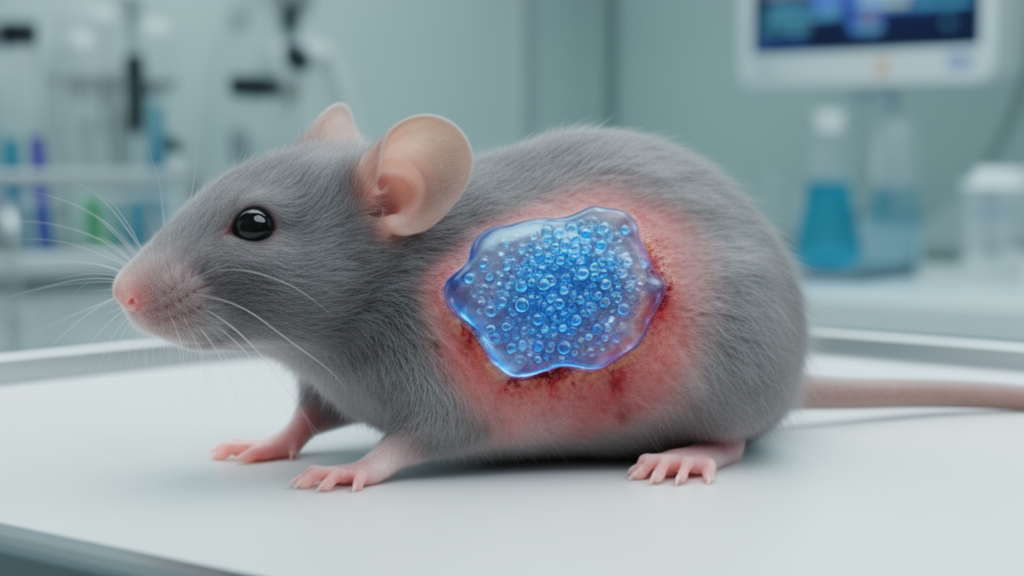
Those with blood glucose above 16.7 millimoles per litre were given a 10-millimetre circular full-thickness skin wound, which was inoculated with a bacterial suspension at 1 × 10⁹ colony-forming units per millilitre. After one day of infection, the mice were randomly assigned to five groups, with four animals per group: untreated control, MC@PB-2 plus near-infrared irradiation, SP film, SPMP film and SPMP plus irradiation. The treatment design did not include MC@PB-2 without irradiation or SP plus irradiation.
Those omissions prevented a full factorial separation of the nanozyme, film and heating effects. In addition, the SP and SPMP precursor solutions contained ethanol, which may have supplied an early antibacterial effect independent of the nanozyme. Despite those limitations, several outcomes favoured SPMP plus irradiation.
Bacterial concentrations recovered from wounds on day 5 were lower than in controls. The control group developed visible suppuration on day 7, whereas the study did not provide a quantitative comparison of suppuration across the treatment groups. By day 14, control wounds retained a relative area of 38.60 ± 3.59%, whereas SPMP plus irradiation reached 8.90 ± 2.74%.
The MC@PB-2 plus irradiation group closed more slowly during days 10 to 14, which the researchers attributed to dilution and clearance of nanozymes by wound exudate. No significant body-weight changes were detected among the groups during the 14-day period, offering no evidence of acute systemic toxicity in this small mouse study. The results therefore show improved wound closure in a specific preclinical model, rather than establishing safety or effectiveness in patients.
Tissue analysis on day 14 pointed to changes in inflammation, collagen deposition and vascularization. Relative to a control value of 100%, IL-6 fell to 72.91 ± 10.03% with MC@PB-2 plus irradiation and 56.68 ± 7.88% with SPMP plus irradiation; both changes were reported as significant at p < 0.01. TNF-α declined to 68.98 ± 9.57% and 49.35 ± 7.52%, respectively.
CD31 staining, used as a marker of endothelial cells, rose to 2.14 ± 0.28-fold the control value with MC@PB-2 plus irradiation and 2.81 ± 0.29-fold with SPMP plus irradiation, with both comparisons at p < 0.01. Masson staining showed the greatest collagen volume fraction in the SPMP plus irradiation group, while histology indicated more complete re-epithelialization than in controls. These findings support a combined mechanism involving photothermal bacterial killing, reactive-oxygen-species scavenging and reduced inflammatory signalling, but the animal design cannot determine which component was decisive.
The SPMP formulation offers a practical laboratory route for depositing nanozymes directly on an irregular wound, and its mechanical properties were largely unchanged by particle loading. The film had a tensile strength of 13.78 ± 1.06 megapascals, elongation at break of 19.98 ± 3.29% and Young’s modulus of 71.67 ± 18.79 megapascals, closely matching the nanoparticle-free SP film. It could be removed with ethanol and dissolved completely in anhydrous ethanol within 24 hours.
These laboratory and mouse findings establish a promising multifunctionality—catalytic antioxidant activity, photothermal disinfection, immunoregulation and conformal film formation—but also define the next experimental steps. The researchers say that ethanol-free formulations and additional in vivo groups are needed to separate nanozyme and irradiation effects.
Subject of Research: Preclinical testing of a photothermal antioxidant nanozyme dressing for infected diabetic wounds in mice
Article Title: In situ-forming manganese-curcumin nanozyme film promotes diabetic wound healing via photothermal antibacterial and anti-inflammatory actions
Article References: Wang, Y., Wang, L., Yang, W., Sun, B., Huang, X., Wang, X., Zhang, M., Wang, X., & Tu, J. (2026). In situ-forming manganese-curcumin nanozyme film promotes diabetic wound healing via photothermal antibacterial and anti-inflammatory actions. Materials Today Bio, 41, Article 103759. https://doi.org/10.1016/j.mtbio.2026.103759
Image Credits: AI Generated
DOI: 10.1016/j.mtbio.2026.103759
Keywords: diabetic wounds, nanozymes, manganese-curcumin, Prussian blue, photothermal therapy, oxidative stress, antibacterial dressing, inflammation, wound healing, in situ film, situ-forming, nanozyme
News Source: Denise Maddox. (October 22, 2026). Nanozyme film speeds infected diabetic wound healing in mice. Scienmag.