• HOME
  • NEWS
  • EXPLORE
    • CAREER
      • Companies
      • Jobs
    • EVENTS
    • iGEM
      • News
      • Team
    • PHOTOS
    • VIDEO
    • WIKI
  • BLOG
  • COMMUNITY
    • FACEBOOK
    • INSTAGRAM
    • TWITTER
Monday, May 25, 2026
BIOENGINEER.ORG
No Result
View All Result
  • Login
  • HOME
  • NEWS
  • EXPLORE
    • CAREER
      • Companies
      • Jobs
        • Lecturer
        • PhD Studentship
        • Postdoc
        • Research Assistant
    • EVENTS
    • iGEM
      • News
      • Team
    • PHOTOS
    • VIDEO
    • WIKI
  • BLOG
  • COMMUNITY
    • FACEBOOK
    • INSTAGRAM
    • TWITTER
  • HOME
  • NEWS
  • EXPLORE
    • CAREER
      • Companies
      • Jobs
        • Lecturer
        • PhD Studentship
        • Postdoc
        • Research Assistant
    • EVENTS
    • iGEM
      • News
      • Team
    • PHOTOS
    • VIDEO
    • WIKI
  • BLOG
  • COMMUNITY
    • FACEBOOK
    • INSTAGRAM
    • TWITTER
No Result
View All Result
Bioengineer.org
No Result
View All Result
Home NEWS Science News Chemistry

Nanomaterials based strategies for treatment of hypoxic tumor

Bioengineer by Bioengineer
August 31, 2020
in Chemistry
Reading Time: 2 mins read
0
IMAGE
Share on FacebookShare on TwitterShare on LinkedinShare on RedditShare on Telegram

IMAGE

Credit: ©Science China Press

Hypoxia is a typical characteristic of most tumors, owing to the fast consumption of oxygen by tumor tissue over the supply through malformed and abnormal tumor vasculature. Hypoxia in tumor tissue promotes the probability of tumor metastasis and endows hypoxia-tolerant tumor cells with resistance to some tumor therapies, including chemotherapy, radiotherapy, photodynamic therapy, and immunotherapy.

Nanomaterials have been rapidly developed, which opens up new areas in biomedical applications. Nanomaterials equipped with drugs are easier to accumulate in tumor tissues compared with small molecules. Also, nanomaterials are facile to be modified and armed with enhancive multi-functions, which is favorable for tumor therapy.

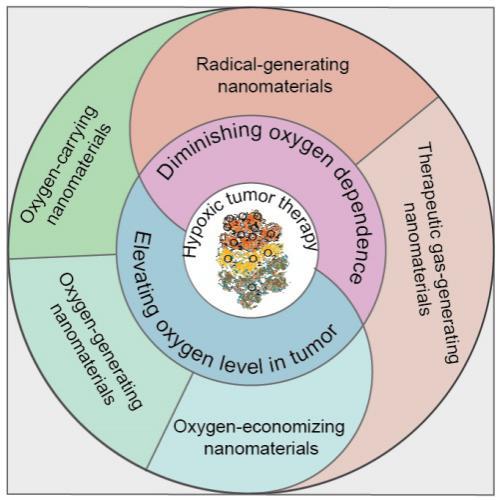
One strategy is to directly elevate the oxygen level in tumor tissues. Oxygen-carrying nanomaterials, oxygen-generating nanomaterials, and oxygen-economizing nanomaterials are utilized to relieve the hypoxic tumor environment. As the oxygen level elevates in tumor site, the resistance to tumor therapies of hypoxia-tolerant tumor cells is reduced and the tumor therapies are more effective.

Another strategy is to diminish oxygen dependence. It is readily comprehensible that therapies independent with oxygen are powerful weapons to treat hypoxic tumors. Free radicals are substances with strong oxidizing properties, which can induce cell death. Radical-generating nanomaterials can be used to treat tumor with oxygen dependence. Besides, some gaseous molecules play an essential role in physiological modulation, and therapeutic gas-generating nanomaterials can control the delivery of gas for hypoxic tumor therapy.

In a new overview published in the Beijing-based National Science Review, scientists at Wuhan University and South-Central University for Nationalities, China present the latest advances on nanomaterials for the treatment of hypoxic tumors. Xian-Zheng Zhang et al. summarized nanomaterials for treatment of hypoxic tumor with different strategies: 1) Elevating oxygen level in tumor by nanomaterials (oxygen-carrying nanomaterials, oxygen-generating nanomaterials, oxygen-economizing nanomaterials) for enhanced oxygen-dependent tumor therapy and 2) diminishing oxygen dependence of nanomaterials (therapeutic gas-generating nanomaterials and radical-generating nanomaterials) for hypoxic tumor therapy are reviewed.

They also outlined the potential development direction of future nanomaterials for treatment of hypoxic tumors. “Oxygen-carrying nanomaterials or oxygen-generating nanomaterials are hard to continually alleviate the hypoxia for tumor therapy,” Zhang said. “It is necessary to develop nanomaterials with controllable and sustained release of oxygen in tumor site, which may be favorable for synergistic therapy.”

###

This research received funding from the National Natural Science Foundation of China.

See the article:

Mei-Zhen Zou, Wen-Long Liu, Han-Shi Chen, Xue-Feng Bai, Fan Gao, Jing-Jie Ye, Han Cheng, Xian-Zheng Zhang

Advances on nanomaterials for treatment of hypoxic tumor

National Science Review, nwaa160

https://doi.org/10.1093/nsr/nwaa160

The National Science Review is the first comprehensive scholarly journal released in English in China that is aimed at linking the country’s rapidly advancing community of scientists with the global frontiers of science and technology. The journal also aims to shine a worldwide spotlight on scientific research advances across China.

Media Contact
Xian-Zheng Zhang
[email protected]

Related Journal Article

http://dx.doi.org/10.1093/nsr/nwaa160

Tags: Chemistry/Physics/Materials Sciences
Share12Tweet8Share2ShareShareShare2

Related Posts

Lanthanide Nanocrystals Unlock Room-Temperature Organic Phosphorescence — Chemistry

Lanthanide Nanocrystals Unlock Room-Temperature Organic Phosphorescence

May 25, 2026
Study Reveals How Valproate Affects Early Brain Development: Insights into the Antiepileptic Drug’s Impact — Chemistry

Study Reveals How Valproate Affects Early Brain Development: Insights into the Antiepileptic Drug’s Impact

May 22, 2026

Sustainable Chemistry: Iron Replaces Noble Metals in Catalytic Reactions

May 22, 2026

Advancing Thin-Film Device Manufacturing with Imaging Ellipsometry for Enhanced Process Control

May 22, 2026
Please login to join discussion

POPULAR NEWS

  • ESMO 2025: mRNA COVID Vaccines Enhance Efficacy of Cancer Immunotherapy

    315 shares
    Share 126 Tweet 79
  • New Study Reveals Plants Can Detect the Sound of Rain

    734 shares
    Share 293 Tweet 183
  • Research Indicates Potential Connection Between Prenatal Medication Exposure and Elevated Autism Risk

    847 shares
    Share 339 Tweet 212
  • Common Food Preservatives Associated with Elevated Blood Pressure and Increased Heart Disease Risk

    56 shares
    Share 22 Tweet 14

About

BIOENGINEER.ORG

We bring you the latest biotechnology news from best research centers and universities around the world. Check our website.

Follow us

Recent News

Ferroptosis and Macrophage Polarization: Key Mechanisms Revealed

Phenome-wide Study Links Second-Line Diabetes Drugs to Health Outcomes

Schizophrenia RNA Alters Mouse Brain and Behavior

Subscribe to Blog via Email

Enter your email address to subscribe to this blog and receive notifications of new posts by email.

Join 82 other subscribers
  • Contact Us

Bioengineer.org © Copyright 2023 All Rights Reserved.

Welcome Back!

Login to your account below

Forgotten Password?

Retrieve your password

Please enter your username or email address to reset your password.

Log In
No Result
View All Result
  • Homepages
    • Home Page 1
    • Home Page 2
  • News
  • National
  • Business
  • Health
  • Lifestyle
  • Science

Bioengineer.org © Copyright 2023 All Rights Reserved.