


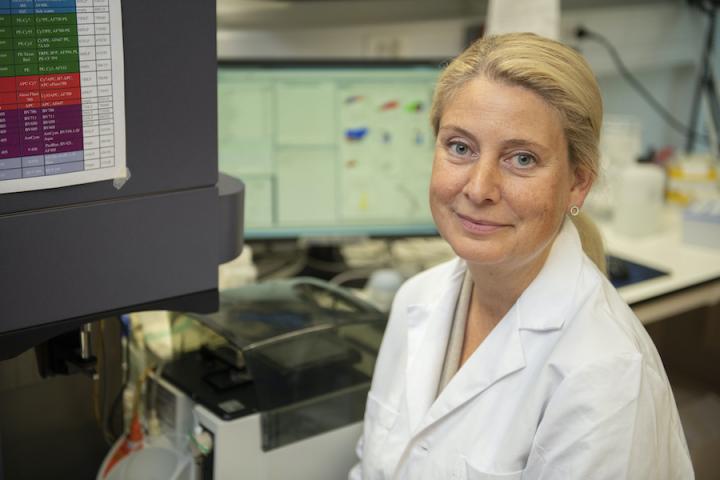
Credit: Ulf Sirborn
Individual variations in how the immune system responds to SARS-CoV-2 appear to impact the severity of disease. Researchers at Karolinska Institutet in Sweden have now been able to show that patients with severe COVID-19 have significantly elevated levels of a certain type of immune cells in their blood, called myeloid-derived suppressor cells. The study published in the Journal of Clinical Investigation may bring an increased understanding of how early immune responses impact disease severity.
Most individuals with COVID-19 develop mild to moderate symptoms and recover without needing hospital treatment. In severe cases, however, COVID-19 can lead to respiratory failure or even death. It is not yet known why the severity of disease varies so much between patients.
Researchers at Karolinska Institutet, Karolinska University Hospital, Stemirna Therapeutics in Shanghai, and Stanford University in the United States have now studied one type of immune cell, monocytic myeloid-derived suppressor cells, or M-MDSC, and their potential role in COVID-19.
T cells are part of the immune system and play an important part in the body’s protection against viral infections such as COVID-19. M-MDSCs have been shown to increase in other inflammatory conditions, and their suppressive effect on T cell activity has been established.
The role of M-MDSC in respiratory infections, however, is largely unknown. Since low levels of T cells are a hallmark of COVID-19, it is of interest to understand the role of M-MDSCs in this disease.
The study consisted of 147 patients with mild to fatal COVID-19 who were sampled repeatedly from blood and the respiratory tract. These were then compared with patients with influenza and healthy individuals.
The results show that patients with severe COVID-19 have significantly elevated levels of M-MDSCs in blood compared with milder cases and healthy individuals. COVID-19 patients had fewer T cells in blood than healthy subjects, and they showed signs of impaired function.
The analysis also showed that the levels of M-MDSCs early in the course of disease seemed to reflect subsequent disease severity.
“Our results help increase the understanding of what causes severe COVID-19 and is an important piece of the puzzle in understanding the connection between the early, innate immune system, which includes M-MDSC, and the later, adaptive immune system, which includes T cells. There is also a strong clinical connection, as you could potentially use the results to find new biomarkers for severe illness”, says Anna Smed Sorensen, associate professor at the Department of Medicine, Solna, Karolinska Institutet, and the study’s last author.
An inherent limitation of the study is the number of patients and amount of sample material that could be collected, why each sample was used as efficiently as possible.
“The next step in our research is to further study the connection between different parts of the immune system, such as M-MDSC, T cells, and antibodies”, says Anna Smed Sorensen.
###
The study was funded by the Swedish Research Council, the Swedish Heart-Lung Foundation, Bill & Melinda Gates Foundation, the Knut and Alice Wallenberg Foundation, and Karolinska Institutet. There are no reported conflicts of interest.
Publication: “Functional monocytic myeloid-derived suppressor cells increase in blood but not airways and predict COVID-19 severity”, Sara Falck-Jones, Sindhu Vangeti, Meng Yu, Ryan Falck-Jones, Alberto Cagigi, Isabella Badolati, Bjorn Osterberg, Maximilian Julius Lautenbach, Eric Ahlberg, Ang Lin, Rico Lepzien, Inga Szurgot, Klara Lenart, Fredrika Hellgren, Holden Maecker, Jorgen Salde, Jan Albert, Niclas Johansson, Max Bell, Karin Lore, Anna Farnert, and Anna Smed Sorensen. Journal of Clinical Investigation, online 25 January 2021, doi: 10.1172/JCI44734.
Media Contact
Press Office
[email protected]
Original Source
https:/
Related Journal Article
http://dx.



