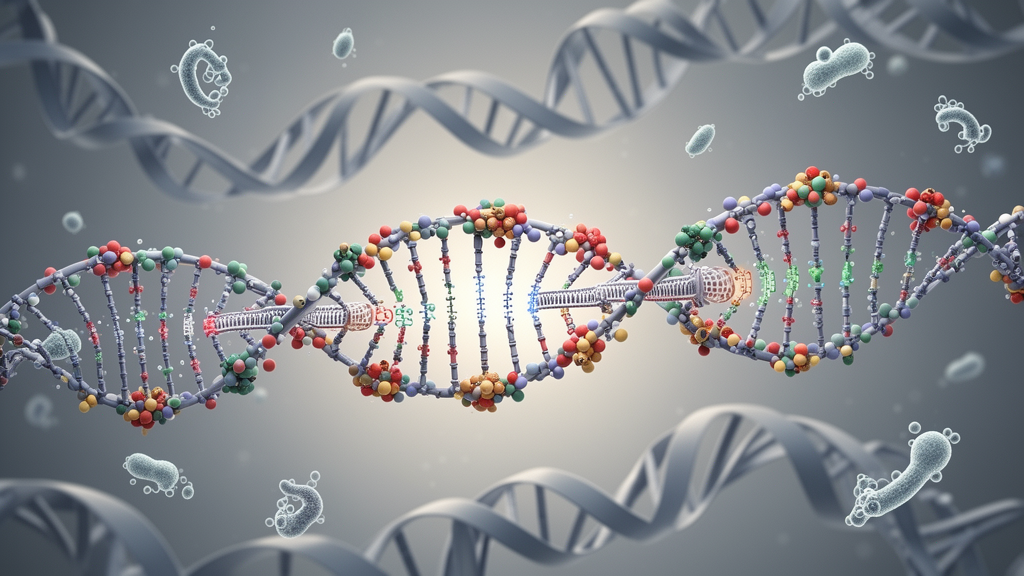
A single-nucleotide analysis of human genetic variation found a pronounced hypermutation peak at transcription start sites (TSSs) of protein-coding genes. The pattern appeared both in population polymorphisms and in de novo mutations identified from parent-offspring trios, linking the unusual mutation distribution to the human genome rather than to a single dataset. The researchers also detected similar hypermutation peaks at TSSs used to produce long noncoding RNAs and at intergenic RNA polymerase II pause sites.
The pattern was dependent on transcriptional activity in testes, a result consistent with a contribution from transcription-associated processes in the germline, although the study did not establish one exclusive molecular mechanism. Mutation patterns were not identical throughout genes. The analysis identified distinct mutational signatures at exon-intron boundaries and within introns, indicating that mutations differ across these genomic compartments.
These findings describe differences in the types and distribution of mutations observed in the analyzed sequences; they do not by themselves identify every process responsible for those differences. To examine the evolution of nucleotide composition, the team compared current sequence content with equilibrium levels predicted from mutation and fixation rates. Analyses of derived ancestral frequency spectra detected signals compatible with a low level of ongoing background GC-biased gene conversion across the region.
They also detected signals of stronger ancestral GC-biased gene conversion centered immediately downstream from TSSs. The signals are compatible with historical conversion activity, rather than direct observations of every conversion event. Forward-in-time simulations were then used to test explanations for the current nucleotide composition around TSSs.
Simulated sequences were best explained when local mutation biases were combined with both ongoing and ancestral patterns of gene conversion. Together, the results indicate that nucleotide composition surrounding human TSSs is largely shaped by non-adaptive forces, particularly mutation bias and GC-biased gene conversion. The analysis does not rule out a contribution from natural selection, but the simulations show that mutation and conversion biases can account for much of the observed pattern without requiring adaptive selection as the dominant explanation.
The study’s scope centers on the fine-scale sequence environment around transcription start sites in the human genome, with supporting comparisons involving long noncoding RNA genes and intergenic RNA polymerase II pause sites. Its conclusions rest on inherited variation, de novo mutations, population-genetic analyses and simulations, so the mechanisms underlying the observed mutation and conversion patterns remain subjects for further investigation.
Subject of Research: Evolutionary forces shaping nucleotide composition near human transcription start sites
Article Title: Non-adaptive evolutionary forces predominantly shape nucleotide composition near human transcription start sites
Article References: Qiu, Y., Hebraud, E., Pouyet, F., & Palazzo, A. F. (2026). Non-adaptive evolutionary forces predominantly shape nucleotide composition near human transcription start sites. PLOS Biology, 24(10), e3004063. https://doi.org/10.1371/journal.pbio.3004063
Image Credits: AI Generated
DOI: 10.1371/journal.pbio.3004063
Keywords: human genome, transcription start sites, mutation rates, GC-biased gene conversion, evolutionary genomics, nucleotide composition, germline mutations, population polymorphisms, forward-in-time simulations, non-adaptive evolution, Non-adaptive, evolutionary
News Source: Juliet Wilcox. (October 21, 2026). Mutation bias and gene conversion shape sequences near human transcription start sites. Scienmag.