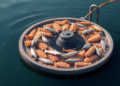
Mussels are notorious maritime stowaways known for damaging the hulls of boats, but these same adhesive properties have widespread engineering applications, scientists in China and the United states write in review published July 10 in the journal Matter. They suggest that the chemistry of mussel threads is inspiring engineering innovations that address a wide range of problems, from cleaning up oil spills to treating contaminated water.
Mussels withstand powerful currents and forceful waves by attaching themselves to rocks using clusters of thin, surprisingly hardy byssus threads. These threads owe their adhesive power to an amino acid group called dihydroxyphenylalanine (DOPA), which clings to the surface by performing a series of molecular gymnastics, including hydrogen bonds and hydrophobic and electrostatic interactions.
Scientists have found that DOPA can adhere to all sorts of solid substrates through these interactions–and so can dopamine, a molecule with a similar structure to DOPA. Research suggesting that dopamine can form a universal coating on a wide range of substrates spurred the growth of mussel-inspired chemistry as a powerful new tool for material surface engineering and environmental science.
“Mussels are broadly regarded as a nuisance in marine industries because they will colonize submerged surfaces,” says Hao-Cheng Yang a researcher at the School of Chemical Engineering and Technology at Sun Yat-sen University in China. “But from another point of view, the robust attachment of mussels on substrates under water has inspired a biomimetic strategy to realize strong adhesion between materials in water.”
A variety of mussel-inspired innovations are already underway. A group of researchers in China has developed a universal red blood cell, which can be accepted by individuals of every blood type, that works by using mussel-inspired coatings to shelter the cell from detection by the body’s immune system (and therefore preventing the destructive immune response that would result).
Other research has succeeded in developing superior materials for separating oil and water, which could help to mitigate environmental damage to marine environments after oil spills. Unlike some previously developed materials, researchers believe these mussel-driven innovations may be suitable for large-scale production. Mussels have also inspired advancement in water purification technology. Innovative materials capable of removing heavy metals, organic pollutants, and pathogens from wastewater are being developed from polymerized dopamine, which easily binds to these contaminants or to other materials with such capture properties.
However, although the binding properties of mussels have inspired a variety of recent research, challenges still must be overcome before they can be applied in the real world. Scientists are still working to fully understand the structure-property relationships of mussel-inspired chemicals such as polydopamine and to understand the complex web of interactions between amino acids that influence their adhesive properties.
“Despite simplicity and effectiveness, there are still some inherent limitations,” says Yang. “Alkaline conditions are usually needed to realize the polymerization of dopamine, so it cannot be applied to materials that are unstable under alkaline conditions. Moreover, the deposition of PDA is a time-consuming process–it takes tens of hours to form a uniform coating on most material surfaces.”
Some researchers hope to overcome these challenges by finding low-cost, stable, and safe substitutes to polydopamine, such as polyphenols.
###
This work was also supported by the National Key Research and Development Program of China. The National Natural Science Foundation of China, the Nature Science Foundation of the Jiangxi Province, and the State Key Laboratory of Chemical Resource Engineering. Work at Argonne National Laboratory was supported as part of the Advanced Materials for Energy-Water Systems Center, an Energy Frontier Research Center funded by the US Department of Energy, Office of Science, Basic Energy Sciences.
Matter, Wang and Yang et al.: “Mussel-Inspired Surface Engineering for Water-Remediation Materials” https://www.cell.com/matter/fulltext/S2590-2385(19)30027-X
Matter (@Matter_CP), published by Cell Press, is a new journal for multi-disciplinary, transformative materials sciences research. Papers explore scientific advancements across the spectrum of materials development–from fundamentals to application, from nano to macro. Visit: https:/
Media Contact
Joseph Caputo
[email protected]
http://dx.