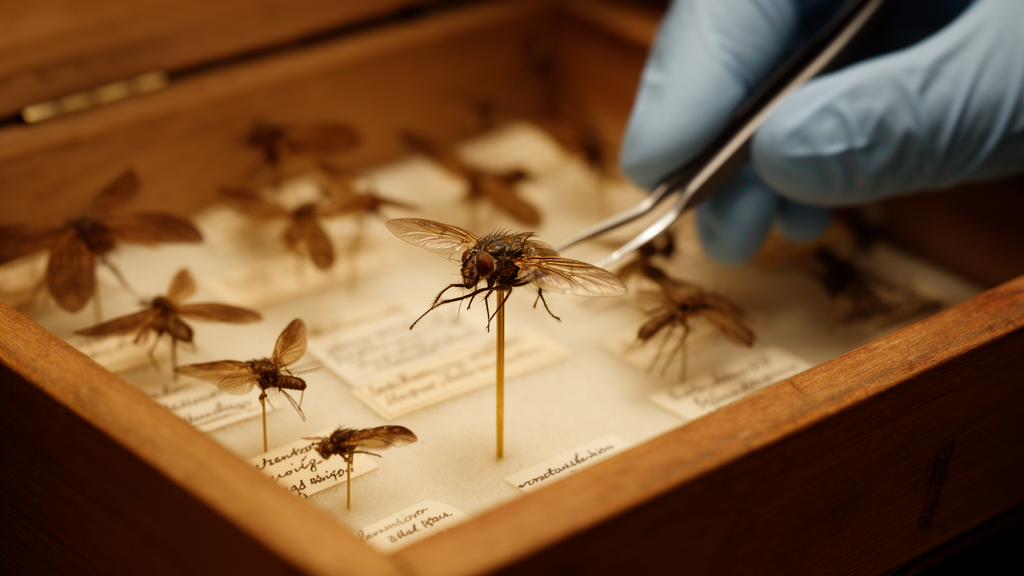
A museum-based morphological taxonomic study redescribed two species of the fly genus Anthomyia and revised the nomenclatural status of Anthomyia diversa Wiedemann, 1830. The researchers examined preserved type and additional specimens, designated lectotypes for the three focal species and documented male and female diagnostic characters with images of habitus and terminalia. Type material of A. lindigii Schiner, 1868, A. punctipennis Wiedemann, 1830 and A. diversa was housed at the Naturhistorisches Museum Wien in Austria.
Additional specimens came from collections in Brazil, Venezuela, Belgium, the United States and Ecuador. For terminalia analysis, abdomens were immersed in 10% cold potassium hydroxide for 24 hours to lighten and soften the structures, transferred to acetic acid for 15 seconds, and then stored in glycerin-filled microvials. Specimens were photographed with a Canon EOS R5 and MP-E 65 mm lens, while dissected terminalia were imaged with a Nikon SMZ25 stereomicroscope coupled to a Nikon DS-Ri2 camera.
Anthomyia lindigii was redescribed from male and female habitus, male terminalia and female terminalia. The species has a dark-brown ground colour, four white dorsal thoracic stripes, dark-brown legs and a light-brown wing bearing a dark cloudy area along the anterior margin from the wing insertion to the R2+3 apex. Examined males had body lengths of 5.3–6.6 mm and wing lengths of 5.2–6.0 mm; females had body lengths of 5.0–6.1 mm and wing lengths of 4.7–5.9 mm.
The male terminalia include triangular cerci, a slightly curved phallapodeme, a pregonite with two long setae and a postgonite with a long hook-shaped seta. In females, tergites 6–8 are reduced to paired lateral plates, and three round spermathecae were observed. The 11-specimen type series of A. lindigii includes 10 specimens labelled from Venezuela and one male labelled from Chile.
The authors reported that collector Lindig worked around Bogotá, Colombia, and considered the Venezuelan locality probably to have resulted from mislabeling. A further female was judged unlikely to have been part of the original syntype series because of its later labels. The species is recorded from Chile, Colombia, Ecuador, Peru and Venezuela.
Among the additional specimens examined in the study, localities ranged from 2,600 to 4,108 m in elevation, including sites in Colombia, Ecuador, Peru and Venezuela. Anthomyia punctipennis was redescribed from a female type specimen designated as the lectotype. The fly has a light-brown ground colour with gray pruinosity, dark-brown legs and three light-brown thoracic stripes.
Its wings bear dark-brown spots at the R1 apex, r-m and dm-m, together with an inconspicuous spot between Rs and the base of M1. The lectotype measures 3.8 mm in body length and 3.4 mm in wing length. The species is reported across the Neotropical, Nearctic, Afrotropical and Australian regions.
The A. punctipennis lectotype had previously been treated as lost after it could not be found in Vienna or the Zoological Museum of the University of Helsinki, leading a previous author to recommend designation of a neotype. The rediscovered female agrees with Wiedemann’s original description and Stein’s 1904 observations. The researchers proposed that the specimen may have been overlooked because its labels state Buenos Aires rather than Montevideo, or temporarily misplaced when the collection was rearranged.
The study did not resolve the taxonomic limits of A. punctipennis : its broad distribution and observed variation in wing-spot pattern, body and leg coloration, and the shape of the dm-m vein indicate that it may represent a complex of two or more species, for which further morphological and molecular studies are needed. Examination of the two male syntypes of A. diversa showed that they were not conspecific. The specimen selected as lectotype was morphologically consistent with Delia sanctijacobi Bigot, 1885, rather than Delia platura Meigen, 1826, under which the name had previously been treated.
The lectotype of A. diversa was found to agree with the economically important D. sanctijacobi , a name that had appeared as a valid name in at least 25 publications by more than 10 authors. To preserve prevailing usage and nomenclatural stability, the authors applied reversal of precedence under Article 23.9 of the International Code of Zoological Nomenclature. They treated Anthomyia diversa as a nomen oblitum and Delia sanctijacobi as a nomen protectum, formally synonymizing A. diversa with D. sanctijacobi .
South American records previously assigned to D. platura may require revision and could represent D. sanctijacobi or an undescribed species, but the present study did not conduct that broader reassessment.
Subject of Research: Morphological redescription and nomenclatural revision of three Neotropical Anthomyiidae type specimens
Article Title: Notes and redescriptions of Anthomyia lindigii Schiner, 1868 and Anthomyia punctipennis Wiedemann, 1830, including revised synonymy of Anthomyia diversa Wiedemann, 1830 ( Diptera , Anthomyiidae )
Article References: Gomes, L. R. P., de Carvalho, C. J. B., & Camargo, A. (2026). Notes and redescriptions of Anthomyia lindigii Schiner, 1868 and Anthomyia punctipennis Wiedemann, 1830, including revised synonymy of Anthomyia diversa Wiedemann, 1830 (Diptera, Anthomyiidae). Deutsche Entomologische Zeitschrift, 73(1), 181-191. https://doi.org/10.3897/dez.73.188415
Image Credits: AI Generated
Keywords: Anthomyia, Delia sanctijacobi, taxonomy, morphology, type specimens, lectotypes, synonymy, Diptera, Anthomyiidae, nomenclature, Notes, redescriptions
News Source: Drew Townsend. (October 20, 2026). Museum morphology study redescribes two Anthomyia flies and revises the synonymy of Anthomyia diversa. Scienmag.