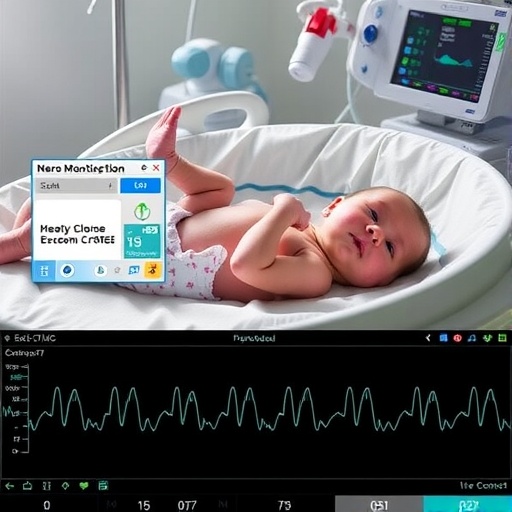

In the evolving landscape of neonatal critical care, extracorporeal membrane oxygenation (ECMO) has emerged as a pivotal life-support technology for infants facing severe cardiorespiratory failure. While ECMO’s life-saving potential is well-recognized, the vulnerable neurological status of these neonates commands equal attention, as the risk of brain injury remains a pressing concern. Recent advances in multimodal neuromonitoring (MNM) offer promising avenues not only to detect neurologic injury early but also to guide tailored interventions during ECMO support. A groundbreaking study led by Young et al. encapsulates these developments by meticulously characterizing the neonatal population on ECMO, elucidating the spectrum of neurologic insults, and detailing the state-of-the-art MNM strategies that are reshaping clinical management.
The neonatal cohort requiring ECMO is inherently complex. Typically, these patients suffer from critical conditions such as congenital diaphragmatic hernia, meconium aspiration syndrome, persistent pulmonary hypertension of the newborn, or cardiac anomalies requiring mechanical circulatory support. The sheer fragility of their developing brains renders them disproportionately susceptible to hypoxic-ischemic injuries, hemorrhagic events, and reperfusion-related damage, compounded by the physiological perturbations induced by ECMO itself. Understanding this delicate interplay mandates comprehensive neurophysiological surveillance, which traditional assessment techniques often fail to adequately capture.
Intracranial hemorrhage and ischemia remain the predominant categories of neurologic injury in neonatal ECMO populations, but the pathogenesis involves multilayered processes. ECMO circuitry, while providing oxygenation and circulatory support, can incite systemic inflammatory responses, endothelial dysfunction, and coagulopathies that potentiate cerebral insults. Moreover, fluctuations in cerebral blood flow during initiation, maintenance, and weaning of ECMO exacerbate vulnerability. These complex pathologies necessitate continuous, sensitive neuromonitoring approaches capable of real-time assessment with minimal invasiveness.
.adsslot_Pp0znrtT6s{width:728px !important;height:90px !important;}
@media(max-width:1199px){ .adsslot_Pp0znrtT6s{width:468px !important;height:60px !important;}
}
@media(max-width:767px){ .adsslot_Pp0znrtT6s{width:320px !important;height:50px !important;}
}
ADVERTISEMENT
Multimodal neuromonitoring integrates a suite of complementary techniques that collectively enhance detection fidelity and therapeutic responsiveness. Among these, near-infrared spectroscopy (NIRS) stands out for its ability to noninvasively monitor regional cerebral oxygen saturation, thereby providing dynamic insight into cerebral perfusion and oxygen delivery. NIRS’s real-time feedback is invaluable during ECMO, where cerebral autoregulation may be compromised, and oxygenation targets must be judiciously balanced against the risk of hyperoxia or hypoxia.
Electroencephalography (EEG) forms another cornerstone of MNM, enabling continuous cortical function surveillance. Neonatal EEG during ECMO can detect seizures, subclinical epileptiform discharges, and background pattern abnormalities that portend neurological compromise. Given the high incidence of seizures in this population, often silent and missed without EEG, this modality is indispensable. Integration of amplitude-integrated EEG (aEEG) with conventional EEG further amplifies monitoring sensitivity and facilitates bedside interpretation by neurocritical care teams.
Advanced cranial ultrasound provides a safe, bedside imaging modality enabling repetitive structural assessments. Critical for detecting intraventricular hemorrhage, periventricular leukomalacia, and evolving ischemic lesions, ultrasound complements functional monitoring techniques. Though limited by operator dependence and less sensitivity to subtle parenchymal injury, its portability and safety profile justify its routine use in the ECMO setting, bridging gaps in surveillance.
Magnetic resonance imaging (MRI), although less feasible during active ECMO due to equipment incompatibilities and patient instability, remains the gold standard for definitive neuroanatomic evaluation post-ECMO or during weaning phases. Innovations in portable MRI and motion correction algorithms may soon expand feasibility, allowing detailed characterization of cerebral injury patterns and providing prognostic information.
Jugular venous oximetry and transcranial Doppler ultrasound represent additional neurophysiological tools that yield valuable information about cerebral oxygen extraction and blood flow velocity, respectively. These modalities refine the understanding of cerebrovascular dynamics under ECMO, supporting individualized optimization of circuit parameters, ventilator settings, and pharmacologic interventions aiming to preserve neurologic integrity.
The integration of these diverse monitoring techniques generates a comprehensive neurological profile in real time. This multimodal approach enhances diagnostic precision, guides timely therapeutic adjustments, and informs prognostic deliberations. In clinical practice, MNM has led to modifications in ECMO flow rates, anticoagulation management, and ventilator settings based on early signs of neurologic compromise, exemplifying its transformative impact on patient-centered care.
Crucially, MNM also facilitates multidisciplinary coordination involving neonatologists, neurologists, intensivists, and ECMO specialists, converging expertise to interpret complex data streams. By fostering real-time dialogue, MNM supports rapid clinical decision-making, reduces diagnostic uncertainty, and ultimately mitigates the incidence and severity of long-term neurodevelopmental sequelae.
Challenges remain, however, in standardizing MNM protocols across institutions and ensuring data interoperability. Variability in monitoring device availability, clinician expertise, and interpretation frameworks can hinder widespread adoption. Efforts toward developing consensus guidelines, training programs, and integrated data platforms are indispensable to harness MNM’s full potential in neonatal ECMO care.
Emerging technologies like machine learning algorithms promise to revolutionize MNM analytics by detecting subtle, emergent patterns predictive of neurologic injury before clinical manifestation. Such predictive analytics could enable preemptive interventions, personalized therapeutic adjustments, and improved outcome stratification, ushering in a new era of precision neurocritical care.
Furthermore, ongoing research exploring the pathophysiological mechanisms of ECMO-associated neurologic injury continues to inform tailored neuromonitoring strategies. Insights into microvascular dysfunction, neuroinflammation, and blood-brain barrier integrity are delineating novel biomarkers and therapeutic targets that MNM modalities can track and modulate in real time.
In conclusion, the neonatal population demanding ECMO support represents a uniquely vulnerable group wherein neurologic injury poses significant morbidity and mortality risks. The integration of multimodal neuromonitoring provides an indispensable window into cerebral integrity during this critical intervention, enabling earlier detection, refined management, and enhanced neuroprotection. As technologies advance and collaborative care models evolve, MNM is poised to redefine the standard of neurocritical monitoring in neonatal ECMO, promising safer outcomes and a brighter neurodevelopmental future for these fragile patients.
Subject of Research: Neonatal patients requiring extracorporeal membrane oxygenation and the application of multimodal neuromonitoring for neurologic injury assessment.
Article Title: Multimodal neuromonitoring modalities of neonatal patients on extracorporeal membrane oxygenation.
Article References: Young, A., Vorster, L., Riviello, J. et al. Multimodal neuromonitoring modalities of neonatal patients on extracorporeal membrane oxygenation. J Perinatol (2025). https://doi.org/10.1038/s41372-025-02385-z
Image Credits: AI Generated
DOI: https://doi.org/10.1038/s41372-025-02385-z
Tags: advancing neonatal neuromonitoring practicesbrain injury detection in infantscomplex neonatal conditions requiring ECMOcritical care for neonatesextracorporeal membrane oxygenation riskshypoxic-ischemic injury in neonatesmultimodal neuromonitoring techniquesneonatal brain injuriesneonatal ECMO management strategiesneurological status monitoring in ECMOneurophysiological surveillance in critical caretailored interventions during ECMO support