• HOME
  • NEWS
  • EXPLORE
    • CAREER
      • Companies
      • Jobs
    • EVENTS
    • iGEM
      • News
      • Team
    • PHOTOS
    • VIDEO
    • WIKI
  • BLOG
  • COMMUNITY
    • FACEBOOK
    • INSTAGRAM
    • TWITTER
Thursday, June 25, 2026
BIOENGINEER.ORG
No Result
View All Result
  • Login
  • HOME
  • NEWS
  • EXPLORE
    • CAREER
      • Companies
      • Jobs
        • Lecturer
        • PhD Studentship
        • Postdoc
        • Research Assistant
    • EVENTS
    • iGEM
      • News
      • Team
    • PHOTOS
    • VIDEO
    • WIKI
  • BLOG
  • COMMUNITY
    • FACEBOOK
    • INSTAGRAM
    • TWITTER
  • HOME
  • NEWS
  • EXPLORE
    • CAREER
      • Companies
      • Jobs
        • Lecturer
        • PhD Studentship
        • Postdoc
        • Research Assistant
    • EVENTS
    • iGEM
      • News
      • Team
    • PHOTOS
    • VIDEO
    • WIKI
  • BLOG
  • COMMUNITY
    • FACEBOOK
    • INSTAGRAM
    • TWITTER
No Result
View All Result
Bioengineer.org
No Result
View All Result
Home NEWS Science News Health

Mount Sinai researchers develop COVID-19 mortality prediction model

Bioengineer by Bioengineer
September 22, 2020
in Health
Reading Time: 2 mins read
0
IMAGE
Share on FacebookShare on TwitterShare on LinkedinShare on RedditShare on Telegram

IMAGE

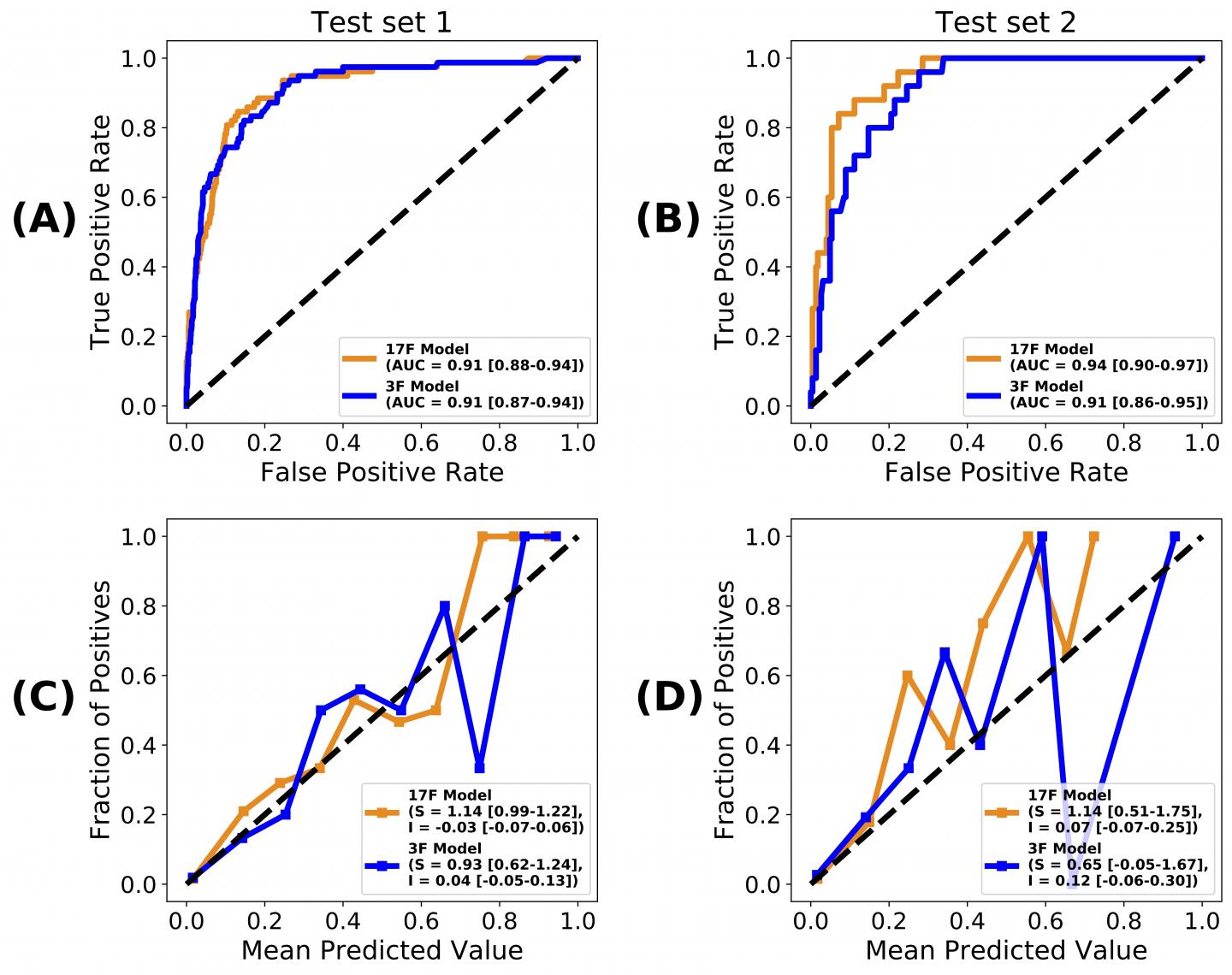
Credit: Department of Genetics and Genomic Sciences, Icahn School of Medicine at Mount Sinai

Bottom Line:

Given the toll that the COVID-19 pandemic has taken on people’s health and lives worldwide, it is crucial to be able to accurately predict patients’ outcomes, including their chances of mortality from the disease. Using the largest clinical dataset to date, and a systematical machine learning framework, the research team at Mount Sinai identified an accurate and parsimonious prediction model of COVID-19 mortality.

This model was based on only three routinely collected clinical features, namely patient’s age, minimum oxygen saturation over the course of their medical encounter, and type of patient encounter (inpatient vs outpatient and telehealth visits).

This model could yield an additional “vital sign” that is assessed regularly during a patient’s hospital course, that can be integrated into the clinical care flow of a COVID-19 patient. Clinical teams could use results from the prediction model throughout COVID-19 patients’ hospital courses to flag individuals at high risk of death so that they can promptly focus treatment and attention on such individuals to prevent their mortality.

Main Findings:

Using the largest development dataset yet (n=3841), and a systematic machine learning framework, we developed a COVID-19 mortality prediction model that showed high accuracy (AUC=0ยท91) when applied to test datasets of retrospective (n=961) and prospective (n=249) patients. This model was based on three clinical features: patient’s age, minimum oxygen saturation over the course of their medical encounter, and type of patient encounter (inpatient vs outpatient and telehealth visits).

Motivation of the research:

The COVID-19 pandemic has affected millions of individuals and caused hundreds of thousands of deaths worldwide;

“Predicting mortality among patients with COVID-19 who present with a spectrum of complications is very difficult, hindering the prognostication and management of the disease,” said Dr. Gaurav Pandey, Assistant Professor of Genetics and Genomic Sciences. “We aimed to develop an accurate prediction model of COVID-19 mortality using unbiased computational methods, and identify the clinical features most predictive of this outcome.”

###

Yadaw AS, Li Y-C, Bose S, Iyengar R, Bunyavanich S, Pandey G. Clinical features of COVID-19 mortality: development and validation of a clinical prediction model. Lancet Digital Health 2020; 2: e516-25, doi: 10.1016/S2589-7500(20)30217-X

Manuscript Title:

Clinical features of COVID-19 mortality: development and validation of a clinical prediction model

(https://www.thelancet.com/journals/landig/article/PIIS2589-7500(20)30217-X/fulltext)

Journal:

The Lancet Digital Health

Media Contact
Jennifer Gutierrez
[email protected]

Related Journal Article

http://dx.doi.org/10.1016/S2589-7500(20)30217-X

Tags: Algorithms/ModelsBioinformaticsMedicine/HealthPublic Health
Share12Tweet8Share2ShareShareShare2

Related Posts

Tracking Lanthanide-Labeled Microplastics in Plants

June 25, 2026

Neural Design Enables Zero-Shot Drug-Binding Proteins

June 25, 2026

Genomic Insights into Human Skin Fungi Diversity

June 25, 2026

Chiral Laser Gyroscopes Surpass Lock-In Limit

June 25, 2026
Please login to join discussion

POPULAR NEWS

  • Saying Goodbye to PGY-6: Pediatric Fellowship Realities

    103 shares
    Share 41 Tweet 26
  • Multi-Hospital Study Reveals Long Covid Burden Is Twice as High as Current Estimates

    92 shares
    Share 36 Tweet 23
  • Detection of EDCs in Breast Milk and Infant Urine Up to Six Months Highlights Early Exposure Risks

    77 shares
    Share 31 Tweet 19
  • New Drug Candidate Developed at McMaster Shows Potential for Treating Brain Cancer

    58 shares
    Share 23 Tweet 15

About

We bring you the latest biotechnology news from best research centers and universities around the world. Check our website.

Follow us

Recent News

Tracking Lanthanide-Labeled Microplastics in Plants

POSTECH Researchers Slash Cost of Reconstituted Cell-Free Systems by 95%

AI and Physics Collaborate to Design Advanced Hydrogen Storage Materials

Subscribe to Blog via Email

Enter your email address to subscribe to this blog and receive notifications of new posts by email.

Join 82 other subscribers
  • Contact Us

Bioengineer.org ยฉ Copyright 2023 All Rights Reserved.

Welcome Back!

Login to your account below

Forgotten Password?

Retrieve your password

Please enter your username or email address to reset your password.

Log In
No Result
View All Result
  • Homepages
    • Home Page 1
    • Home Page 2
  • News
  • National
  • Business
  • Health
  • Lifestyle
  • Science

Bioengineer.org ยฉ Copyright 2023 All Rights Reserved.