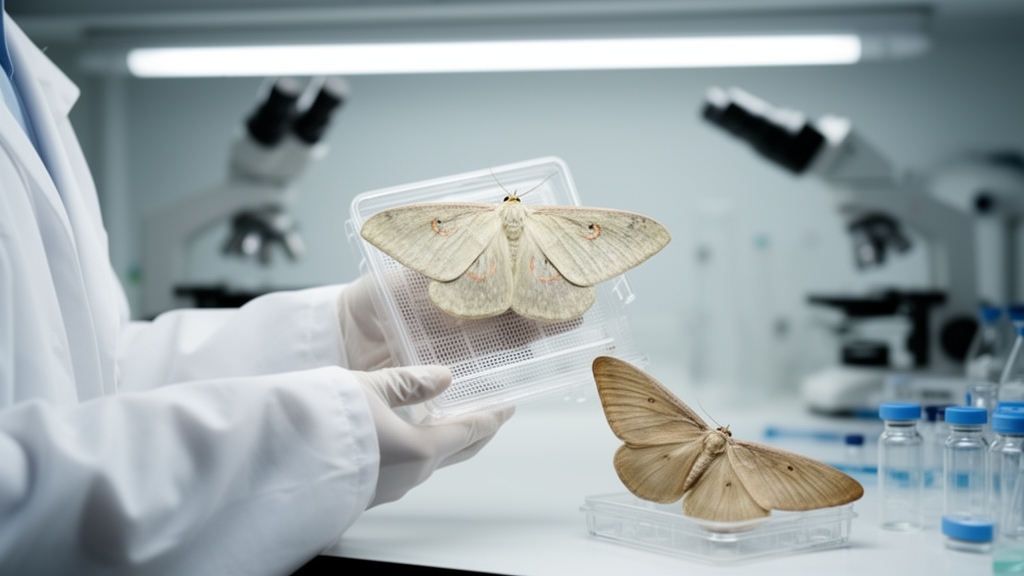
For the first time, scientists have experimentally changed the shape of a moth’s wings, a result that lends support to a long-standing idea about how butterflies sculpt their own wings. In a study published in the journal Evolution & Development, Andrei Sourakov, collection coordinator of Lepidoptera at the Florida Museum of Natural History and affiliate associate professor of entomology at the University of Florida, altered both the patterns and the shape of moth wings by applying two common sulfated polysaccharides, heparin and dextran sulfate, at precise moments during development. The seven-year effort involved hand-rearing more than 700 luna and polyphemus moths from egg to adulthood, and it produced changes so dramatic that camouflaged wing patterns shifted into conspicuous warning displays within a single generation of treatment.
The work matters because wing shape had never before been experimentally manipulated in Lepidoptera, the insect order that encompasses all moths and butterflies. Researchers had previously altered wing color patterns in butterflies, but the three-dimensional silhouette of the wing, including structures such as the luna moth’s elegant hindwing tails, had remained beyond the reach of experimental intervention. By showing that a simple chemical cue, delivered at the right developmental window, can widen a moth’s tail and reshape its eyespots, the study suggests that some of the same factors involved in early wing development and wing pattern formation can also be involved in shaping the wings themselves.
Sourakov focused on two giant silk moth species: the luna moth, Actias luna, famed for its long hindwing tails and barely noticeable eyespots, and the polyphemus moth, Antheraea polyphemus, whose large eyespots are among the most striking in the insect world. He administered tiny quantities of heparin shortly before and after pupation, the stage in which insect larvae undergo their final metamorphosis into adults and the stage at which their wing patterns are determined.
The path to a result was far from straightforward. After two years of trial and error with adjusted concentrations and timing, nothing happened. Then came a single transformation, and it was not of wing pattern at all. One luna moth emerged with wing tails that had grown wider than in any of the hundreds of moths reared up to that point. “I kept trying, and eventually, I achieved a single transformation. But it wasn’t of the wing pattern. It was the wing shape. This single specimen was so different that I couldn’t ignore it,” Sourakov said. At first he suspected that genes normally responsible for wing patterns might, in this case, have been acting on wing shape, because that seemed to be the only thing that had changed.
That hypothesis did not survive long. By adjusting the timing of when heparin was administered, Sourakov eventually produced the anticipated eyespot alterations in combination with wing shape changes, showing that the same treatment could reach both pattern-forming and shape-forming processes depending on when it was delivered. In polyphemus moths, the yellow borders of the two upper lemon-shaped eyespots thickened, the surrounding brown scales that matched the rest of the wing became whiter, and the black border surrounding the hindwing eyespots expanded, all changes that made the eyespots more conspicuous. In luna moths, the circular eyespots on the posterior wings became squinted and developed a thick border of mascara-like pigment, similarly making them more noticeable.
The speed and simplicity of these transformations surprised even the researcher. Some giant silk moths carry eyespots that make them appear threatening to would-be predators, while others resemble leaves, with translucent eyespots that mimic holes in the foliage. “What’s amazing to me, and what I learned from this study, is how easy it is for these features to go from one state to another. They do this without big inventions by simply expanding or contracting existing elements to the point where eyespots look completely different. All they need is a slight increase in the amount of certain compounds at the right moment,” Sourakov said. In other words, the boundary between a camouflaged moth and a conspicuous one may rest on a small quantitative shift in signaling activity at a specific developmental moment, rather than on the evolution of entirely new structures.
That plasticity has evolutionary implications. The ability to change appearance within a short time span allows moths to adapt rapidly to new environments. Luna moths normally stay hidden from visually oriented predators by having the general appearance of a leaf. If that cryptic disguise suddenly stopped working, mutations combined with hunting pressure from birds could, in principle, quickly increase the visibility of their eyespots within just a few generations, by exploiting the moths’ existing capacity to expand or contract the pattern elements that form their eyespots. “If you are a smaller bird or a squirrel, you will think twice before attacking something in the darkness of the forest that looks like the eyes of an owl. Butterflies and moths are masters of such deceptions,” Sourakov said.
The study also grew out of a deeper question about the evolutionary origins of eyespots. Moth and butterfly eyespots are located in different parts of the wing, which indicates that they evolved independently of each other. Sourakov initially wanted to know whether the two groups used the same genes to create eyespots or had independently converged on the same design. In the largest family of butterflies, the nymphalids, eyespots sit along the wing margin, and adding heparin during early development can delete them entirely. But in a previous study, when Sourakov administered heparin to two species of giant silk moth, their eyespots grew bigger. To him, these reversed effects were a clear indication that the eyespots of these moths evolved independently of those in butterflies, though he noted that further experimental work would be needed to confirm homology definitively.
The wing shape results connect to what Sourakov calls the cookie-cutter form of growth, a feature unique to Lepidoptera. Unlike the wings of other flying insects, which simply stop growing when they reach a certain size, Lepidoptera wings terminate their growth through a series of programmed cell deaths along what will ultimately become the wing margins, giving the order its extraordinary diversity of wing shapes. The signal for these marginal cells to self-destruct is mediated by a protein called Cut, which does not respond to heparin or dextran sulfate. Earlier in development, however, before the marginal cells die, another signaling protein called Wingless, which does respond to the two compounds, controls the size of individual wing elements, defined as the space between veins. The wingless gene is mostly inactive by the time eyespots begin to form, which is when Sourakov begins to tamper with wing development, which is why changes to element size are seldom observed in eyespot-focused experiments.
Wingless has another important function: repairing damaged cells after a wing sustains an injury, meaning it can be switched on and off when needed. Sometimes that need is to grow new cells in wounded areas of the wing; sometimes, as in the pipevine swallowtail, it is to develop the species’ tiny wing tails. A landmark 2010 study demonstrated that both Cut and Wingless are active in tail formation in pipevine swallowtails. Sourakov suspects the same may be true of luna moths. If that is correct, it would mean the wingless gene was independently co-opted by natural selection for the evolution of wing tails in moths and butterflies, an example of parallel evolutionary tinkering with the same molecular tool. Compared with the small swallowtail tails, which function as a visual distraction for birds by adding to a false-head effect, luna moth tails are much longer, and their shape affects how these insects fly. Why wing shape changed in moths but has not been observed in butterflies remains unclear, and Sourakov offers a deduction rather than a demonstrated mechanism: “I think it is very plausible and would explain why in butterflies or other moths we don’t see much change to the wing shape in response to heparin, wingless is not turning on at that stage of wing development in most species.” The study, published online under the DOI 10.1111/ede.70058, was released on 21 August 2026.
Subject of Research: Experimental alteration of wing shape and eyespot patterns in giant silk moths using sulfated polysaccharides
Article Title: Experimental study on moths supports the molecular cookie cutter idea proposed for butterflies
Article References: Experimental study on moths supports the molecular cookie cutter idea proposed for butterflies. Original publication (Bibliographic details unavailable.)
Image Credits: AI Generated
DOI: Not provided
Keywords: Lepidoptera, moths, wing development, eyespots, luna moth, polyphemus moth, heparin, Wnt signaling, wingless gene, evolutionary development, Evolution & Development, Florida Museum of Natural History
News Source: Gavin Prescott. (October 28, 2026). Moth Wing Shape Altered in Lab First, Backing Butterfly Cookie-Cutter Idea. Scienmag.