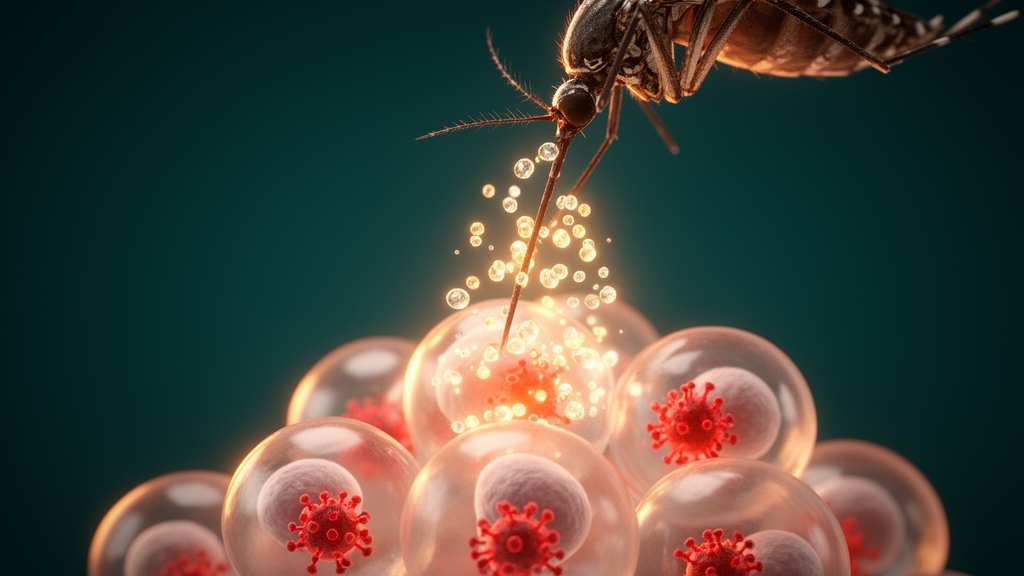
A laboratory study has pinpointed the precise region of an Aedes albopictus salivary protein that binds dengue virus serotype 2 (DENV-2) and enhances its replication in immune cells. The protein, known as 34k2, was already known to promote DENV-2 infection, but the functional domain responsible had remained undefined. The new work, published in Parasites & Vectors, identifies the C-terminal portion of the protein as the viral-binding site and shows that this fragment alone is sufficient to potentiate viral replication and alter inflammatory signaling.
The researchers used AlphaFold3 structural prediction and ZDOCK molecular docking to localize the interaction interfaces between 34k2 and DENV-2 virions. From these predictions they constructed two truncated variants: an N-terminal fragment designated rAlb-34k2-I and a C-terminal fragment designated rAlb-34k2-II, corresponding to residues 148 to 322 of the full protein. Surface plasmon resonance measured how tightly each fragment bound to DENV-2 particles.
The binding results were decisive. The C-terminal fragment rAlb-34k2-II bound DENV-2 virions with high affinity, with a reported dissociation constant of 2.88 nanomolar, while the N-terminal fragment rAlb-34k2-I showed no measurable binding. This asymmetry indicates that the viral-binding capability of 34k2 resides specifically within its C-terminal region rather than being distributed across the protein.
Functional assays followed in two human and mouse immune cell lines: RAW264.7 macrophages and THP-1 monocytes. When cells were pre-incubated with rAlb-34k2-II before viral exposure, the fragment significantly enhanced DENV-2 replication and the production of infectious plaque-forming virus, as assessed by immunofluorescence, plaque assays and quantitative RT-PCR. These are in vitro cell culture findings, so they demonstrate a mechanism in isolated cells rather than an effect measured directly in human infection.
Beyond facilitating replication, the salivary fragment reshaped the inflammatory response of the immune cells. Both rAlb-34k2-II and the full-length rAlb-34k2 protein significantly upregulated the transcription of the pro-inflammatory cytokines IL-6 and IL-1β and the chemokines CCL2 and CXCL2 in vitro, measured by qPCR and ELISA. The response followed a distinctive kinetic pattern: a transient early spike in inflammatory cytokines was followed by sustained expression of chemokines.
To extend the findings beyond cell culture, the team used a murine footpad injection model. Injection of the full-length 34k2 protein into the footpad induced a pro-inflammatory profile in the local tissue that was consistent with the in vitro results, supporting the idea that the protein’s immunomodulatory activity operates in living tissue and not only in cultured cells.
The authors conclude that the C-terminal fragment of Ae. albopictus 34k2 constitutes a high-affinity viral-binding domain that potentiates DENV-2 replication and modulates host inflammation. They propose that targeting this specific salivary–viral interface could support the development of competitive decoy peptides or next-generation salivary-based vaccines aimed at interrupting arboviral transmission. Such applications remain proposals at this stage; the study did not test decoy peptides or vaccines, and the reported effects come from structural predictions, cell culture experiments and a local murine injection model rather than from efficacy trials.
The work is presented as an early-access, peer-reviewed accepted article, citable with a permanent DOI and subject to further edits before the final version of record. Its mechanistic contribution is to narrow a broad observation—that mosquito saliva can facilitate arboviral infection—down to a defined 175-residue domain, and to link that binding activity to a measurable shift in cytokine and chemokine expression. If subsequent research confirms the interface in vivo and develops inhibitors against it, the finding could inform strategies against dengue, a disease transmitted by Aedes mosquitoes whose saliva proteins are increasingly studied as modulators of viral infection and host immunity.
Subject of Research: Identification of the C-terminal viral-binding domain of the Aedes albopictus salivary protein 34k2 and its effects on DENV-2 replication and host inflammation.
Article Title: A C-terminal fragment of Aedes albopictus salivary protein 34k2 facilitates DENV-2 replication and modulates host inflammation
Article References: Mu, A., Huang, Z., Zhou, L., Jin, R., Li, Y., Qin, F., Wu, J.-H., & Shang, Z.-L. (2026). A C-terminal fragment of Aedes albopictus salivary protein 34k2 facilitates DENV-2 replication and modulates host inflammation. Parasites & Vectors. https://doi.org/10.1186/s13071-026-07670-0
Image Credits: AI Generated
DOI: 10.1186/s13071-026-07670-0
Keywords: Aedes albopictus, dengue virus DENV-2, salivary protein 34k2, viral replication, surface plasmon resonance, molecular docking, cytokines, chemokines, immune modulation, arbovirus transmission, macrophages, murine model
News Source: Kristina Jarvis. (October 28, 2026). Mosquito Saliva Protein Fragment Boosts Dengue Virus Replication in Immune Cells. Scienmag.