• HOME
  • NEWS
  • EXPLORE
    • CAREER
      • Companies
      • Jobs
    • EVENTS
    • iGEM
      • News
      • Team
    • PHOTOS
    • VIDEO
    • WIKI
  • BLOG
  • COMMUNITY
    • FACEBOOK
    • INSTAGRAM
    • TWITTER
Monday, October 5, 2026
BIOENGINEER.ORG
No Result
View All Result
  • Login
  • HOME
  • NEWS
  • EXPLORE
    • CAREER
      • Companies
      • Jobs
        • Lecturer
        • PhD Studentship
        • Postdoc
        • Research Assistant
    • EVENTS
    • iGEM
      • News
      • Team
    • PHOTOS
    • VIDEO
    • WIKI
  • BLOG
  • COMMUNITY
    • FACEBOOK
    • INSTAGRAM
    • TWITTER
  • HOME
  • NEWS
  • EXPLORE
    • CAREER
      • Companies
      • Jobs
        • Lecturer
        • PhD Studentship
        • Postdoc
        • Research Assistant
    • EVENTS
    • iGEM
      • News
      • Team
    • PHOTOS
    • VIDEO
    • WIKI
  • BLOG
  • COMMUNITY
    • FACEBOOK
    • INSTAGRAM
    • TWITTER
No Result
View All Result
Bioengineer.org
No Result
View All Result
Home NEWS Science News Biology

Molecular target UNC45A is essential for cancer but not normal cell proliferation

Bioengineer by Bioengineer
April 19, 2019
in Biology
Reading Time: 3 mins read
0
IMAGE
Share on FacebookShare on TwitterShare on LinkedinShare on RedditShare on Telegram

IMAGE

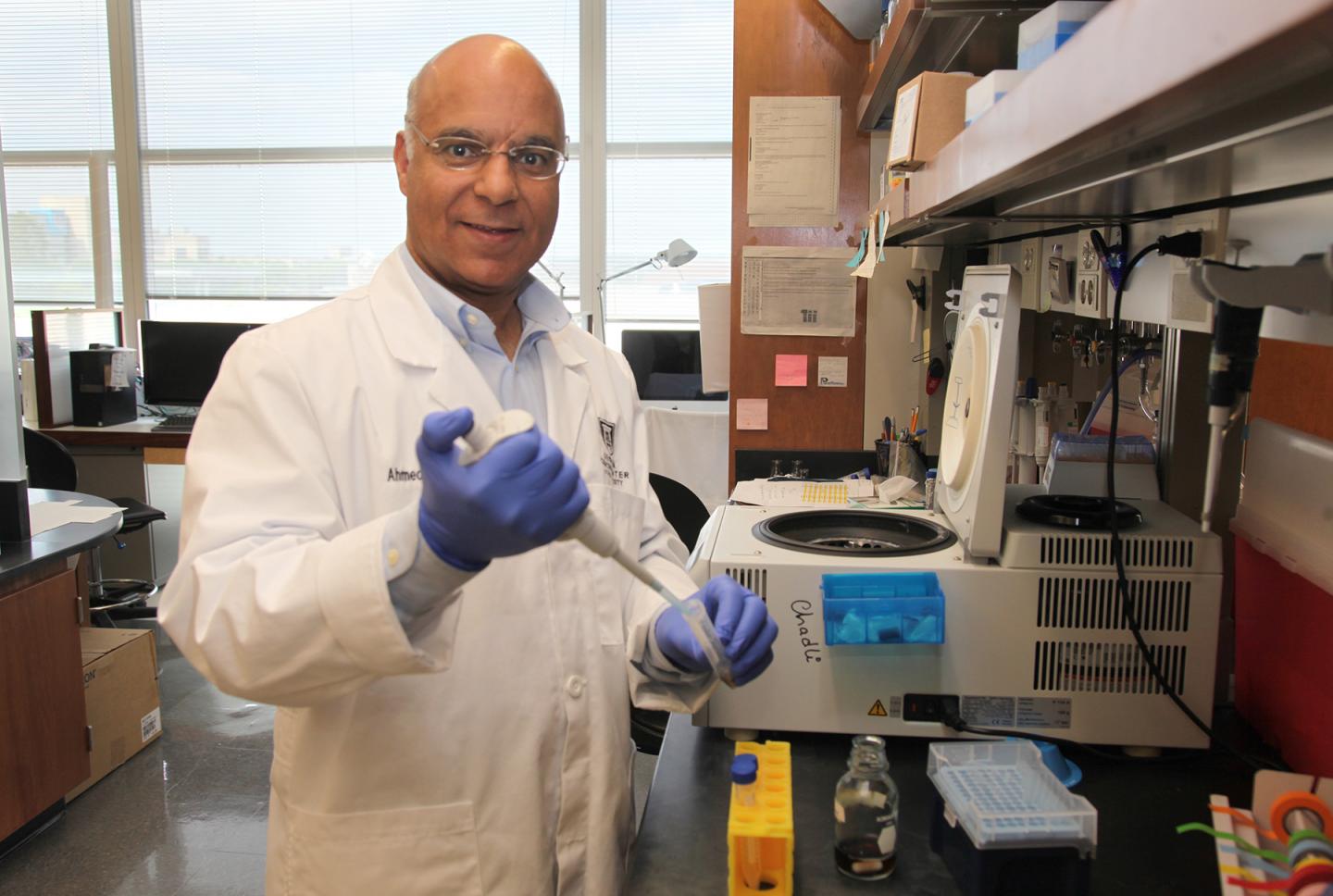
Credit: Phil Jones, Senior Photographer, Augusta University

Augusta, Ga. (April 19, 2019) – Identifying a protein that plays a key role in cancer cell growth is a first step toward the development of a targeted cancer therapy. It is especially promising when this protein is dispensable for the growth of normal cells. Their discovery that UNC45A fits these criteria has researchers, led by Dr. Ahmed Chadli, of the Georgia Cancer Center at Augusta University, excited about potential new cancer therapeutic strategies involving the inhibition of UNC45A.

UNC45A has long been recognized as a molecular chaperone, responsible for helping other proteins reach their functional state by guiding protein folding. It has a distinct role in cancer, however, where its over-expression in breast and ovarian cancer patient tissues correlates with grade and stage of the disease. After confirming that UNC45A is not required for the proliferation of normal breast cells, Dr. Chadli’s group showed that in both cell and mouse models of breast cancer, UNC45A is required for cancer cell proliferation and tumor growth.

They published the underlying molecular mechanism in the Journal of Biological Chemistry, first by demonstrating that when they silenced UNC45A expression, an enzyme called NEK7 was also down-regulated, by 2-fold. NEK7 plays a key role in cell proliferation by orchestrating the proper separation of chromosomes during cell division. Either silencing UNC45A or deleting NEK7 resulted in decreased cancer cell proliferation, and adding NEK7 to UNC45A-silenced cells restored proliferative capacity.

Examining normal versus cancer cell lines and normal versus cancerous human breast tissues, the researchers observed significantly more UNC45A present inside (versus outside) of a cell’s nucleus. They further discovered that in the nucleus, UNC45A interacts with a protein called the glucocorticoid receptor that, in turn, promotes NEK7 expression.

Due to NEK7’s key role in cell division, they further explored the effect of silenced UNC45A on cell replication. Importantly, they found that silencing UNC45A, which results in NEK7 down-regulation, caused the cancer cells to undergo what is known as mitotic catastrophe and die, exemplifying the ultimate therapeutic goal.

This result was captured in a dramatic set of real-time videos of cell division in normal versus UNC45A-deficient cells. In normal cells (Movie 1), nuclear material, pictured in green, divides to form two separate cells, each surrounded by a cell membrane, which appears white. In UNC45A-deficient cells, (Movie 2), the nuclear material struggles to divide, and the division into two cells fails.

“Inhibiting UNC45A holds tremendous potential in the fight against solid tumors, since its role in proliferation does not seem to be necessary for the survival of normal cells,” said Dr. Chadli. “How to inhibit its tumoral role apart from its normal functions is the topic of future studies that would improve our understanding of this molecular machine and how to harness its potential clinical application.”

###

Click this link to read the full study, http://www.jbc.org/content/294/14/5246.long.

Media Contact
Chris Curry
[email protected]

Related Journal Article

http://dx.doi.org/10.1074/jbc.RA118.006597

Tags: BiochemistrycancerCell BiologyGenesMedicine/Health
Share12Tweet8Share2ShareShareShare2

Related Posts

Monkeys Read Faces as Meaningful Social Signals, Not Just Mouth Movements

Monkeys Read Faces as Meaningful Social Signals, Not Just Mouth Movements

October 5, 2026
Two Master Genes That Decide Whether Blood Cells Are Born or Turn Cancerous

Two Master Genes That Decide Whether Blood Cells Are Born or Turn Cancerous

October 5, 2026

Hidden Parasite Split: DNA Reveals Snake Coccidia on the Brink of Becoming New Species

October 5, 2026

Viruses as Scalpels: Phages Expose Hidden Dependencies in Intact Microbiomes

October 5, 2026
Please login to join discussion

POPULAR NEWS

  • Alloys That Shrink Their Own Grains: New PIX Mechanism Refines Metals With Heat Alone

    Alloys That Shrink Their Own Grains: New PIX Mechanism Refines Metals With Heat Alone

    29 shares
    Share 12 Tweet 7
  • Endurance Exercise Reshapes the Liver in Males and Females Through Distinct Molecular Routes

    29 shares
    Share 12 Tweet 7
  • Single Transcription Factor PU.1 Rapidly Converts Fibroblasts into Macrophage-Lineage Cells

    29 shares
    Share 12 Tweet 7
  • New Scale Measures How Ready Nurse Educators Really Are for the AI Era

    29 shares
    Share 12 Tweet 7

About

We bring you the latest biotechnology news from best research centers and universities around the world. Check our website.

Follow us

Recent News

Alloys That Shrink Their Own Grains: New PIX Mechanism Refines Metals With Heat Alone

Endurance Exercise Reshapes the Liver in Males and Females Through Distinct Molecular Routes

Single Transcription Factor PU.1 Rapidly Converts Fibroblasts into Macrophage-Lineage Cells

Subscribe to Blog via Email

Success! An email was just sent to confirm your subscription. Please find the email now and click 'Confirm' to start subscribing.

Join 85 other subscribers
  • Contact Us

Bioengineer.org © Copyright 2023 All Rights Reserved.

Welcome Back!

Login to your account below

Forgotten Password?

Retrieve your password

Please enter your username or email address to reset your password.

Log In
No Result
View All Result
  • Homepages
    • Home Page 1
    • Home Page 2
  • News
  • National
  • Business
  • Health
  • Lifestyle
  • Science

Bioengineer.org © Copyright 2023 All Rights Reserved.