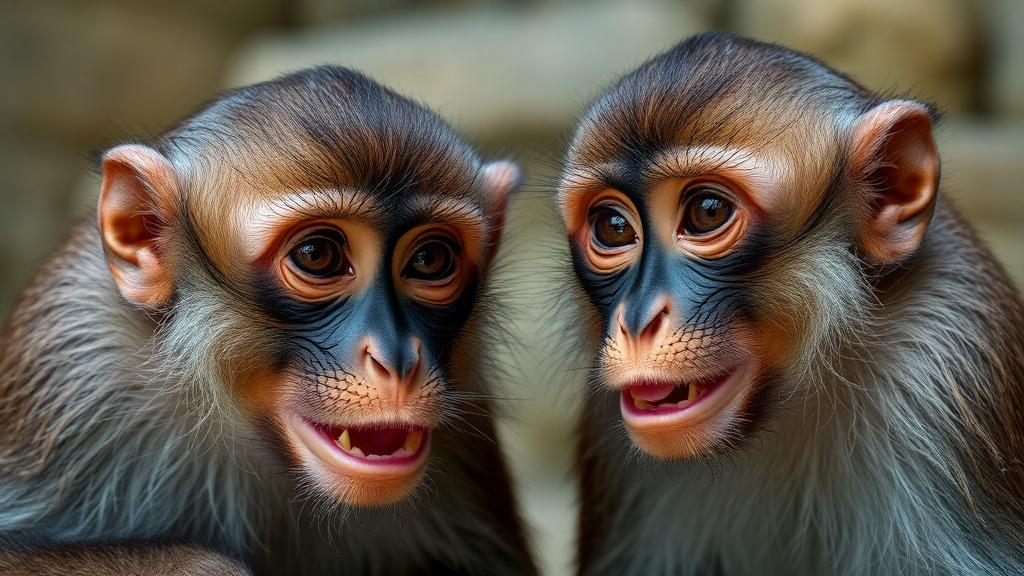
When a rhesus monkey bares its teeth at a rival or smacks its lips at a companion, the message is unmistakable to other monkeys. But what exactly are they reading when they interpret these faces? A new study published in the journal Animal Cognition offers one of the most detailed behavioral portraits yet of how rhesus macaques perceive facial expressions, and its central finding is striking: monkeys do not judge expressions by a single feature such as mouth shape. Instead, they appear to weigh the whole constellation of facial behavior, including eyebrows, ears, gaze, body characteristics, and the functional meaning of the signal itself.
The research, conducted by Ramona Siebert, Nick Taubert, Martin A. Giese, and Peter Thier at the University of Tübingen, trained two rhesus macaques to categorize videos of four distinct facial expression types: neutral faces, lip-smacking, silent bared-teeth displays, and open-mouth threat displays. These categories span the social spectrum of macaque communication, from affiliative gestures that signal benign intent to aggressive displays that warn of possible attack. The animals watched dynamic, naturalistic video clips rather than static photographs, an important design choice because real facial expressions unfold in time and involve coordinated movements of many facial structures at once.
Once the monkeys had learned the task, the researchers tested whether the animals could generalize their classifications to videos they had never seen before, featuring novel individuals. The macaques succeeded, demonstrating that they had not merely memorized specific clips or individual faces but had extracted something general about each expression category. Performance, however, was not perfect, and the pattern of errors proved to be one of the most informative aspects of the study. Misclassifications did not simply track how visually similar two expression categories looked, which suggested that something more interesting than raw visual resemblance was shaping the monkeys’ judgments.
To understand what drove those errors, the team developed a novel automated approach that combined deep learning-based motion tracking with the Macaque Facial Action Coding System, a standardized framework for decomposing macaque faces into discrete action units such as lip movements, brow raises, and ear positions. This pipeline allowed the researchers to objectively quantify the facial movements in every video clip, replacing subjective human coding with measurable, reproducible descriptors. The analysis revealed that the monkeys’ category boundaries could not be reduced to visual similarity metrics alone, a result that challenges simple feature-matching accounts of expression perception.
Some expressions, it turned out, were far easier for the monkeys than others. Open-mouth threat displays were readily categorized correctly and reliably distinguished from lip-smacking, and they also produced the strongest arousal responses, as measured by pupil dilation. Pupillometry has become a valuable tool in animal cognition research because pupil size is modulated by autonomic arousal, providing a physiological readout of how salient or emotionally charged a stimulus is. The combination of accurate categorization and heightened arousal suggests that threat displays carry particular functional significance for macaques, commanding both perceptual precision and an emotional response.
Silent bared-teeth displays told a very different story. Categorization of these expressions varied substantially across stimulus identities, meaning that the same expression type produced different judgments depending on who was making it. The researchers found that this variability was influenced by the signaler’s body weight, gaze direction, and coordinated movements of the eyebrows and ears. In macaque societies, the bared-teeth display can serve multiple functions, from signaling submission to facilitating affiliation, and the new findings hint that monkeys may interpret such displays in a context-dependent way, factoring in who is signaling and what the rest of the face and body are doing.
To probe these mechanisms further, the team turned to synthetic stimuli. Using morphed avatar faces, they generated expressions whose component intensities could be precisely controlled. The monkeys categorized these avatar expressions according to the intensity of the expression components, demonstrating graded perception rather than all-or-nothing category boundaries. This is a significant result because it shows that macaque expression perception is not a rigid sorting process but a graded one, in which the strength of facial actions maps continuously onto perceptual judgments, much as human observers perceive emotional intensity along a continuum.
The avatar experiments also allowed the researchers to dissect which ingredients of a facial expression are actually necessary for recognition. Manipulations revealed that categorization was robust against the lack of coherent motion and against the lack of facial realism, so long as a basic level of texture was present. In other words, the monkeys did not need a fully lifelike, smoothly moving face to classify an expression; a sufficiently textured but simplified avatar sufficed. This finding has practical implications for laboratory research, since it validates the use of synthetic faces in primate studies and suggests that the perceptual system extracts expression-relevant structure even from impoverished stimuli.
One boundary of the monkeys’ abilities emerged clearly: human facial expressions elicited no systematic categorizations and no differential arousal. Despite the superficial resemblance between some human and macaque expressions, the macaques did not treat human faces as meaningful within their classification framework. This cross-species result underscores that expression perception in these animals is tuned to conspecific signals, shaped by the specific morphology, dynamics, and social functions of macaque facial behavior rather than by a generic facial expression detector.
Taken together, the study paints a picture of facial expression perception in rhesus monkeys as functionally meaningful, context-dependent, and holistic. Expressions are not fixed categories defined by mouth movements alone; they are social signals whose interpretation is shaped by all components of facial behavior and by characteristics of the signaler, including body weight and gaze. The methodological contribution may prove as influential as the behavioral one: by fusing deep learning motion tracking with an established action coding system, the researchers have created a toolset for quantifying facial behavior objectively, opening the door to comparable studies across laboratories and species. For a field that has long relied on human judgment to define what a monkey’s face means, the message is clear that the monkeys themselves may be reading far more than we assumed.
Subject of Research: Dynamic facial expression perception and categorization in rhesus macaques using naturalistic videos and synthetic avatars
Article Title: Behavioral characterization of dynamic facial expression perception in rhesus monkeys (Macaca mulatta) using naturalistic and synthetic stimuli
Article References: Siebert, R., Taubert, N., Giese, M. A., & Thier, P. (2026). Behavioral characterization of dynamic facial expression perception in rhesus monkeys (Macaca mulatta) using naturalistic and synthetic stimuli. Animal Cognition. https://doi.org/10.1007/s10071-026-02109-6
Image Credits: AI Generated
DOI: 10.1007/s10071-026-02109-6
Keywords: rhesus macaque, facial expression, animal cognition, social signaling, pupillometry, deep learning, facial action coding system, avatars, graded perception, threat display, lip-smacking, Tübingen
News Source: Glenn Wilkins. (October 5, 2026). Monkeys Read Faces as Meaningful Social Signals, Not Just Mouth Movements. Scienmag.