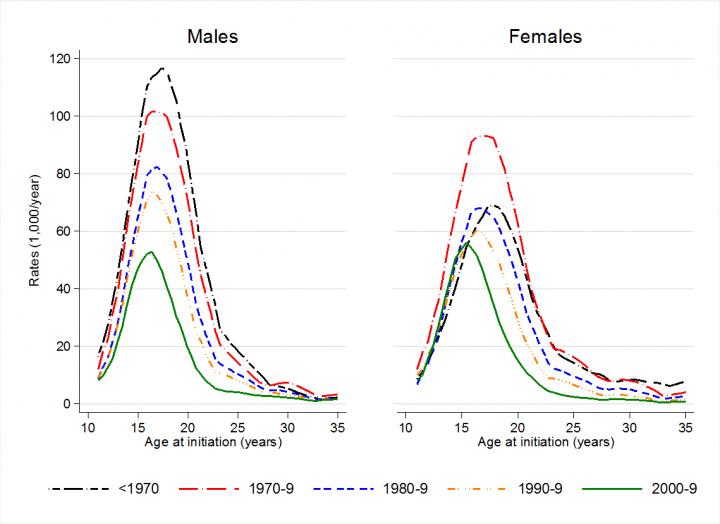
Credit: Marcon et al., 2018
In most of Europe, the rates of smoking initiation among older teens have declined since the 1970s, while "new smoker" rates among younger teens have risen in recent years, according to a study published August 22, 2018 in the open-access journal PLOS ONE by an international team of researchers involved in the Ageing Lungs in European Cohorts (ALEC) study, coordinated by Deborah Jarvis, Imperial College of London, UK.
Smoking is the leading cause of avoidable mortality and the strongest modifiable risk factor for a number of diseases. Many smokers initially become addicted to nicotine during adolescence, making it critical to understand smoking trends in this population.
The ALEC study pooled data from six multicenter studies, including 119,104 people from 17 countries. Information on smoking was retrospectively obtained from participants, who answered questions including "Are you a smoker," "Have you ever smoked for as long as a year?" and "How old were you when you started smoking?" Data was grouped by region of Europe and analyzed both as a whole and by region.
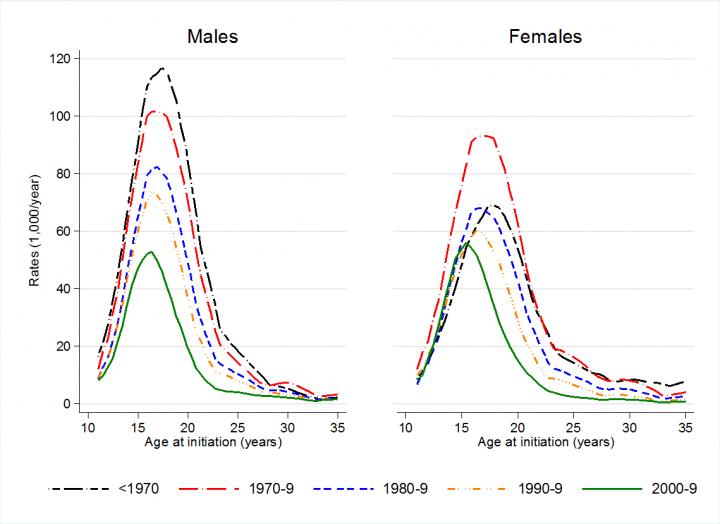
Overall, the rates of smoking initiation before 1970 peaked at age 18 in males and 19 in females; in the 2000s they peaked at ages 16 and 15. For both sexes, and all regions, smoking initiation during late adolescence (age 16 to 20) declined from the 1970s through to the 2000s. In the late 2000s, rates of smoking initiation in late adolescence were lowest in North Europe, with 20 people per 1,000 per year initiating smoking. In other regions, rates remained high at 40-80 new smokers per 1000 per year. Smoking initiation rates during early adolescence (age 11 to 15) increased in nearly all regions from 1990 through the 2000s. In West Europe, smoking initiation rates in this population reached 40 people per 1,000 per year around 2005.
"Smoking initiation is still unacceptably high among European adolescents, and increasing rates among those aged 15 or less deserve attention," the authors say. "Reducing initiation in adolescents is fundamental, since youngsters are particularly vulnerable to nicotine addiction and tobacco adverse effects."
First author Alessandro Marcon adds: "Unacceptably high rates of smoking initiation during late adolescence by the late 2000s, and increasing rates in children from 1990 on, suggest the necessity for most European countries to intensify the implementation of tobacco control measures reaching the youngsters."
###
Peer-reviewed / Meta-analysis / People
In your coverage please use this URL to provide access to the freely available article in PLOS ONE: http://journals.plos.org/plosone/article?id=10.1371/journal.pone.0201881
Citation: Marcon A, Pesce G, Calciano L, Bellisario V, Dharmage SC, Garcia-Aymerich J, et al. (2018) Trends in smoking initiation in Europe over 40 years: A retrospective cohort study. PLoS ONE 13(8): e0201881. https://doi.org/10.1371/journal.pone.0201881
Funding: This study has received funding from the European Union's Horizon 2020 research and innovation programme under grant agreement No 633212. DJ has received support from the European Union and the Medical Research Council. National funders who supported data collection in the original cohort and cross-sectional studies are listed in S2 Appendix. The funders had no role in the writing of the manuscript or the decision to submit it for publication. The corresponding author had full access to all the data and had final responsibility for the decision to submit for publication.
Competing Interests: TZ has received industry consulting, research grants and/or honoraria from: AstraZeneca, AbbVie, ALK, Almirall, Astellas, Bayer Health Care, Bencard, Berlin Chemie, FAES, HAL, Henkel, Kryolan, Leti, L'Oreal, Meda, Menarini, Merck, MSD, Novartis, Pfizer, Sanofi, Stallergenes, Takeda, Teva, UCB; TZ reports the following organizational affiliations: Committee member, WHO-Initiative "Allergic Rhinitis and its Impact on Asthma" (ARIA); Member of the Board, German Society for Allergy and Clinical Immunology (DGAKI); Head, European Centre for Allergy Research Foundation (ECARF); Secretary General, Global Allergy and Asthma European Network (GA2LEN); Member, Committee on Allergy Diagnosis and Molecular Allergology, World Allergy Organisation (WAO). All the other authors report no financial relationships with any organisations that might have an interest in the submitted work in the previous three years, and no other relationships or activities that could appear to have influenced the submitted work. These competing interests do not alter the authors' adherence to PLOS ONE policies on sharing data and materials. There are no restrictions to the sharing of data from this study.
Media Contact
Alessandro Marcon
[email protected]
Related Journal Article
http://dx.doi.org/10.1371/journal.pone.0201881