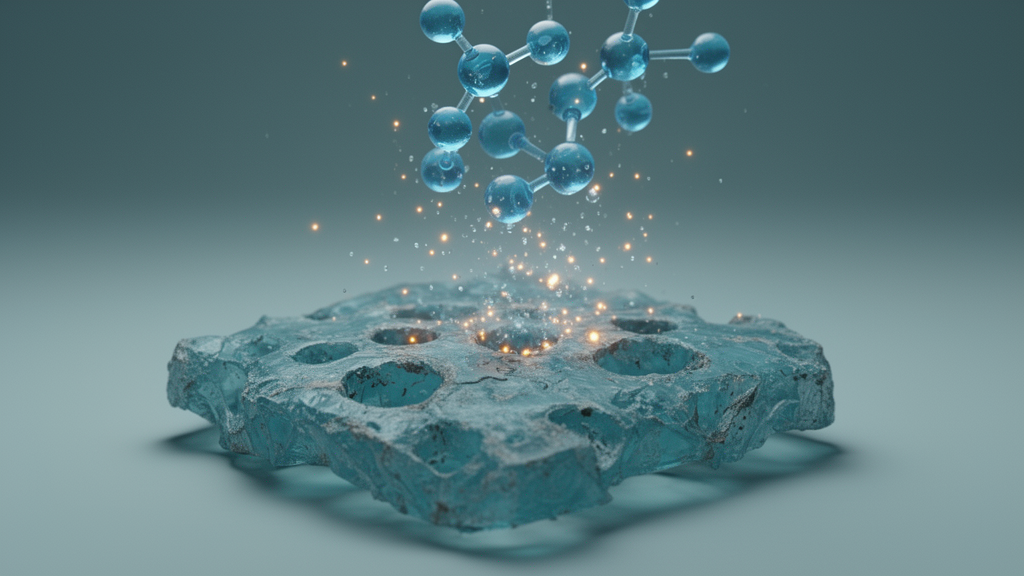
For decades, the safety case for plastics has rested on a single, comforting assumption: that these materials are chemically inert under ordinary conditions. A new study published in Nature challenges that assumption at its foundation. A team led by Naixin Qian and Wei Min at Columbia University, together with theorists at the University of California, Berkeley, reports that commodity microplastics suspended in water spontaneously generate hydroxyl radicals, one of the most aggressive oxidants known to chemistry. The activity requires no light, no catalyst and no added chemicals. It arises, the authors show, from the way water itself behaves when pressed against a hydrophobic plastic surface, and it grows stronger the more water-repellent the plastic is. The finding reframes microplastics not as passive debris but as chemically active particles whose very interface with water can damage biomolecules and cells.
The experimental starting point was disarmingly simple. The researchers mixed polystyrene microplastic powder, a plastic prized for its durability and chemical resistance, into water containing methyl orange, an azo dye that is degraded by reactive oxygen species. Polystyrene carries no reactive functional groups beyond its hydrocarbon backbone and pendant phenyl rings, so nothing in conventional chemistry predicts that it should attack the dye. Yet over ten days of continuous stirring, the solution faded from light yellow to nearly colourless, with almost ninety per cent of the methyl orange destroyed. Crucially, the same experiment performed in methanol, ethanol, acetonitrile or dimethylformamide produced no comparable degradation. Water, and only water, transforms otherwise inert polystyrene particles into chemically active suspensions, pointing to something happening precisely at the boundary between the plastic and the aqueous phase.
To identify the chemical culprit, the team turned to electron spin resonance spectroscopy with a radical-trapping molecule called DMPO. The spectra revealed a mixture of radical species, dominated by a signal consistent with oxidation of the trap by hydroxyl radicals, alongside a weaker component from direct hydroxyl radical capture. Because hydroxyl radicals are known to cleave azo bonds, their presence neatly explains the dye degradation. But where were the radicals being born? A fluorogenic sensor called aminophenyl fluorescein, which reacts selectively with hydroxyl radicals, allowed the researchers to map radical production in space using confocal microscopy. The fluorescence appeared predominantly at the particle surface, not in the surrounding solution, establishing an interfacial origin. Time-lapse tracking showed the signal rising continuously, and linear fits yielded a lower-bound production rate on the order of 0.1 to 1 nanomolar per minute, sustained over hours.
The interface hypothesis passed a decisive test when the researchers perturbed the surface with a surfactant. Adding Triton X-100, a non-ionic detergent that coats hydrophobic surfaces, dramatically suppressed the fluorescence at the plastic–water boundary, halted its growth over time and largely prevented bulk conversion of the sensor during prolonged incubation. Because control experiments showed that the surfactant does not interfere with the sensor’s reaction with hydroxyl radicals, the suppression had to come from changes to the interface itself. The effect was also concentration-dependent, and the reactivity proved reproducible across polystyrene from different suppliers, with modest variation tied to particle morphology and surface oxidation. Whatever was driving the chemistry, it lived at the surface and could be switched down by masking it.
That surface, the study shows, is also electrically alive. Electrophoresis measurements revealed a large negative zeta potential for pristine polystyrene particles in pure water and dilute salt solution, indicating an accumulation of negative charge at the interface. A positively charged dye, Rhodamine 800, used as an electrostatic reporter, enriched visibly at the particle surface under the microscope, corroborating the existence of an electrical double layer. In ethanol, by contrast, the zeta potential was far less negative, the dye showed minimal surface partitioning and no dye degradation occurred, underscoring that water is what electrifies the plastic. Across four Triton X-100 concentrations, the electrostatic and chemical activities tracked each other with a Pearson correlation of minus 0.99: as the surface charge vanished, so did the radical generation. The authors emphasize that this water-induced electrification is fundamentally different from charging by ionizable surface groups, which is insensitive to solvent identity.
Was this a quirk of polystyrene? Apparently not. Applying the same imaging assay to six common commodity plastics, including polypropylene, polyethylene, polyvinyl chloride, polyethylene terephthalate and poly(methyl methacrylate), the researchers observed spontaneous radical generation at every one of their aqueous interfaces. But the magnitude varied enormously, and the pattern was telling. Polyolefins such as polyethylene and polypropylene, made purely of non-polar hydrocarbon chains, were the most active, while the more hydrophilic PET and PMMA were the least. Quantifying hydrophobicity by the water contact angle, the team found a strong correlation between interfacial activity and contact angle, with a Pearson coefficient of 0.93. The more a plastic repels water, the more chemically violent its encounter with water becomes, a structure–activity relationship that held across the entire panel of materials.
The theoretical half of the study, led by Ruoqi Zhao and Teresa Head-Gordon at Berkeley, explains why. Using molecular dynamics simulations with reactive force fields and high-level ab initio calculations, the team computed the vertical ionization energy, the energetic cost of stripping an electron from hydroxide to form a hydroxyl radical, for hydroxide ions at polyethylene, PVC and PMMA surfaces. In bulk water, that cost is about 207 kilocalories per mole, far too high for spontaneous oxidation. But at hydrophobic interfaces, a distinct population of undercoordinated hydroxide ions, partially solvated and hydrogen-bonded to water molecules bearing dangling hydroxyl groups, showed ionization energies below 130 kilocalories per mole, with the most hydrophobic polyethylene producing the largest share of these low-energy configurations. When the researchers additionally modelled the negative surface charge inferred from the measured zeta potentials, roughly one negative charge per three square nanometres, comparable to values reported for oil droplets and nanoparticles in water, the ionization energies shifted below 100 kilocalories per mole, bringing spontaneous radical formation within reach of coupled redox pathways involving dissolved oxygen or hydronium as electron acceptors.
The simulations also captured why hydrophobicity matters at the molecular level. Across the six polymers, the fraction of interfacial water molecules with dangling hydroxyl groups, a signature of a defective, partially solvated hydrogen-bond network, correlated strongly with the measured radical activity, with a Pearson coefficient of 0.94. Polyolefins leave the most water molecules undercoordinated; polymers bearing ester groups, such as PET and PMMA, hydrogen-bond effectively and suppress the dangling population, while the phenyl rings of polystyrene and the chlorine atoms of PVC act as weak acceptors in between. Partial solvation and interfacial electrostatics thus act synergistically: the more hydrophobic the surface, the more undercoordinated hydroxide it hosts and the more negative charge it carries, and the cheaper it becomes to make a radical.
The biological consequences follow directly. Fluorescence imaging showed that charged biomolecules, including positively charged wheat germ agglutinin, negatively charged R-phycoerythrin and DNA oligomers, all partition to microplastic surfaces, with the positively charged protein enriching more strongly, consistent with the negative interface. More hydrophobic polypropylene attracted far more biomolecules than PMMA, and surfactant coating reversed the effect, suggesting that interfacial electrostatics help regulate the protein corona that forms around microplastics in biological fluids. More ominously, when lysozyme stained with thioflavin T, a probe for protein aggregation, was incubated with polystyrene particles, fluorescence accumulated at the particle surface over time, indicating fibril formation. Adding caffeine, a well-established hydroxyl radical scavenger, or coating the particles with Triton X-100, suppressed the aggregation almost completely, implicating surface-generated radicals in the structural damage. Across plastic types, the tendency to induce aggregation mirrored the interfacial activity, with a correlation of 0.68.
Cells felt it too. Mouse red blood cells incubated with polystyrene microplastics developed fragmented, helmet-like schistocyte morphologies after direct encounters with particles, and quantification of released haemoglobin revealed haemolytic activity that varied across plastic types in proportion to their measured interfacial activity, with a correlation of 0.75. The authors stress that this intrinsic chemistry is distinct from the photoirradiation and chemical oxidation pathways usually invoked in microplastic degradation; it operates in the dark, under ambient conditions, and persists in realistic media including cell culture medium and serum. Beyond health, the mechanism may contribute to plastic ageing, the transformation of co-pollutants and even catalyst-free plastic upcycling, and it connects microplastic surfaces to the broader and rapidly growing field of microdroplet chemistry, where hydrophobic water interfaces have been shown to accelerate otherwise unfavourable redox reactions. Perhaps most consequentially, the structure–activity relationship offers an engineering principle: how a polymer surface interacts with water should become a design variable in creating safer, more sustainable plastics, because the study demonstrates that the line between inert material and reactive hazard can be as thin as a single layer of interfacial water.
Subject of Research: Spontaneous hydroxyl radical generation at microplastic–water interfaces and its implications for microplastic toxicity
Article Title: Intrinsic physicochemical activity at microplastic–water interfaces
Article References: Intrinsic physicochemical activity at microplastic–water interfaces. (n.d.). https://doi.org/10.1038/s41586-026-11141-y
Image Credits: AI Generated
DOI: 10.1038/s41586-026-11141-y
Keywords: microplastics, hydroxyl radicals, reactive oxygen species, interfacial chemistry, water–hydrophobe interactions, zeta potential, polystyrene, polyolefins, protein aggregation, hemolysis, microdroplet chemistry, plastic toxicity
News Source: Denise Maddox. (October 16, 2026). Microplastics Are Not Chemically Inert: Water Turns Their Surfaces Into Radical Factories. Scienmag.