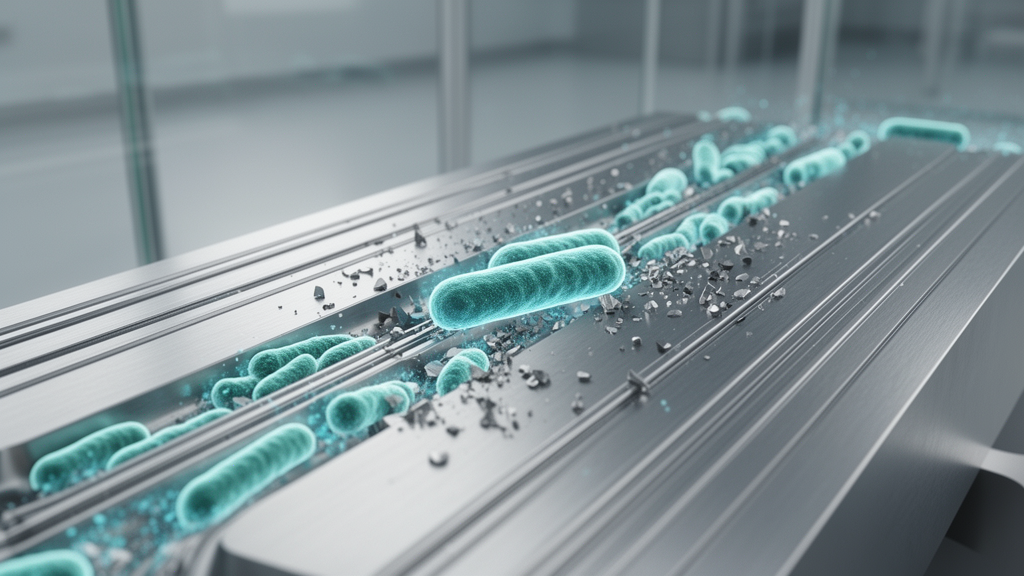
A new review published in Bioresources and Bioprocessing on 13 October 2026 takes stock of an unusual manufacturing idea: letting microorganisms do the machining. Biomachining, as the technique is called, uses microbial metabolism and bioelectrochemical reactions to dissolve material under mild conditions, replacing the brute force of cutting tools or the intense energy of lasers with the quiet chemistry of living cells. Authors Jingyu Song, Hui Huang, and Weibin Shi systematically survey the field from its origins in 1996 through March 2026, drawing on literature indexed in Web of Science, Scopus, and Google Scholar, and their conclusion is measured: the approach works in the laboratory, but its path to the factory floor remains obstructed by low removal rates, poor dimensional accuracy, and unstable microbial behavior.
The concept dates to a landmark experiment in which Uno and colleagues used the bacterium Acidithiobacillus ferrooxidans to fabricate microgrooves on copper, coining the term biomachining in the process. The review organizes nearly three decades of subsequent work into three stages. From 1996 to 2005, researchers demonstrated feasibility, showing that microbial oxidation and metabolic products could dissolve metal in a controlled fashion. From 2006 to 2018, attention shifted to selecting microorganisms, matching them to materials, and tuning process parameters to improve material removal rate and surface roughness. Since 2019, the field has entered what the authors call an engineering exploration stage, introducing external energy fields, hybrid strategies, and optimization methods to push beyond the limits of conventional biomachining.
The cast of microbial workers is central to the technique. Acidithiobacillus ferrooxidans and Acidithiobacillus thiooxidans are currently the most widely used strains, driving metal dissolution through the oxidation of ferrous iron to ferric iron, which then acts as a chemical etchant. The fungus Aspergillus niger contributes through organic acids and glucose oxidase, while Staphylococcus species can create acidic or alkaline corrosive microenvironments that enable localized dissolution. Other strains, including Paracoccus versutus, Leptospirillum ferrooxidans, and Sulfobacillus thermosulfidooxidans, have been applied to different material systems. Unlike a milling cutter, however, these agents are alive, and their performance depends on cell density, metabolic activity, and culture conditions, with microbial populations moving through lag, exponential, and decline phases that alter removal behavior over processing time.
At its core, biomachining of metals is an electrochemical dissolution process in which metal atoms lose electrons and enter solution as ions. The review distinguishes three removal mechanisms. Direct removal involves microbial attachment to the surface and extracellular electron transfer between cells and metal; microscopy has confirmed that bacteria do adhere and participate in dissolution, but maintaining efficient biofilms during machining is difficult, so the direct contribution remains limited. Indirect removal, the dominant pathway, relies on extracellular oxidizing species such as ferric iron, oxalic acid, and hydrogen peroxide generated or transformed during metabolism, which etch the material through redox reactions. A hybrid mechanism combines both routes, with Acidithiobacillus ferrooxidans and sulfate-reducing bacteria promoting dissolution through electron transfer and oxidation cycles simultaneously, though the relative contributions of each pathway vary by organism and condition and remain difficult to quantify.
To bring rigor to the field, the authors adapt thermodynamic and kinetic tools from bioleaching and microbiologically influenced corrosion research. The Nernst equation describes how ion activity, temperature, and electron transfer number govern system potential, while the Gibbs free energy relationship establishes when oxidative dissolution is thermodynamically spontaneous: when the electrode potential difference is positive and the free energy change negative. Kinetic analysis through polarization curves, Tafel relationships, and Faraday’s law links current density to metal dissolution rate, and electrochemical impedance spectroscopy can reveal whether removal is limited by charge transfer, diffusion, or interfacial film resistance. Yet the review is candid that these analyses, largely borrowed from corrosion science, cannot yet directly predict material removal rates because they neglect microbial growth, metabolic fluctuation, and biofilm evolution.
Compared with conventional machining, biomachining’s appeal is what it avoids. Because it does not rely on tool-workpiece contact, it imposes low mechanical loading, reducing residual stress and subsurface damage, which makes it attractive for thin-walled structures, brittle material surfaces, and low-damage microfabrication. Compared with laser machining and electrical discharge machining, it produces almost no heat-affected zone, recast layer, or thermal cracks, preserving surface integrity in heat-sensitive materials. Against chemical etching, it substitutes mild microbial metabolites for strong acids and oxidizing etchants, potentially reducing safety hazards and corrosive waste. The trade-offs are equally clear: conventional methods retain decisive advantages in removal rate, accuracy, equipment maturity, and batch stability, and the authors caution that biomachining’s environmental benefits should not be assumed from its mild conditions alone but verified through full comparisons of energy, chemicals, waste, and cost.
In practice, researchers have combined biomachining with masking techniques borrowed from lithography to confine microbial etching and fabricate microgrooves, micro-pits, and complex patterns. The results demonstrate feasibility but expose a persistent problem: undercutting. Lateral diffusion of oxidative metabolites near mask edges, combined with the quasi-isotropic corrosion behavior of the process, causes the actual removal region to deviate from the designed pattern, and longer processing times intensify the effect, yielding lower aspect ratios, rounded edges, and reduced pattern fidelity. Dimensional accuracy is therefore governed not only by mask quality but by biochemical reactions and interfacial mass transfer, and the review notes that most studies report representative morphologies or single experimental cases rather than statistical evaluation of repeatability.
Hybrid biomachining seeks to overcome the process’s inherent slowness by coupling it with external assistance. Electric fields can promote anodic dissolution by altering the workpiece potential; in the original Uno experiment, applying a voltage increased the removal depth of copper by approximately 52 percent. Flow and jet assistance enhance mass transfer between metabolites and the workpiece surface, galvanic coupling exploits potential differences between materials to strengthen selective dissolution, and acid assistance reduces interfacial reaction resistance by raising hydrogen ion concentration. But faster is not always better. Some jet-assisted studies showed that surface roughness and removal rate increased simultaneously, meaning higher efficiency came at the expense of surface quality. The review argues that hybrid strategies must be judged on roughness, dimensional error, undercutting, surface integrity, and batch repeatability, not removal rate alone.
Among the application areas surveyed, tool dressing stands closest to practical engineering use. Biomachining has been used to dress fixed abrasive lapping plates and metal-bonded diamond grinding wheels by selectively removing metal bond or loading layers, improving abrasive protrusion, chip space, and subsequent grinding performance, including in sapphire wafer grinding. Other applications remain more speculative: micro-gears, microchannel molds for polydimethylsiloxane microfluidic devices, friction-reducing and hydrophobic surface textures, cell-adhesive implant surfaces, and porous electrodes that increase specific surface area and enhance electron transfer in microbial fuel cells. Most of these, the authors note, sit at the proof-of-concept or prototype stage, with long processing times, lateral removal, and reaction residues threatening the accuracy and cleanliness that devices demand.
The review’s roadmap for maturing the field is deliberately unglamorous. In the short term, it calls for standardized strain preservation, culture medium formulation, pH and oxidation-reduction potential monitoring, and repeatable evaluation metrics. In the medium term, it envisions mechanism-data fusion models combining kinetic constraints with machine learning, online sensing of pH, temperature, dissolved oxygen, ion concentration, and microbial activity, and dedicated machining reactors that integrate cultivation, reaction, medium circulation, waste treatment, and metal ion recovery, ultimately linked through digital twin-based closed-loop control. In the long term, engineering validation through life cycle assessment and techno-economic analysis under clearly defined functional units would establish where biomachining genuinely outperforms alternatives. The authors’ central message resists hype: the future of biomachining lies not in adding fashionable concepts but in transforming microbial reactions into manufacturing processes that can be monitored, modeled, controlled, and verified.
Subject of Research: A review of biomachining, a manufacturing method that uses microbial metabolism to remove material under mild conditions
Article Title: Biomachining in manufacturing: mechanisms, processes, applications and future perspectives
Article References: Song, J., Huang, H., & Shi, W. (2026). Biomachining in manufacturing: mechanisms, processes, applications and future perspectives. Bioresources and Bioprocessing, 13(1), Article 149. https://doi.org/10.1186/s40643-026-01143-z
Image Credits: AI Generated
DOI: 10.1186/s40643-026-01143-z
Keywords: biomachining, microbial manufacturing, Acidithiobacillus ferrooxidans, electrochemical dissolution, microfabrication, hybrid biomachining, surface engineering, tool dressing, microfluidics, sustainable manufacturing, bioleaching, digital twin
News Source: Denise Maddox. (October 29, 2026). Microbes That Machine Metal: Review Maps Biomachining’s Promise and Barriers. Scienmag.