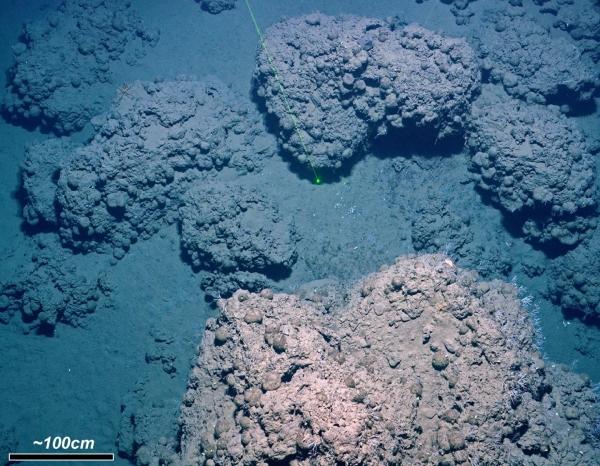
Credit: Giuliana Panieri
Ice ages are not that easy to define. It may sound intuitive that an ice age represents a frozen planet, but the truth is often more nuanced than that.
An ice age has constant glaciations and deglaciations, with ice sheets pulsating with the rhythm of changing climate. These giants have been consistently waxing and waning, exerting, and lifting pressure from the ocean floor.
Several studies also show that the most recent deglaciation, Holocene (approximately 21ka-15ka ago) of the Barents Sea has had a huge impact on the release of methane into the water. A most recent study in Geology looks even further into the past, some 125 000 years ago, and contributes to the conclusion: Melting of the Arctic ice sheets drives the release of the potent greenhouse gas methane from the ocean floor.
“In our study, we expand the geological history of past Arctic methane release to the next to last interglacial, the so-called Eemian period. We have found that the similarities between the events of both Holocene and Eemian deglaciation advocate for a common driver for the episodic release of geological methane – the retreat of ice sheets.” says researcher Pierre-Antoine Dessandier, who conducted this study as a postdoctoral fellow at CAGE Centre for Arctic Gas Hydrate Environment and Climate at UiT The Arctic University of Norway.
Seeing thousands of years of methane release in tiny shells
The study is based on measurements of different isotopes found in sediment cores collected from the Arctic Ocean. Isotopes are variations of chemical elements, such as carbon and oxygen, in this case. Different isotopes of the same element have different weight and interact with other chemical elements in the environment in specific ways. This means that the composition of certain isotopes is correlated to the environmental changes – such as temperature or amount of methane in the water column or within the sediment. Isotopes are taken up and stored in the shells of tiny organisms called foraminifera and in that way get archived in the sediments for thousands of years as the tiny creatures die. Also, if methane was released for longer periods of time, the archived shells get an overgrowth of carbonate which in itself also can be tested for isotopes.
“The isotopic record showed that as the ice sheet melted and pressure on the seafloor lessened during the Eemian, methane was released in violent spurts, slow seeps, or a combination of both. By the time the ice disappeared completely, some thousands of years later, methane emissions had stabilized.” says Dessandier.
Where did the methane come from?
Arctic methane reservoirs consist of gas hydrates and free gas. Gas hydrates are solids, usually methane gas, frozen in a cage with water, and extremely susceptible to pressure and temperature changes in the ocean. These reservoirs are potentially large enough to raise atmospheric methane concentrations if released during the melting of glacial ice and permafrost. The Geology study reinforces the hypothesis that the release of this greenhouse gas strongly correlates with the melting of the ice sheets. It is also an example of the past showing what the future may hold.
“The present-day acceleration of Greenlands ice melt is an analogue to our model. We believe that the future release of methane from below and nearby these ice sheets is likely.” Says Dessandier
Increasing methane emissions are a major contributor to the rising concentration of greenhouse gases in Earth’s atmosphere, and are responsible for up to one-third of near-term global heating. During 2019, about 60% (360 million tons) of methane released globally was from human activities, while natural sources contributed about 40% (230 million tons).
How much methane eventually made it to the atmosphere during the Eemian and Holocene deglaciations remains uncertain. Part of the problem in quantifying this are the microbial communities that live on the seafloor and in the water and use methane to survive.
But both those past deglaciations happened over thousands of years, while the current retreat of the ice sheets is unprecedentedly rapid according to the geological record.
“The projections of future climate change should definitely include the release of methane following in the wake of diminishing ice sheets. Past can be used to better inform the future.”
###
Media Contact
Maja Sojtaric
[email protected]
Original Source
https:/
Related Journal Article
http://dx.