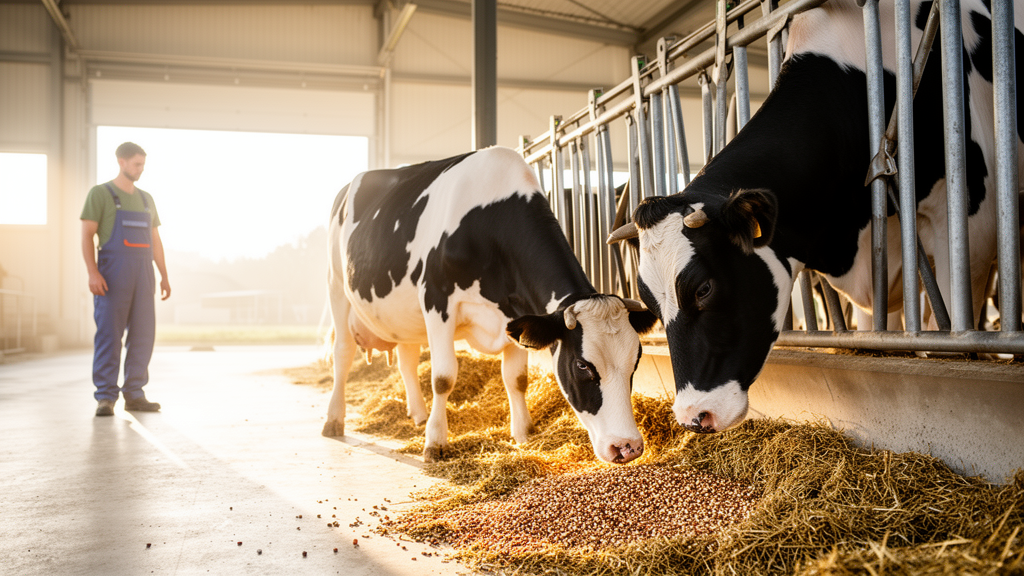
A feed additive that has been hailed as one of the most promising tools for cutting methane emissions from cattle may carry subtle behavioral costs, according to a pilot study of dairy cows at Aarhus University in Denmark. The additive, 3-nitrooxypropanol, marketed as Bovaer and approved in the European Union at concentrations of 60 to 100 milligrams per kilogram of dry matter, has already been shown in a recent meta-analysis to reduce enteric methane emissions by an average of 32.7 percent for production, 30.9 percent for yield, and 32.6 percent for intensity. But the new research, published in the journal Dairy Science and Management, reports that when primiparous Danish Holstein cows received the additive at 60 milligrams per kilogram of dry matter in a partially mixed ration, they spent less time in an upright posture, showed a suggestive trend toward increased lying time, tended to be more vigilant, and ate measurably less feed than cows on a control diet.
The study was designed as a pilot investigation of behavioral responses, not a definitive welfare assessment. Researchers Guilherme Amorim Franchi, Trinidad de Evan, Martin Riis Weisbjerg, and Margit Bak Jensen analyzed video recordings collected from a larger experiment that ran at the departmental resident Danish Holstein herd of Aarhus University in Tjele from September 2022 to May 2024, investigating the effects of 3-NOP and nitrate on performance and greenhouse gas emissions. The behavioral analysis itself was conducted from June to December 2024, and at the time of submission the data from the larger experiment had not been published. Because of budget limitations, the pilot study used only the periods when cows were fed the 3-NOP and control diets, leaving out the nitrate treatment.
The larger experiment followed a complete Latin square design with three treatments and three three-week periods. Cows were continuously enrolled 14 to 21 days after calving and randomly allocated to one of the three treatments. Each period began on a Wednesday at 10.00 h and consisted of 14 days of adaptation to the environment and diets, followed by seven days of sampling. The cows were healthy, loose-housed, lactating first-parity Holsteins kept in two sections with cubicles fitted with mattresses and sawdust bedding, 24 automatic feed bins per section, and two water troughs. Groups were dynamic, with cows entering the experiment at different times and moving to non-experimental pens after completing their third period, ensuring both sections consistently housed 24 cows throughout the trial. The partially mixed ration was formulated for first-parity Holstein cows using the Nordic Feed Evaluation System and was based on 550 grams per kilogram of dry matter of roughage, a roughly 50:50 mixture of grass clover silage and maize silage, plus 430 grams per kilogram of concentrate containing rapeseed meal, spring barley, and sugar beet pulp.
For the behavioral observations, the researchers randomly selected 46 cows, balanced across the two sections. The sample size was supported by a one-way ANOVA power calculation at the 5 percent significance level with 80 percent power, using an effect size estimated from differences in standing time between ketotic and healthy cows around calving, since ketosis is a systemic health disorder that can induce discomfort-related behavioral changes similar to those potentially induced by 3-NOP. One camera was placed above each side of each section at a height of 7 meters, overlooking half of the section, and together the two cameras per section ensured full coverage of all cows. Cows were individually marked with hair bleach on their backs for identification in the video recordings.
The behavior of each cow was labeled on days 18 and 20 relative to the start of the experimental period, during two three-hour windows from 10.00 h to 13.00 h and from 20.00 h to 23.00 h, using the open-source software BORIS and a protocol of 1-minute instantaneous recording, yielding 360 scans per cow per day. Postures and behaviors were mutually exclusive and were only labeled when cows were undisturbed, meaning the cow was visible in the pen and no human was present. Video labeling was carried out by two experimenters blinded to the treatments, and inter-observer agreement, assessed on six hours of footage of two non-experimental cows, reached an agreement index of 0.93 with a 95 percent confidence interval of 0.81 to 0.99. Behavioral percentages were calculated using the number of undisturbed scans as the denominator and analyzed with generalized linear mixed models in R, with treatment, experimental day, period, and their interactions as fixed effects and cow nested in section as random effects. Over the experimental days and periods, the proportion of undisturbed scans was similar between treatments, with medians of 91.3 percent for the control group and 91.0 percent for the 3-NOP group.
The results showed that when supplemented with 3-NOP, cows spent less time in an upright posture, standing still or in motion, at 52.6 percent versus 56.8 percent of scans per six-hour observation period, a statistically significant difference with a P value of 0.027. Correspondingly, cows showed a suggestive trend toward more time in lying posture, which summed lying sternally with head raised, lying sternally with head down, and lying laterally, at 34.8 percent versus 31.5 percent of scans, with a P value of 0.095. The cows also tended to be more vigilant under 3-NOP supplementation, with an odds ratio of 5.3 compared with the control diet, a tendency that fell just short of conventional significance at P = 0.067. The authors note that reduced time spent upright has previously been reported in cows undergoing systemic health disorders, and increased lying time has previously been associated with the occurrence of metabolic disease, although they caution that these preliminary tendencies should be interpreted carefully because observations were unevenly distributed between day and night and do not represent overall daily activity.
Concomitantly, dry matter intake, accounting for recordings from both the feed bins and the methane measuring unit, declined by 4.5 percent when 3-NOP was provided, from 17.7 to 16.9 kilograms per day, a difference that was statistically significant at P < 0.01. This finding corroborates earlier studies investigating the performance effects of the same 3-NOP dose in dairy cows, and two recent systematic reviews have reported that supplementation of 3-NOP is associated with reductions in dry matter intake in dairy and beef cattle, although energy-corrected milk and feed efficiency were unaffected in dairy cows. The reduced feed intake suggests that the experimental cows negatively responded to 3-NOP at a dose of 60 milligrams per kilogram of dry matter, raising welfare concerns for supplementation at that dose. Milk yield data from the larger experiment were not available for inclusion in this pilot analysis, so potential production responses associated with the observed intake reduction could not be evaluated.
Several mechanisms have been proposed to explain why 3-NOP might reduce feed intake, including a shift in rumen fermentation toward greater propionate production, which may increase satiety; accumulation of hydrogen gas in the rumen stimulating stretch receptors and causing bloating; and the formation of potentially toxic metabolites. Reduced feed intake is frequently associated with compromised animal welfare and the experience of negative affective states such as discomfort, which can be manifested as reduced activity, self-grooming, and social interactions. Based on the current findings, the authors speculate that the reduced feed intake and the behavioral changes, namely reduced standing time and tendencies toward increased lying time and increased vigilance, may be consequences of cows experiencing discomfort potentially associated with increased ruminal pressure, changes in ruminal dynamics, or altered feed preference and sensory-specific appetite. The tendency for higher vigilance could alternatively indicate a trade-off between feeding and vigilance previously seen in cows experiencing fear, or increased feeding motivation and heightened attention to feed delivery, although the dynamic grouping of cows in the larger experiment complicates that interpretation. No other 3-NOP effects on video-recorded behavior were detected.
The authors emphasize that these behavioral indications, detected approximately three weeks after the start of supplementation, should be viewed as preliminary pilot findings that require confirmation with continuous 24-hour behavioral observations. The analysis was based on two treatments extracted from a larger Latin square experiment, which inherently reduces randomization and may introduce period-related variation; to account for this, period was included as a fixed effect in all models, and only observations from the third week of each period were analyzed to allow sufficient time for diet washout, with residual diagnostics suggesting that carry-over effects were effectively mitigated. This is the first study reporting general behavior of cows supplemented with 3-NOP, and the researchers recommend that future research include cows at different parities and lactation stages housed in stable groups, follow a continuous randomized block design allowing long-term behavioral assessment at different doses, and comprise a larger range of measures including physiological, clinical, and more detailed behavioral measures, with larger sample sizes potentially needed to detect more subtle behavioral changes. The supplementation of 60 milligrams of 3-NOP per kilogram of dry matter in a partially mixed ration induced behavioral changes in primiparous cows, the study concludes, and the findings warrant further examination of the behavior and welfare effects of 3-NOP on dairy cattle.
Subject of Research: Behavioral effects of the methane-reducing feed additive 3-nitrooxypropanol in primiparous dairy cows
Article Title: Behavioral changes in dairy cows feed-supplemented with 3-nitrooxypropanol: a pilot study
Article References: Franchi, G. A., de Evan, T., Weisbjerg, M. R., & Jensen, M. B. (2026). Behavioral changes in dairy cows feed-supplemented with 3-nitrooxypropanol: a pilot study. Dairy Science and Management, 3(1), Article 2. https://doi.org/10.1186/s44363-026-00024-2
Image Credits: AI Generated
DOI: 10.1186/s44363-026-00024-2
Keywords: dairy cattle, 3-nitrooxypropanol, Bovaer, enteric methane, animal welfare, feed intake, cow behavior, lying time, vigilance, pilot study, Danish Holstein, discomfort
News Source: William Thompson. (October 28, 2026). Methane-cutting feed additive subtly shifts dairy cow behavior in pilot study. Scienmag.