


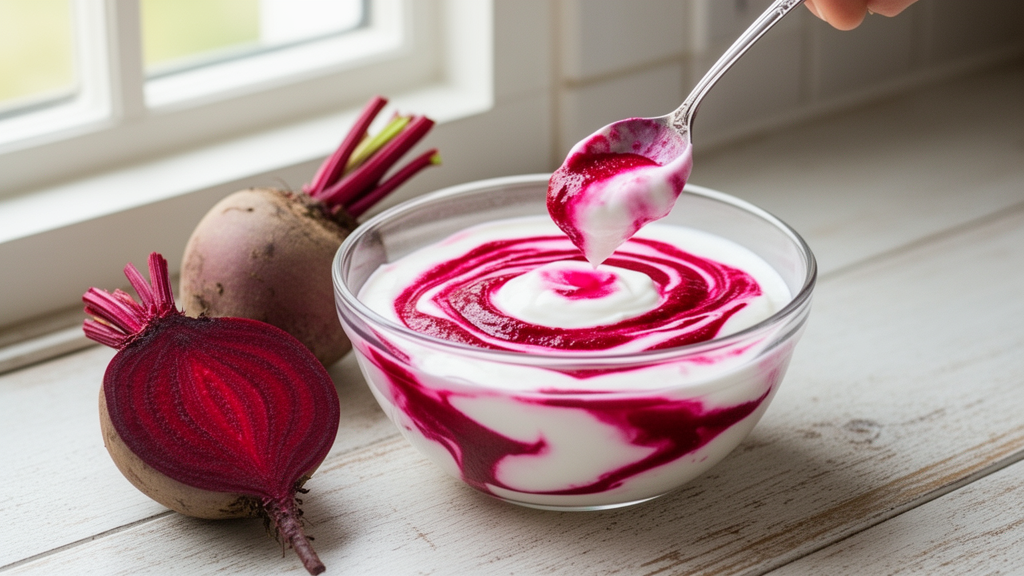
Yoghurt enriched with beetroot puree has emerged from a laboratory study with markedly stronger antioxidant credentials than a conventional counterpart made with synthetic colour and flavour additives, according to research published in the Springer Nature journal Food, Nutrition and Health. In the study, antioxidant activity, measured as DPPH radical scavenging, rose from 61.30 percent in the control sample to 84.77 percent in yoghurt containing 8 percent beetroot puree. Total phenolic content climbed even more dramatically over the same comparison, increasing from 0.38 to 5.40 milligrams of gallic acid equivalents per gram. Both increases were statistically significant at the 0.05 level, and both were achieved without any statistically significant change in the yoghurt’s proximate composition of protein, fat, moisture, ash and carbohydrate.
The research team, led by Mercia Lionel Adjei of Kwame Nkrumah University of Science and Technology in Kumasi, Ghana, set out to test whether a natural plant ingredient could replace the synthetic additives that are traditionally used to give yoghurt its appearance and taste. Consumer awareness of the potential health implications of synthetic colourants and flavouring agents has been driving demand for natural alternatives in the food industry, the authors note in their introduction. Beetroot, Beta vulgaris, was chosen as the candidate ingredient because it is rich in bioactive compounds, including betalains, phenolic compounds and antioxidants, and because its intense natural pigmentation makes it a plausible substitute for artificial red colourants.
The experimental design was deliberately structured to make that comparison direct. A control yoghurt, designated T0, was prepared with strawberry flavouring and food-grade red colourant consisting of the permitted dyes Ponceau 4R (E124) and Tartrazine (E102), added at levels consistent with typical industrial formulations. Against this reference, the researchers produced yoghurts containing 2 percent, 2.03 percent and 8 percent beetroot puree. The seemingly odd value of 2.03 percent was not a rounding artefact but a genuine output of the study’s optimisation procedure, which used response surface methodology to model the effects of puree concentration and incubation time on titratable acidity, pH and a composite desirability score.
Yoghurt production followed a standard protocol. Spray-dried whole milk powder was reconstituted, pasteurised at 85 degrees Celsius, cooled to 44 degrees and inoculated with a thermophilic starter culture containing Streptococcus thermophilus and Lactobacillus bulgaricus. The milk was then incubated at 43 degrees Celsius for 2.5 hours before the sugar and beetroot puree were stirred in, after which the finished yoghurt was chilled at 4 degrees. The beetroot itself was prepared in two forms, raw and baked, with the baked samples heated in foil at 200 degrees for 45 minutes before blending with a small volume of water into a puree that was stored under refrigeration until use.
Proximate analysis of the finished yoghurts told a story of remarkable stability. Moisture content ranged narrowly from 80.27 to 80.43 percent across the treatments, ash content edged up from 0.66 to 0.71 percent with increasing beetroot concentration, protein declined marginally from 3.49 percent in the control to 3.30 percent in the 8 percent sample, fat ranged from 1.27 to 1.10 percent, and carbohydrate rose slightly from 14.30 to 14.46 percent. None of these differences reached statistical significance. The authors attribute this stability to the composition of the beetroot puree itself, which was dominated by moisture at 87.41 to 87.54 percent and contained only modest amounts of protein, at 1.40 to 1.45 percent, fat, at 0.18 to 0.19 percent, and ash, at 1.23 to 1.32 percent. Adding a moisture-rich ingredient to an already high-moisture dairy matrix, they reason, simply cannot shift macronutrient proportions unless far higher substitution levels are used.
The functional picture was entirely different. Antioxidant activity and total phenolic content both increased significantly as beetroot concentration rose, with intermediate values recorded in the 2 percent and 2.03 percent samples. The authors link the two outcomes mechanistically, noting that the strong relationship observed between total phenolic content and DPPH radical scavenging activity supports the role of phenolic compounds as primary contributors to antioxidant capacity. They attribute the increase to the direct contribution of beetroot-derived phytochemicals rather than to metabolites generated during fermentation. Crucially, the comparison with the synthetic-additive control gives the finding its practical edge: while the artificial colour and flavour contribute to sensory attributes, they provide no nutritional or functional benefit, whereas the beetroot samples delivered significantly higher antioxidant activity and phenolic content.
The microbiological results were less straightforward and form an important caveat to the study’s conclusions. Lactic acid bacteria counts ranged from 7.20 times ten to the power of three to 7.86 times ten to the power of four colony-forming units per gram, with a slight increase corresponding to higher beetroot concentrations. Micrographs visually confirmed a higher density of bacterial cells in the beetroot-enriched samples than in the control, and the authors suggest that beetroot components may provide fermentable substrates such as simple sugars that support microbial growth. However, all of these counts fall below the standard threshold of approximately ten to the power of seven colony-forming units per gram typically required for yoghurt classification, meaning the product may not meet conventional microbiological criteria as produced.
The authors are explicit about the likely cause of this shortfall. The 2.5-hour fermentation period was applied because of constraints in the optimisation design, and it is considerably shorter than the four to eight hours typical of conventional yoghurt fermentation. They state that this limitation is primarily attributed to the reduced fermentation time rather than to beetroot incorporation, and that the short incubation likely limited microbial proliferation and acidification. Previous studies, they note, have demonstrated that extended incubation periods significantly increase lactic acid bacteria counts through enhanced metabolic activity and substrate utilisation. In other words, the low counts reflect the processing conditions chosen for the optimisation experiment, not a defect of the ingredient itself.
The response surface model added further nuance to the fermentation question. It indicated that a puree concentration of approximately 2.03 percent at 2.5 hours yielded the highest composite desirability, suggesting that optimal product characteristics were achieved under relatively mild fermentation conditions. Yet extending the incubation period to 3.0 hours produced higher titratable acidity and lower pH, which the authors caution may negatively affect product acceptability if not properly controlled. This trade-off between acidity and desirability, they argue, highlights the importance of balancing fermentation conditions with ingredient incorporation to achieve the desired physicochemical and functional properties in the final product.
The overall conclusion drawn by the team is that beetroot puree can enhance the functional quality of yoghurt, particularly its antioxidant capacity, without significantly altering its basic proximate composition, but that the effectiveness of such incorporation is strongly influenced by processing conditions, especially fermentation time. They recommend that future studies explore extended fermentation periods and include additional physicochemical parameters such as pH dynamics, syneresis and rheological properties to provide a more comprehensive evaluation of yoghurt quality. The data were analysed using SPSS version 22 with analysis of variance at the 0.05 significance level and Tukey’s HSD post-hoc comparisons, with microbiological data analysed separately using one-way ANOVA at a 95 percent confidence interval. As the authors frame it, beetroot puree demonstrates promising potential as a multifunctional ingredient that can improve both the nutritional and functional quality of yoghurt, provided the fermentation conditions behind that claim are themselves optimised in future work.
Subject of Research: The effect of beetroot puree incorporation on the nutritional, antioxidant and microbiological properties of yoghurt
Article Title: Quality evaluation of yoghurt incorporated with beetroot puree
Article References: Adjei, M. L., Boakye, A., Deku, G., Ameyaw, N. B. P., Jnr, A. S. A., Oduro, I. N., & Ellis, W. O. (2026). Quality evaluation of yoghurt incorporated with beetroot puree. Food, Nutrition and Health, 3(1), Article 37. https://doi.org/10.1007/s44403-026-00086-9
Image Credits: AI Generated
DOI: 10.1007/s44403-026-00086-9
Keywords: yoghurt, beetroot puree, antioxidant activity, total phenolic content, lactic acid bacteria, fermentation, functional foods, natural colourants, proximate composition, response surface methodology, DPPH, food science
News Source: Daisy Hatcher. (October 28, 2026). Beetroot Puree Boosts Yoghurt Antioxidants Without Changing Its Basic Nutrition. Scienmag.



