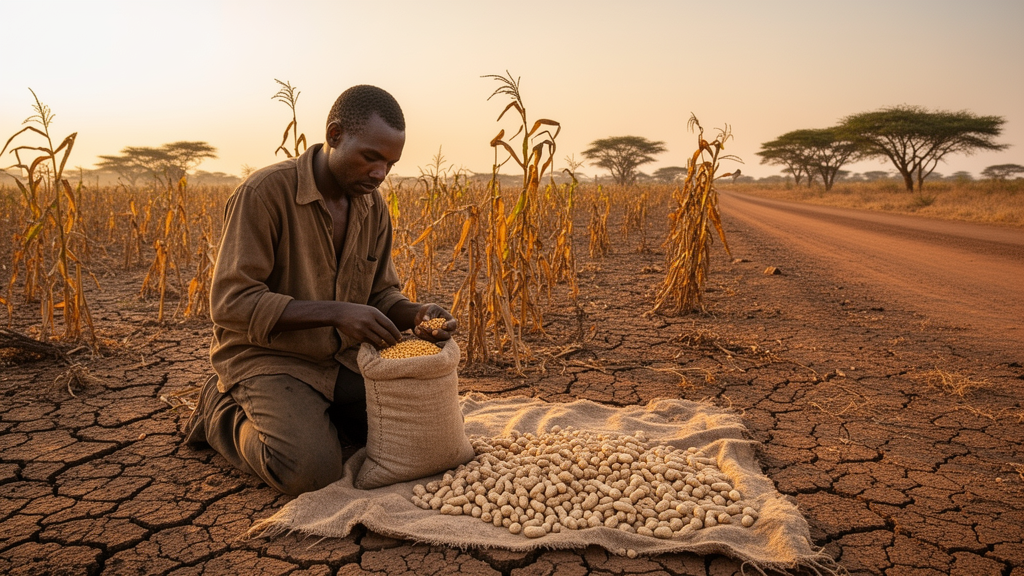
Maize and groundnut are two of Tanzania’s most important food crops, yet the seed systems that should deliver improved varieties to farmers in the country’s drier regions are struggling on multiple fronts. A new open-access study published in Agriculture & Food Security maps the formal and informal seed value chains for both crops across central and northern Tanzania, and finds a sector marked by weak private investment, poor coordination among stakeholders, and heavy reliance on farm-saved seed.
They also interviewed the full cast of value chain actors: seed companies, agricultural research institutions, agrodealers, the seed regulatory authority, the public seed production agency, extension staff and the Ministry of Agriculture. Porter’s value chain framework was used to analyse the components of each chain and the links between its key nodes, with data analysed in SPSS Version 23.
The demographic picture differs sharply between the two crops. Maize seed-producing households were dominated by men, who made up 71 percent of respondents and were described in focus group discussions as the primary decision-makers in maize farming. Groundnut tells the opposite story: 69 percent of groundnut seed producers were women, a pattern the authors attribute to the crop’s traditional cultivation by women, with commercialisation and mechanisation tending to draw men into enterprises over time. Groundnut seed producers averaged 46.8 years of age, ranged from 20 to 74, and 42 percent were youth aged 18 to 35, suggesting the enterprise does attract younger participants.
Land use patterns reveal where farmers’ priorities lie. Groundnut seed growers owned an average of 3.3 hectares but allocated only 0.8 hectares, about 24 percent of their land, to groundnut, with maize taking more than 60 percent of owned land. Maize households averaged 45 years of age, seven members, 2.2 hectares of total farm size and 1.4 hectares under maize varieties. Formal education averaged seven to seven and a half years for both crops, indicating basic literacy that the authors argue is important for the networking and coordination a seed enterprise demands.
Information flows along the chains are uneven. Government agricultural extension officers were the dominant source of information on improved varieties for both crops, cited by 30 percent of maize farmers and a striking 58 percent of groundnut farmers. Other farmers and agrodealers mattered for maize, each cited by 24 percent, while for groundnut the media accounted for 15 percent and other farmers 13 percent. Agrodealers were far less important for groundnut, at just 5 percent, because few of them stock groundnut seed at all. Among agrodealers themselves, 92 percent obtained information about improved varieties from seed companies, 50 percent from social networks of fellow agrodealers and farmers, and only 8.3 percent from research institutions such as TARI, CIMMYT and ICRISAT or from government extension officers.
The formal sector’s asymmetry between the two crops is stark. Seed companies were the main producers of maize seed, with 51.8 percent of the seed produced by sampled companies being maize, more than all other crops combined. For groundnut, public research institutions were the main seed producers, and no well-established seed company deals in groundnut in central Tanzania. Only two entities, the Dodoma Agricultural Seed Production Association (DASPA) and Muungwano Kilimo, operated as seed companies there, producing, multiplying and distributing certified groundnut seed from base stock supplied by TARI-Naliendele, without engaging in variety development. Both cited poor infrastructure and access to market information as their main challenges, and both accessed credit at interest rates between 7 and 18 percent. Most business enterprises in the chain, 83.3 percent, were owned by men.
Agrodealers, the retail backbone of seed distribution, face their own squeeze. Most owned a single outlet, and 75 percent of those interviewed sourced maize seed from seed companies, with the rest using private distributors. All sold to smallholder farmers and all stocked other inputs such as fertilisers and pesticides. Their most pressing internal challenge, cited by 41.8 percent, was inadequate cash to buy stock, followed by inadequate seed stock to satisfy farmers’ demand on time, at 33.3 percent. Externally, 33 percent cited competition from non-agrodealers, while lack of credit facilities and lack of relevant seed information ranked second. Because no major private seed company distributes groundnut seed in the country, groundnut supply instead flows from community seed banks, NGOs and research institutes, and agrodealers described this as a major drawback given high demand for quality seed.
Upstream, the public institutions that should anchor the system are strained. Staff at the Selian Agricultural Research Institute under TARI each supply less than two tons of foundation seed annually, and only one of the interviewed breeders consulted farmers before developing improved varieties. The Tanzania Agricultural Seed Agency (ASA) works with TARI on seed production and is mandated to expand distribution, foster public-private partnerships and stimulate demand for certified seed, but seed companies reported struggling to obtain basic seed from ASA on time, and suggested ASA focus on open-pollinated varieties and crops such as groundnut and sorghum that attract less private interest. The regulatory body TOSCI, responsible for compulsory certification, seed testing and National Performance Trials, was reported to delay issuing certified seed stickers, missing planting windows in areas with limited rainfall, while variety release procedures were described as unnecessarily long. Understaffing and under-resourcing hamper registration and certification, over-regulation complicates licensing agreements between research institutes and private companies, and a lack of maintenance protocols for released public varieties is contributing to loss of Distinctiveness, Uniformity and Stability.
Seed companies themselves face production constraints that discourage investment in the drier districts. Certified seed requires isolating multiplication fields to avoid contamination, making land access critical, yet companies reported difficulty acquiring land. Climate change has brought lower rainfall, pushing the need for irrigation and more resilient varieties. Contract farmers are scarce because most farmers in the region are resource-constrained smallholders, and available out-growers lack the finances to fulfil contracts, forcing companies to shoulder nearly all activities. Side marketing, poor isolation and contamination of improved varieties compound the problem. Farmers’ excessive reliance on farm-saved seed was identified as a major factor suppressing demand for certified seed, and stakeholder analysis revealed poor coordination between the key actors in the seed value chain. Notably, no prominent seed company operates aggressively for both crops in central Tanzania, and stakeholders across the chain prefer investing in maize over groundnut because maize is perceived to offer greater financial returns.
The study’s conclusions point toward an integrated seed supply system built on the actors already present. Community seed banks were recognised as an efficient option for delivering improved groundnut varieties to smallholder farmers, and the informal seed system is seen as a foundation on which private investment in groundnut could be built. The authors identify seed production as the most feasible economic entry point for farmers in central Tanzania, provided it is supported by access to basic seed, credit services and extension support, none of which currently reach farmers adequately; extension agents, for instance, offered no guidance on credit access, and their mobility is hampered by lack of government facilitation. Groundnut and drought-tolerant maize hybrids, being drought-resilient, are presented as genuine opportunities for seed companies willing to invest in semi-arid central Tanzania. The authors caution that future work is needed on market systems and the different seed systems, which they say exert the greatest influence on seed demand and supply, and they call for innovation platforms and strategic partnerships to bring stakeholders together where neither the public nor the private sector currently delivers alone.
Subject of Research: Seed value chain analysis for maize and groundnut in central and northern Tanzania
Article Title: Analysis of the maize and groundnut seed value chains in central and northern Tanzania
Article References: Jumbo, M. B., Mwololo, J., Manda, J., Kamau, P., Munthali, W., Okori, P., Makumbi, D., Mushoriwa, H., Zeledon, I., Bekunda, M., Chivasa, W., & Prasanna, B. (2026). Analysis of the maize and groundnut seed value chains in central and northern Tanzania. Agriculture & Food Security, 15(1), Article 43. https://doi.org/10.1186/s40066-026-00623-x
Image Credits: AI Generated
DOI: 10.1186/s40066-026-00623-x
Keywords: Tanzania, maize, groundnut, seed value chain, seed systems, agrodealers, smallholder farmers, certified seed, quality declared seed, community seed banks, extension services, CIMMYT
News Source: Alan Morgan. (October 28, 2026). Seed value chains for maize and groundnut remain fragile in Tanzania’s drylands. Scienmag.