Adding blood serum metabolite measurements to genomic prediction models can meaningfully improve how accurately researchers predict economically important production traits in pigs, according to a new study published in Genetics Selection Evolution. The improvement, however, is not uniform: it depends strongly on which trait is being predicted and on when the metabolites were sampled during the animal’s development. The finding comes from a large analysis of a single purebred pig population in which the researchers combined genotype data with metabolite profiles collected at two distinct ages, ten weeks and twenty weeks, and tested how each combination performed across five traits central to pig breeding programs.
The study, led by Quazi Abir Hassan Roddur and colleagues with senior author Hao Cheng, analyzed data from 1,637 pigs with complete phenotype, genotype, and metabolite-profile records. The animals came from a dataset of 2,101 pigs originally collected, with data provided by PIC, a Genus company. The pigs were housed in pens equipped with feeders that recorded individual feed intake, and they had ad libitum access to feed. Feed intake was recorded from ten to twenty weeks of age, with the first three days excluded as a training period. The researchers defined five traits: average daily feed intake (DFI), feed conversion ratio (FCR), backfat thickness (BF), test daily gain (TDG), and loin depth (LD). DFI, FCR, and TDG were measured over the ten-to-twenty-week span, while backfat and loin depth were measured by ultrasound at twenty weeks of age.
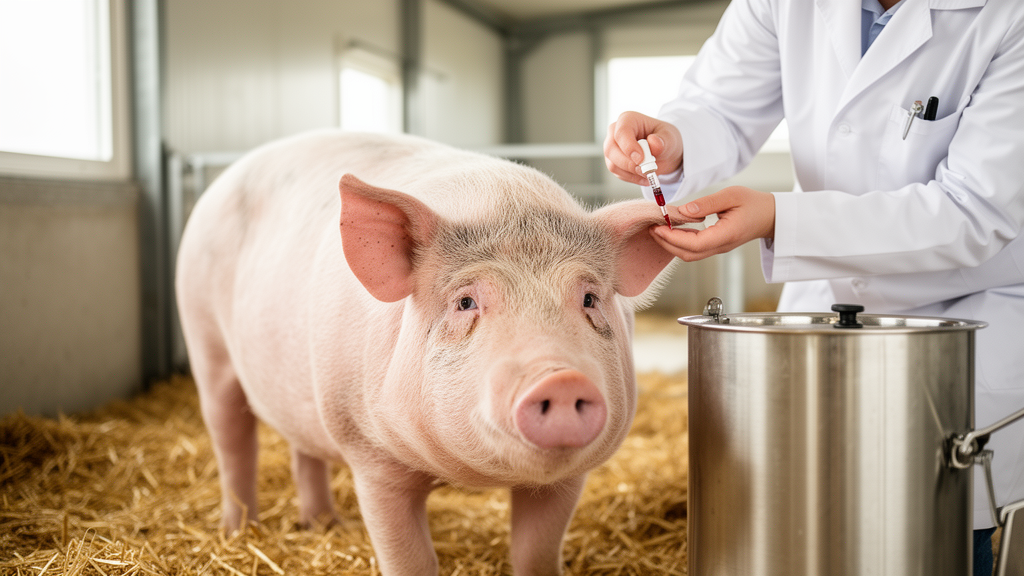
Blood samples were drawn at both the ten-week and twenty-week timepoints, at approximately 10:00 a.m., and serum was analyzed using proton nuclear magnetic resonance spectroscopy on a Bruker AV-III 600 MHz spectrometer certified for In Vitro Diagnostic research analysis. The resulting profiles captured a broad snapshot of each animal’s metabolic state, including amino acids and their derivatives, ethanol, carboxylic acids, keto acids, sugars, and lipoprotein fractions. The raw metabolite dataset contained 149 metabolites, composed of 112 lipoproteins and 37 small-molecule metabolites. After quality control, which excluded metabolites measured in fewer than 80 percent of the original animals, the final dataset comprised 95 metabolites: 78 lipoproteins and 17 small-molecule metabolites.
The team evaluated seven predictive models within a BayesC modeling framework: a genotype-only model (G), metabolite-only models using ten-week data (M1), twenty-week data (M2), or both timepoints (M1+M2), and combined models integrating genotypes with metabolite profiles from one or both timepoints (G+M1, G+M2, and G+M1+M2). In the BayesC framework, marker-effect estimation assumes that only a subset of genomic variants has non-zero effects, with the model inferring a null-effect probability reflecting the proportion of SNPs whose effects are zero. Metabolite-profile data were included as additional random regressors, with separate sets of hyperparameter values specified for genotype and metabolite components. Prediction accuracy was evaluated as the Pearson correlation between predictions and adjusted phenotypes in a testing set, using a random 80/20 training-testing split repeated across 20 replicates, with all levels of litter and birth year-month represented in both sets.
Before testing prediction, the researchers estimated the heritability of the 95 metabolites at each timepoint. Most heritability estimates for the ten-week metabolite profiles ranged from 0.08 to 0.23, while the twenty-week estimates were distributed over a slightly wider range, from 0.07 to 0.26. These low to moderate estimates indicate that serum metabolite levels are genetically influenced, supporting their role as intermediate phenotypes that reflect both genetic and physiological processes. The authors note that similar ranges have been reported for serum metabolites in dairy cattle and for plasma metabolites in pigs, reinforcing the idea that metabolite levels carry a heritable component that prediction models can exploit.
The headline result is that prediction accuracy consistently improved when metabolite-profile data were integrated into the models, although the size of the gain varied by trait and sampling timepoint. For average daily feed intake, accuracy rose from 0.33 with the genotype-only model to 0.42 with the models that included twenty-week metabolites (G+M2 and G+M1+M2). For feed conversion ratio, accuracy increased from 0.27 to 0.32 with the same two models. Those two models also delivered the largest gains for backfat thickness, improving from 0.39 to 0.46, and for test daily gain, improving from 0.30 to 0.32. Loin depth showed a different pattern: prediction accuracy was already high under the genotype-only model at 0.42, and the greatest gain came when both ten-week and twenty-week metabolite profiles were combined with genotype data, reaching 0.44.
Statistical testing reinforced the trait-specific and timepoint-specific nature of these benefits. Including twenty-week metabolite-profile data alongside genotypes increased accuracy significantly, at a p-value below 0.001, across all five traits, underscoring the value of late-stage sampling. By contrast, adding only ten-week metabolite data did not improve prediction over the genotype-only model for DFI, BF, or TDG, but it did provide noticeable gains for FCR (p < 0.01) and LD (p < 0.001). Combining metabolite profiles from both timepoints with genotype data achieved a significant improvement relative to the genotype-only model for all five traits, which the authors interpret as evidence that early and late metabolite profiles capture complementary biological signals. The authors suggest that the advantage of late-stage data likely reflects the proximity of the twenty-week sampling to the actual phenotypic measurements, providing a more immediate snapshot of physiological status.
Metabolite-only models generally performed worse than the genotype-only baseline, but with notable exceptions. All metabolite-only models yielded significantly lower accuracy than genotypes for BF, LD, and TDG, and for FCR and DFI when only ten-week data were used. However, for FCR and DFI, the twenty-week metabolite model and the combined two-timepoint model were not significantly different from the genotype-only model. This suggests that late-stage metabolite profiles alone may serve as an alternative predictor for these two traits when genomic data are unavailable, highlighting the potential utility of metabolite measurements, especially late-stage ones, as indicators of specific economically important traits. Across traits, the twenty-week model consistently outperformed the ten-week model as a single timepoint, with the exception of loin depth, and combining both timepoints generally yielded higher accuracy than either alone.
The authors emphasize that the benefit of incorporating metabolite-profile data must be evaluated on a trait-by-trait basis, and that the patterns likely reflect how each trait relates differently to the blood metabolomic landscape. Traits such as loin depth, which is influenced by both early and late biological stages, benefited from integrating metabolite information across multiple developmental stages, while for traits like DFI, late-stage metabolite data provided useful additional signals when combined with genotypes. The study focused on a single purebred population, and the authors note that their analysis addressed phenotype prediction rather than the prediction of breeding values, which they plan to evaluate in future work.
Looking ahead, the researchers outline several strategies for translating these findings into breeding practice. Metabolite genome-wide association studies and gene-metabolite network analyses could identify candidate biomarkers and biological pathways related to feed efficiency, and identifying genomic loci linked to metabolites would allow metabolite-related biological information to be incorporated into genomic prediction models without requiring metabolite measurements for every selection candidate, reducing costs and enabling earlier selection. Multi-layer approaches such as neural networks with mixed models could explicitly model the genotype-metabolite-phenotype relationship and allow prediction for individuals with genotype data only, by leveraging information from animals with metabolite records. Together, the authors argue, these strategies provide a framework for cost-effective, omics-informed selection of complex traits, with metabolite profiles serving as an intermediate omics layer that captures biological information not available from genotypes alone.
Subject of Research: Integrating longitudinal blood serum metabolite profiles with genotype data to improve phenotype prediction of production traits in pigs
Article Title: Integrating longitudinal metabolite profiles improves phenotype prediction in pigs in a trait- and timepoint-dependent manner
Article References: Roddur, Q. A. H., Liang, D., Qu, J., Carrara, E. R., Lourenco, D., Valente, B., Chen, C.-Y., Holl, J., & Cheng, H. (2026). Integrating longitudinal metabolite profiles improves phenotype prediction in pigs in a trait- and timepoint-dependent manner. Genetics Selection Evolution, 58(1), Article 73. https://doi.org/10.1186/s12711-026-01092-3
Image Credits: AI Generated
DOI: 10.1186/s12711-026-01092-3
Keywords: pigs, metabolomics, genomic prediction, phenotype prediction, feed efficiency, BayesC, serum metabolites, heritability, animal breeding, NMR spectroscopy, livestock genetics, longitudinal sampling
News Source: Juliet Wilcox. (October 28, 2026). Blood Metabolites Boost Prediction of Feed Efficiency and Carcass Traits in Pigs. Scienmag.