


Latest research from Affirmativ Health succeeds in treating cognitive decline using personalized, precision medicine.
Credit: Affirmativ Health
Latest research from Affirmativ Health succeeds in treating cognitive decline using personalized, precision medicine.
Affirmativ Health sought to determine whether a comprehensive and personalized program, designed to mitigate risk factors of Alzheimer’s disease could improve cognitive and metabolic function in individuals experiencing cognitive decline. Findings provided evidence that this approach can improve risk factor scores and stabilize cognitive function.
July 31, 2020/Sonoma, CA Cognitive decline is a major concern of the aging population. Already, Alzheimer’s disease affects approximately 5.4 million Americans and 30 million people globally. Without effective prevention and treatment, the prospects for the future are bleak. By 2050, it is estimated that 160 million people globally will have the disease, including 13 million Americans, leading to potential bankruptcy of the Medicare system. Unlike several other chronic illnesses, Alzheimer’s disease is on the rise–recent estimates suggest that Alzheimer’s disease has become the third leading cause of death in the United States behind cardiovascular disease and cancer. Since its first description over 100 years ago, Alzheimer’s disease has been without effective treatment. While researchers continue to seek out a cure, it is becoming clear that there are effective treatment options. More and more research supports the conclusion that Alzheimer’s disease is not a disease of only Beta Amyloid plaques and Tao tangles but a complex and systemic disease. In this study of patients with varying levels of cognitive decline, it is demonstrated how a precision and personalized approach results in either stabilization or improvement in memory.
Interventions to stop the progression of Alzheimer’s disease have been marginally successful at best. This study uses a more comprehensive, personalized approach addressing each participant’s unique risk factors. “The findings, published in the Journal of Alzheimer’s Disease Reports (Journal of Alzheimer’s Disease Reports 4(1)), are encouraging and indicate that a more extensive clinical study is warranted”, said Brian Kennedy, PhD, Director of The Centre for Healthy Aging, National University Health System, Singapore and Chief Scientific Officer, Affirmativ Health.
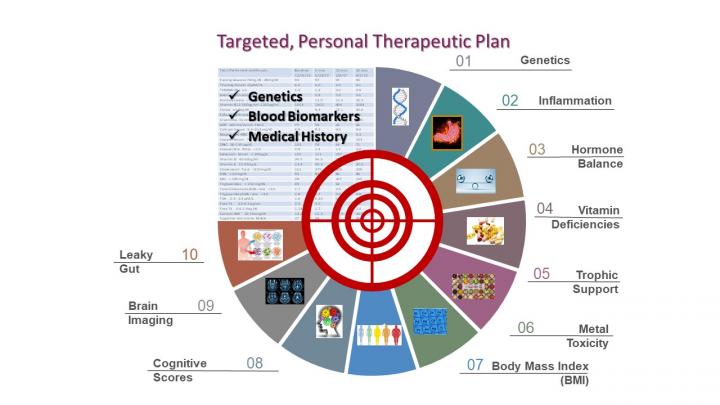
The Affirmativ Health scientific team, after thorough review of published research, has developed a comprehensive approach to addressing scientifically supported risk factors that have been rigorously defined as interventions to promote prevention, increased resiliency, and stabilization of brain function in the realm of AD and dementia. Utilizing cutting edge technology in concert with in-person coaching and consultation, we are demonstrating that a multi-modal and personalized approach promotes an improved resiliency and restoration of optimal brain function. The personalized therapeutic program includes genetics, an extensive blood panel, medical history and lifestyle data to evaluate relevant metabolic risk factors and nutrient levels associated with cognitive health. “Target laboratory levels differ from standard laboratory ranges as the goal is to reach optimized levels for cognitive health”, Ginger Schechter, MD, Chief Medical Officer, Affirmativ Health
The study approach considers more than 35 factors known to contribute to cognitive decline. Results demonstrate that certain of those factors are more affected than others again demonstrating the need for a more precise treatment plan. “This study supports the need for an approach that focuses on a one-size fits one, not a one-size fits all, approach that comprehensively assesses all involved risk factors affecting memory loss”, Denise M Kalos, CEO Affirmativ Health
In conjunction with the publication of this vital study, and to expose alternative treatment options for Alzheimer’s disease and cognitive decline, the team at Affirmativ Health has written a book, Outsmart your Brain – an Insider’s Guide to Life-Long Memory. “Memory is not something that should diminish with age; you are never too young to start developing healthy habits that can ultimately impact your cognition,” Outsmart Your Brain. This book leverages the foundation of Affirmativ Health’s research to deliver a tips and tools guide for the maintenance of good cognitive health. “Far too few people understand how critical lifestyle and dietary choices are for brain function. ‘Outsmart Your Brain’ is an important tool to get this information into the hands of those who should know it, everyone!, in easy-to-understand language”, Ryan R. Fortna, MD, PhD, Chief Medical/Scientific Officer, ADx Healthcare.
###
Media Contact
Denise M Kalos
[email protected]
Related Journal Article
http://dx.



