Researchers from Osaka University identify a novel mechanism by which the protein Smurf2 controls bone formation
Credit: Bone Research (Springer Nature) ISSN 2095-6231 (online)
Osaka, Japan – Bone morphogenetic protein (BMP) has a strong osteogenic (bone forming) ability. BMP has already been clinically applied to spinal fusion and non-union fractures. However, dose-dependent side effects related to BMP use, such as inflammatory reactions at the administration site, prevent widespread use.
For safe use, it was necessary to clarify how the BMP signaling pathway is controlled. In a report published in Bone Research, a group of researchers from Osaka University and Ehime University has recently identified a novel role for the protein Smurf2 in regulating bone formation by BMP.
When BMP transmits its message within cells, it can induce rapid bone formation. Previous studies have shown that Smurf2 can control another similar signaling pathway known as TGF-β (also involved in bone formation). Smurf2 prevents TGF-β signaling from going out of control by degrading the messenger proteins. However, the research team became interested in whether Smurf2 would have any effect on BMP signaling.
“Proper regulation of the BMP pathway is crucial for healthy bone metabolism and formation in humans,” says lead author of the study Junichi Kushioka. “Learning more about the role of Smurf2 in these processes will ultimately provide a deeper understanding of bone regeneration treatment.”
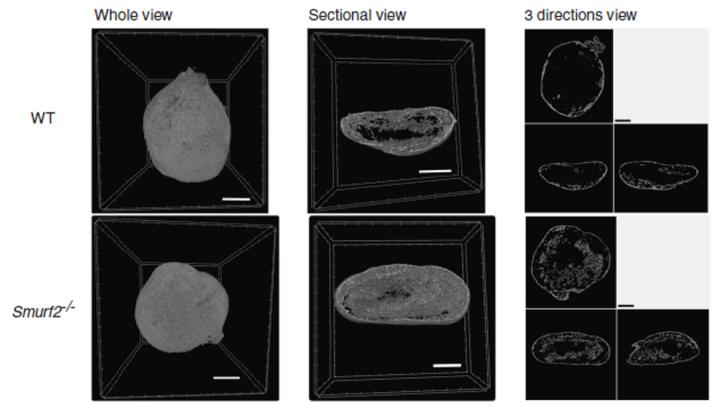
To address their questions, the researchers induced bone formation with BMP in both wild type (normal) mice and mice genetically altered to have the Smurf2 gene knocked out. They looked for differences between the two groups in aspects such as bone mass and bone formation rates. The group also examined the number of osteoblasts, which are cells involved in bone formation.
“We saw that the BMP-induced bone in mice without the Smurf2 protein had significantly greater mass, formation rates, and number of osteoblasts than the wild type mice,” explains Takashi Kaito, the corresponding author. “The outer shell was also much thicker in the BMP-induced bone in Smurf2 knockout mice.”
Further experiments also suggested that Smurf2 uses a process called ubiquitination to mark the BMP pathway messenger proteins for destruction, just like it does in the TGF-β pathway.
“Our results show that Smurf2 can regulate several different mechanisms that affect bone formation,” says Kushioka. “This work will pave the way for bone regeneration treatment for bone non-union, spinal fusion, or bone tumors with massive bone defects.”
###
The article, “A novel negative regulatory mechanism of Smurf2 in BMP/Smad signaling in bone,” was published in Bone Research at DOI: https:/
About Osaka University
Osaka University was founded in 1931 as one of the seven imperial universities of Japan and is now one of Japan’s leading comprehensive universities with a broad disciplinary spectrum. This strength is coupled with a singular drive for innovation that extends throughout the scientific process, from fundamental research to the creation of applied technology with positive economic impacts. Its commitment to innovation has been recognized in Japan and around the world, being named Japan’s most innovative university in 2015 (Reuters 2015 Top 100) and one of the most innovative institutions in the world in 2017 (Innovative Universities and the Nature Index Innovation 2017). Now, Osaka University is leveraging its role as a Designated National University Corporation selected by the Ministry of Education, Culture, Sports, Science and Technology to contribute to innovation for human welfare, sustainable development of society, and social transformation.
Website: https:/
Media Contact
Saori Obayashi
[email protected]
Original Source
https:/
Related Journal Article
http://dx.