• HOME
  • NEWS
  • EXPLORE
    • CAREER
      • Companies
      • Jobs
    • EVENTS
    • iGEM
      • News
      • Team
    • PHOTOS
    • VIDEO
    • WIKI
  • BLOG
  • COMMUNITY
    • FACEBOOK
    • INSTAGRAM
    • TWITTER
Friday, July 3, 2026
BIOENGINEER.ORG
No Result
View All Result
  • Login
  • HOME
  • NEWS
  • EXPLORE
    • CAREER
      • Companies
      • Jobs
        • Lecturer
        • PhD Studentship
        • Postdoc
        • Research Assistant
    • EVENTS
    • iGEM
      • News
      • Team
    • PHOTOS
    • VIDEO
    • WIKI
  • BLOG
  • COMMUNITY
    • FACEBOOK
    • INSTAGRAM
    • TWITTER
  • HOME
  • NEWS
  • EXPLORE
    • CAREER
      • Companies
      • Jobs
        • Lecturer
        • PhD Studentship
        • Postdoc
        • Research Assistant
    • EVENTS
    • iGEM
      • News
      • Team
    • PHOTOS
    • VIDEO
    • WIKI
  • BLOG
  • COMMUNITY
    • FACEBOOK
    • INSTAGRAM
    • TWITTER
No Result
View All Result
Bioengineer.org
No Result
View All Result
Home NEWS Science News Chemistry

Medical robotic hand? Rubbery semiconductor makes it possible

Bioengineer by Bioengineer
September 16, 2020
in Chemistry
Reading Time: 3 mins read
0
IMAGE
Share on FacebookShare on TwitterShare on LinkedinShare on RedditShare on Telegram

Rubbery electronics offer promise for new applications
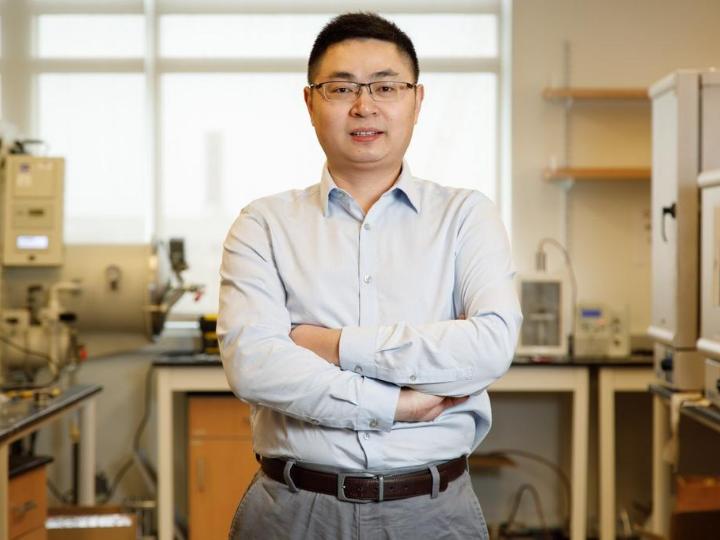
IMAGE

Credit: University of Houston

A medical robotic hand could allow doctors to more accurately diagnose and treat people from halfway around the world, but currently available technologies aren’t good enough to match the in-person experience.

Researchers report in Science Advances that they have designed and produced a smart electronic skin and a medical robotic hand capable of assessing vital diagnostic data by using a newly invented rubbery semiconductor with high carrier mobility.

Cunjiang Yu, Bill D. Cook Associate Professor of Mechanical Engineering at the University of Houston and corresponding author for the work, said the rubbery semiconductor material also can be easily scaled for manufacturing, based upon assembly at the interface of air and water.

That interfacial assembly and the rubbery electronic devices described in the paper suggest a pathway toward soft, stretchy rubbery electronics and integrated systems that mimic the mechanical softness of biological tissues, suitable for a variety of emerging applications, said Yu, who also is a principal investigator at the Texas Center for Superconductivity at UH.

The smart skin and medical robotic hand are just two potential applications, created by the researchers to illustrate the discovery’s utility.

In addition to Yu, authors on the paper include Ying-Shi Guan, Anish Thukral, Kyoseung Sim, Xu Wang, Yongcao Zhang, Faheem Ershad, Zhoulyu Rao, Fengjiao Pan and Peng Wang, all of whom are affiliated with UH. Co-authors Jianliang Xiao and Shun Zhang are affiliated with the University of Colorado.

Traditional semiconductors are brittle, and using them in otherwise stretchable electronics has required special mechanical accommodations. Previous stretchable semiconductors have had drawbacks of their own, including low carrier mobility – the speed at which charge carriers can move through a material – and complicated fabrication requirements.

Yu and collaborators last year reported that adding minute amounts of metallic carbon nanotubes to the rubbery semiconductor of P3HT – polydimethylsiloxane composite – improves carrier mobility, which governs the performances of semiconductor transistors.

Yu said the new scalable manufacturing method for these high performance stretchable semiconducting nanofilms and the development of fully rubbery transistors represent a significant step forward.

The production is simple, he said. A commercially available semiconductor material is dissolved in a solution and dropped on water, where it spreads; the chemical solvent evaporates from the solution, resulting in improved semiconductor properties.

It is a new way to create the high quality composite films, he said, allowing for consistent production of fully rubbery semiconductors.

Electrical performance is retained even when the semiconductor is stretched by 50%, the researchers reported. Yu said the ability to stretch the rubbery electronics by 50% without degrading the performance is a notable advance. Human skin, he said, can be stretched only about 30% without tearing.

###

Media Contact
Jeannie Kever
[email protected]

Original Source

https://uh.edu/news-events/stories/2020/september-2020/09162020yu-rubbery-electronics.php

Related Journal Article

http://dx.doi.org/10.1126/sciadv.abb3656

Tags: Biomedical/Environmental/Chemical EngineeringDiagnosticsElectrical Engineering/ElectronicsMaterialsSuperconductors/SemiconductorsTechnology/Engineering/Computer Science
Share12Tweet8Share2ShareShareShare2

Related Posts

Graz University of Technology Deciphers the Structural Secrets of MOF Thin Films — Chemistry

Graz University of Technology Deciphers the Structural Secrets of MOF Thin Films

July 2, 2026
Breaking Thermodynamic Limits: Wavelength-Driven Catalysis Advances Ammonia Synthesis — Chemistry

Breaking Thermodynamic Limits: Wavelength-Driven Catalysis Advances Ammonia Synthesis

July 2, 2026

From Quantum Mechanics to AI-Powered Materials Discovery: MARVEL Marks 12 Years of Transforming Computational Science

July 2, 2026

Djire Recognized with National Award for Outstanding Contributions in Research and Teaching

July 2, 2026
Please login to join discussion

POPULAR NEWS

  • Detection of EDCs in Breast Milk and Infant Urine Up to Six Months Highlights Early Exposure Risks

    77 shares
    Share 31 Tweet 19
  • Saying Goodbye to PGY-6: Pediatric Fellowship Realities

    103 shares
    Share 41 Tweet 26
  • New Drug Candidate Developed at McMaster Shows Potential for Treating Brain Cancer

    58 shares
    Share 23 Tweet 15
  • KTU Researchers Explore Ultrasound’s Role in Enhancing Blood Flow Beyond Diagnostics

    53 shares
    Share 21 Tweet 13

About

BIOENGINEER.ORG

We bring you the latest biotechnology news from best research centers and universities around the world. Check our website.

Follow us

Recent News

Steatosis Drives Liver Metastasis Diversity in CRC

Unlocking the Mysteries of Alzheimer’s Disease

Pensoft Introduces New Peer-Reviewed Journal of Regeneration to Advance Restorative Biology Across Species

Subscribe to Blog via Email

Enter your email address to subscribe to this blog and receive notifications of new posts by email.

Join 83 other subscribers
  • Contact Us

Bioengineer.org © Copyright 2023 All Rights Reserved.

Welcome Back!

Login to your account below

Forgotten Password?

Retrieve your password

Please enter your username or email address to reset your password.

Log In
No Result
View All Result
  • Homepages
    • Home Page 1
    • Home Page 2
  • News
  • National
  • Business
  • Health
  • Lifestyle
  • Science

Bioengineer.org © Copyright 2023 All Rights Reserved.